Wednesday, December 7, 2011

Amazing banding day in Point Reyes Today

Today Cory, Dan Lipp, Mark Dettling and I banded at one of PRBO's offsites, called Pine Gulch. It consists of 10 net lanes in riparian and marsh-edge habitat alongside Bolinas Lagoon. I really love this spot, not only because we usually catch a lot of birds, but also because we can scope the lagoon for waterfowl, shorebirds and raptors in between net runs. Birds we've seen from our banding location include, but are not limited to, Eurasian Wigeon, Long-billed Curlew, Marbled Godwit, hundreds of American Wigeon and Northern Pintail, Peregrine Falcon, Bald Eagle, Clark's Grebe, six species of gulls, Marsh Wren, Savannah Sparrow, and Orange-crowned Warbler.

Today was an especially good day because we got to see many of these birds, and we also captured 44 birds in our nets.  This time of year can be extremely slow, but Pine Gulch was as busy as ever this morning with 17 recaptures and 27 new birds accounting for 15 species!  Our totals included 6 Golden-crowned Sparrow, 8 Song Sparrow, 2 Hermit Thrush, 1 Townsend's Warbler, 1 Orange-crowned Warbler, 1 Chestnut-backed Chickadee, 1 Downy Woodpecker, 6 Ruby-crowned Kinglet, 7 Dark-eyed "Oregon" Junco, 1 Lincoln's Sparrow, 1 Common Yellowthroat, 1 Swamp Sparrow, 1 Bewick's Wren, 4 Purple Finch, and 3 Fox Sparrow.
Swamp Sparrows are fairly uncommon in Marin county, only showing up on roughly 3% of all ebird checklists in the first week of December, and peaking at 3.5% in the second week.  This individual is an after hatching year bird based on the amount of rufous color in the crown and gray in the supercillium (eyebrow). [Photo by Dan Lipp]


Townsend's Warbler is not an unusual bird in winter in California, but this striking after hatching year male was a treat to band.  The amount of black on the throat, white on the median coverts, and relatively broad and truncate rectrices (tail feathers) indicated that this bird is an adult male. [Photo by Dan Lipp]
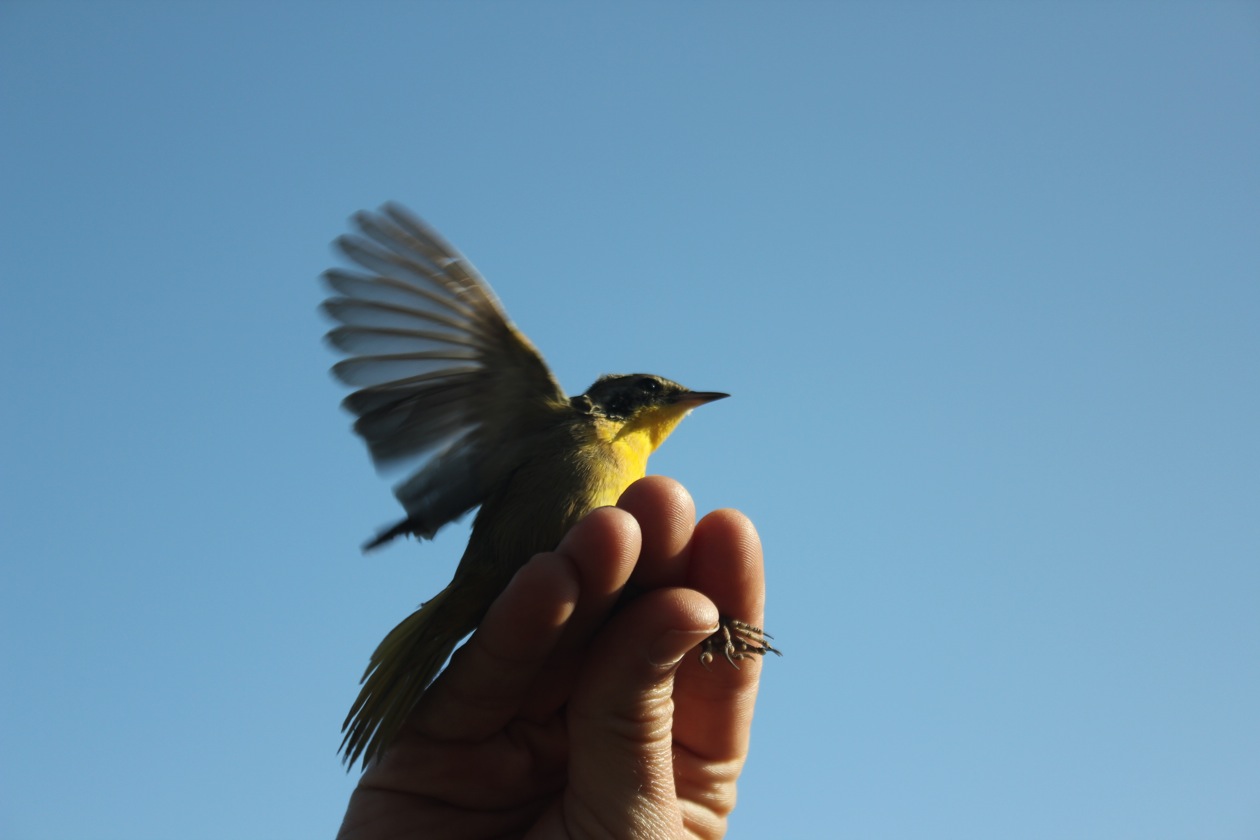
Common Yellowthroats are not terribly common in winter in Marin county, but they remain in decent numbers in suitable habitat like Pine Gulch.  This bird was aged as a hatching year bird based on its relatively narrow and tapered rectrices and plumage, and sexed as a male based on the presence of a dark mask. [Photo by Dan Lipp]
Taking the length of the wing chord is a good measure of the approximate size of the bird.  Here I am taking the wing chord measurement. [Photo by Dan Lipp]
One of the four Purple Finches we caught today had a strange growth on the left foot, perhaps tumorous or some strange form of bird pox, which is a common avian disease (but definitely does not normally look like this).  We weren't really sure what was causing this malformation, but we welcome your comments and thoughts. [Photo by Dan Lipp]
One note that we take for Golden-crowned Sparrows involves looking at the extent of the chocolate/black stripes and yellow on the crown.  Very short stripes or very long stripes can help decipher the ages of the birds, but in between birds can remain ambiguous.  This bird has relatively short crown stripes becoming indistinct past the lores (area just behind the bill), and was called a hatching year. [Photo by Dan Lipp]
Another helpful way to age birds is to look at their rectrices.  In general, younger birds have narrow, tapered tail feathers that are relatively abraded, and older birds have broad, truncate feathers.  This Golden-crowned Sparrow's rectrices match those of typical HY birds. [Photo by Dan Lipp]
Another good measure of relative size is weight.  Since birds can fly, we cannot simply place them on a scale and hope they sit around long enough to get an accurate measure.  Instead we use cylinders of various sizes to place the birds in, and keep them from escaping. It does not hurt the bird, and lasts only a few seconds. [Photo by Dan Lipp]

By Luke Musher

Tuesday, December 6, 2011

Another Color-banded WESJ Re-sighting

While sitting outside after banding today, Cory noticed a Western Scrub-Jay in a douglas fir behind our living quarters.  We got the color combination.  This bird was first caught in May of 2010 and found with a brood patch (bare patch on the belly for incubating eggs) indicating that this individual is a female.  It was caught twice more in October of 2010.  It has been re-sighted once each in December 2010, March 2011, and May 2011, but hasn't been seen since!  Good thing I had my camera handy.
Western Scrub-Jay with color combination [Photo by Lukas Musher]
Left leg = white over blue, right leg = orange over silver (WB/OS). [Photo by Lukas Musher]
By Luke Musher

Monday, December 5, 2011

Attempting to sight some color-banded birds at PRBO's Palomarin Field Station

The PRBO banding operation started in 1967 with the Palomarin Field Station located in Point Reyes near Bolinas, CA.  Since then they have banded tens of thousands of birds, as part of a long-term, constant effort study on populations, demography, and breeding success among other topics.  One of the methods that PRBO uses is color-banding.  For Western Scrub-Jays, Wrentits, Song Sparrows, White-crowned Sparrows, Spotted Towhees and previously California Towhees banders apply unique combinations of four color bands.  These bands allow you to identify birds at the level of the individual when seen in the field, since the unique numbers on metal bands are far too small to read when not in the hand.  This morning I set out to sight some of the birds around the field station, but with so many uncooperative birds, I only found two that I could get the full combination from, but I found other birds as well, many of which had metal bands but no color bands.
One of the many disobliging Song Sparrows that wouldn't allow a view of the full combination.  Although this bird at least posed for a second for a photo.  In this photo we can see half the combination, left leg = black over silver, but the right leg remains hidden. [Photo by Lukas Musher]
Although not incredibly obvious in the picture, this Song Sparrow has a combination of Left Leg = Green over Silver, Right Leg = Yellow over Mauve, or GS/YM in shorthand.  Once the combination is found we can plug it into PRBO's database to find out when the bird was first banded, it's age (if hatching year is known), its movement tendencies around the area (i.e. where it has been previously sighted and captured) and perhaps sex (if noted from the presence of a brood patch or cloacal protrusion in past captures).  This particular bird was first captured as a juvenal bird and banded on 7/18/2011, and has since been captured six times at several locations around the field station.  We know that this bird was must have been born earlier this year.  The bird has been seen recently multiple times around the parking lot for the banding lab. [Photo by Lukas Musher]
This Western Scrub-Jay was too far to accurately get the colors by binoculars, but thanks to 18 megapixels and a 400mm lens I can (see below). [Photo by Lukas Musher]
The combination here is Left leg = orange over blue over yellow, Right leg = silver. This bird has only been captured once in 2010.  [Photo by Lukas Musher]

This individual would not show it's left leg(!), but the metal band can be clearly seen on the right leg. [Photo by Lukas Musher]
If you look closely you can see the lone red color band on the left leg, but no others.  Western Scrub-Jays have powerful bills capable of destroying and ripping off poorly fastened color bands.  This individual is carrying acorns (note the one protruding from the throat, and slightly bulging crop).  [Photo by Lukas Musher]
Other birds were around too, and a little pishing turned up Red-breasted Nuthatch, Hutton's Vireo, Dark-eyed Juncos, Fox Sparrows, Golden-crowned Sparrows, and dozens of Ruby-crowned Kinglets and Chestnut-backed Chickadees.
This Red-breasted Nuthatch came in to see what all the pishing ruckus was about. [Photo by Lukas Musher]
One of the many banded Golden-crowned Sparrows at Palomarin. [Photo by Lukas Musher]
By Luke Musher

A Taste of What's to Come

As you know, Luke and I are banding interns at PRBO this winter, so you're probably wondering where all of the bird-in-hand photos are.  Well, we're still working on getting more good photos of banded birds--which mainly consists of me remembering to bring my camera and make sure to have the camera charged.  However, I do have just a few photos that I want to share in order to whet your appetite.

AHY Purple Finch (some December, 60s and sunny weather in the background)


AHY Purple Finch


AHY Western Scrub-Jay


AHY Western Scrub-Jay

Stay tuned for more to come!

Photos and story by Cory Ritter


Sunday, December 4, 2011

Outer Point Reyes Birding: Dickcissel, Prairie Warbler, Rhinoceros Auklet, and Sparrows galore

I spent my day off, yesterday, birding the outer Point Reyes Peninsula.  Starting at the Nunes Ranch, Suzie Eastman and I relocated the previously reported Dickcissel after scanning the flock of Golden-crowned and White-crowned Sparrows.  Among the other interesting birds present were two White-throated Sparrows, a few Tricolored Blackbirds, and a hatch-year Peregrine Falcon flyover.  Still no sign of the Clay-colored Sparrow, though.

Dickcissel is a good bird for Marin County with only a handful of previous records.
This bird was very cooperative
Hatch-year White-crowned Sparrow (Dickcissel in background)
After hatch-year White-crowned Sparrow.  The winds were strong this morning.


This beautiful AHY White-crowned Sparrow is showing off his crown.
AHY White-crowned Sparrow
White-crowned Sparrows were not quite as common as Golden-crowned Sparrows though.

AHY Golden-crowned Sparrow
White-throated Sparrows aren't too common in Point Reyes, but you can usually find a few hanging around with the other sparrows.
After spending some time watching the sparrow flock and Dickcissel, we headed to the fish docks to look for the Harlequin Ducks people have been seeing (including Cory and I on Wednesday, 1M and 1F).  No luck on that front but we did get Rhinoceros Auklet, Pacific, Common, and Red-throated Loons, Horned, Eared, and Western Grebes, Black and Surf Scoter, Townsend's Warbler, and the previously reported Prairie Warbler in the cypress trees.
Western Grebe, Fish Docks, Point Reyes, CA
Sanderlings at the Fish Docks

Point Reyes Continues to impress.  Now we just need a Snowy Owl...?

Photos and story by Luke Musher

Tundra Swans (almost) High Count, Marin Co., CA

Tundra Swans tend to be scarce in Marin County, California.  Although the previous high count according to ebird was 200 birds seen in fall of 2004, nearly all previous records of this species consist of one or two individuals.  On Wednesday, December 1, Cory and I, along with Jeff Miller of Marin Co., had a flock of twenty birds flying northwest over the Bull Point trail head in outer Point Reyes.
All twenty Tundra Swans can be seen, here, flying NW presumably towards Abbott's Lagoon along the outer Point Reyes Peninsula. 
Previous records outnumber ours, but only seven previous ebird records in the past fifteen years.
From 1997 - 2001 only one record in 1998 of one individual.

From 2002-2006 only four records, all in 2004, within the county.  There are three records of one individual, and one of 200.

Only two records each of one individual in the past five years before our count of twenty on Wednesday.
Figures can be found on www.ebird.org under explore data, line graphs.

Photos by Lukas Musher

Friday, December 2, 2011

Road Trippin' to my 1000th lifer

I recently started a job as a banding intern at Point Reyes Bird Observatory (PRBO) just north of San Francisco.  From Nov. 8th through 15th my friend, Chris Bush, and I drove across the country, and I birded along the way stopping in Big Bend National Park, TX and Southeastern AZ.  Although my time in these areas was limited, I was able to pick up many good birds and lifers, ultimately bringing my life list to over 1000 species.
Acorn Woodpecker, Madera Canyon, Santa Rita Mountains, AZ
We arrived in Big Bend NP on 11/10 ( after dark thanks to some harassment from the TX state police), and began birding the next morning.  After taking down our camp at the Rio Grande Village campground we birded around picking up lifers # 986 through 990 Greater Roadrunner, Pyrrhuloxia, Curve-billed Thrasher, Ladder-backed Woodpecker, and Chihuahuan Raven among other species such as Golden-fronted Woodpecker, Vermilion Flycatcher, and Rock Wren among others.
Lifer # 987, Pyrrhuloxia, at Rio Grande Campground, Big Bend National Park, TX
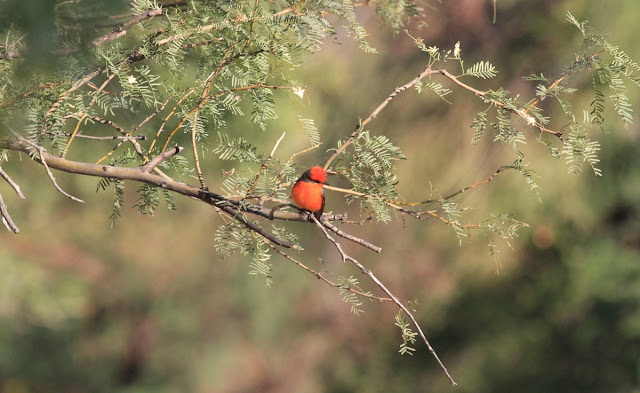
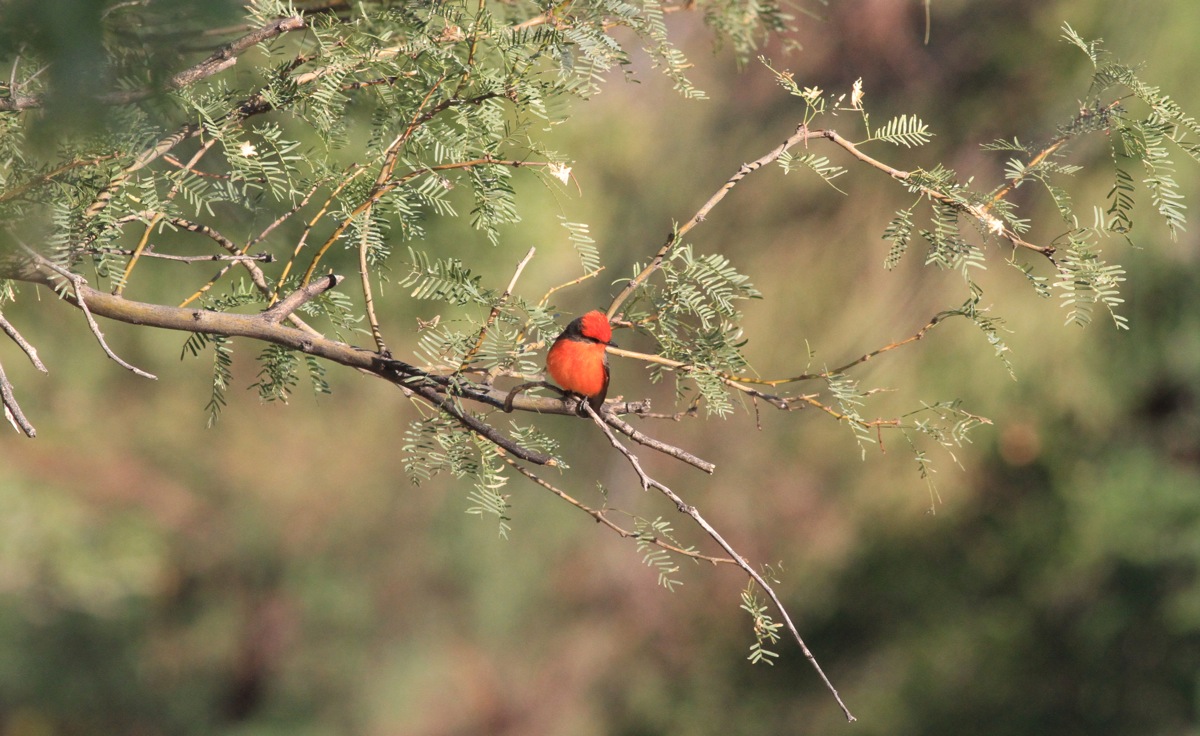
AHY male Vermilion Flycatcher, Rio Grande Village, Big Bend National Park, TX.  Only a couple adult males hanging around with the dozen or so females and HY males.
From there we headed all the way west across the park to the Cottonwood Campground near Castalon.  Here I picked up lifer # 991, Inca Dove, among other good birds like Great Horned Owl (catching rodents in daylight), Orange-crowned Warbler, Pine Warbler (fairly unusual in the park), and Clay-colored Sparrow.  We paused for some time to watch javelinas (AKA collared peccary) feeding in one of the campsites.
This Pine Warbler was hanging out at the campground, a good bird for Big Bend.
Young collared peccary, Cottonwoods Campground, Big Bend National Park, TX
We got back on the road and headed to the middle of the park up in the Chisos Mountains, and birded the basin around the campgound and lodge picking up lifers 992-994 Mexican Jay, Black-crested Titmouse, and Canyon Towhee as well as Cactus Wren,  Clay-colored Sparrow, and a brief glimpse of an Empidonax spuh that I was never able to ID.  We camped the night at there and headed NW the next morning for SE Arizona.  We picked up my lifer #995, Scaled Quail, on the way out of the park.
Clay-colored Sparrow in Chisos Basin, Big Bend National Park, TX.  The pale lores, bold white lateral crown stripe, relatively small bill, and contrasting facial markings help separate this species from Brewer's and Chipping Sparrows.
We stayed the night in Willcox, AZ close the famous birding area known as the Sulphur Springs Valley.  The next morning we set out south picking up waterfowl and shorebirds at Lake Cochise including Pectoral Sandpiper, American Avocet, and just about every species of duck expected.  Along our path further south we picked up my lifers # 996 and 997, Cassin's Kingbird and Bendire's Thrasher also getting hundreds of wintering Lark, Brewer's, Black-throated and White-crowned Sparrows, Prairie Falcon, Feruginous Hawk, Loggerhead Shrikes, Vesper Sparrow, huge flocks of Yellow-headed Blackbird at Whitewater Draw, and hundreds of Sandhill Cranes flying from their roosts into the corn fields around the area.  This area is known for its large number of wintering raptors and high population of Chihuahuan Ravens which were also abundant.
Lifer # 996, Cassin's Kingbird (and Cactus Wren beneath) in the Sulphur Springs Canyon, Cochise County, AZ.
Yellow-headed Blackbirds at Whitewater Draw, Cochise County, AZ
We then headed west along route 82 to the infamous Patagonia for some more SE AZ specialties.  Our first stop was the well-known Paton's Yard.  The Patons keep their yard open to birders to come watch their feeders year-round.  Here I picked up lifer # 998, Broad-billed Hummingbird, along with Inca Dove, Lesser Goldfinch, Sharp-shinned Hawk, Gila Woodpecker, Anna's Hummingbird, and Lincoln's Sparrow.  After a nice lunch at a cafe in Patagonia, we headed to the Patagonia roadside rest area and picked up my lifer # 999, Phainopepla.  Not much else at this location, other than some Northern Cardinals, Ruby-crowned Kinglets, and a lone Pyrrhuloxia.
Lifer # 998, Broad-billed Hummingbird, at "Paton's Yard," Patagonia, AZ.  One of these was caught and banded at PRBO earlier this fall!
Patagonia Lake State Park was only a few miles down the road, and known as one of the most reliable places in the state for Neotropic Cormorant.  We hiked into the park and along the eastern edge of the lake.  On our hike in I picked up my thousandth lifer, Verdin, and after some hiking on the other side of the creek I got # 1001, Bridled Titmouse.  Despite this area's known ability to attract vagrants and rarities, though, we weren't able to pick up anything too rare.  We hiked until nearly sunset looking for the previously reported Black-capped Gnatcatcher, but couldn't get it.  No Elegant Trogons or Ruddy Ground-doves either.  But on the plus side we were able to get good looks at Western Grebe, and several species of waterfowl.  We got back to our car just before dark and headed out of the park.  On the way out of the park a Common Poorwill flew from the road and we were able to get good looks at it along the roadside.
Lincoln's Sparrow at Patagonia Lake State Park, AZ
The next morning we set out from Green Valley, AZ to the Santa Rita Mountains and the Madera Canyon.  Along the way into the canyon I picked up lifer #1002, Rufous-winged Sparrow, and after birding the canyon thoroughly I added six more lifers and lots of good birds.  Painted Redstart, Olive Warbler, Black-throated Gray and Townsend's Warblers, Brown Creeper, Arizona and Acorn Woodpecker, Mexican Jay, Bridled Titmouse, Hermit Thrush, and Western Bluebird were a few of the species found here.

Bridled Titmouse at Madera Picnic Area, Madera Canyon, AZ


Lifer # 1005, Painted Redstart, at Madera Picnic Area, Madera Canyon, AZ

So I made it to 1000 species!  Now that I'm in California, expect more good birding logs from Cory and me.  Recent birding trips around here have included three Loon species, Eurasian Wigeon, both Clark's and Western Grebes, Yellow-billed Magpie, Lewis' Woodpecker, and three species of owl.

Photos and story Luke Musher