Friday, May 11, 2012

Woosh Netting at Fortescue

By Lukas Musher
Paris getting ready to take blood from this Short-billed Dowticher [Photo by Luke Musher]
As many of you know, I've recently started a job banding shorebirds for NJ Audubon.  On Wednesday we set up a type of net called a woosh net with the hopes of catching our first Semipalmated Sandpipers (our main study species) of the year.  Although there were several hundred shorebirds (will soon be a few thousand) present, we only caught about 20 Short-billed Dowitchers and 2 Dunlin.  Not too bad.

There are tons of horseshoe crabs spawning on the bay shore right now, and Fortescue is a good place to watch.  While they're spawning the shorebirds and gulls are present in large numbers.  Yesterday there were Least and Semipalmated Sandpipers, 2 Red Knot, Semipalmated and Black-bellied Plovers, Sanderling, Dunlin, and Short-billed Dowitchers including a beautiful hendersoni.
[Photo by Bruno Almeida]

Woosh nets operate a lot like a cannon net, except that it is fired by bungee chord instead of by cannon.  Two poles are stuck into the sand and act as a guide for the net when it is fired.  When the birds get within range of the net it is fired by pulling a string that pulls pins our allowing the bungees to release.  Watch: 
[Photo by Bruno Almeida]
[Photo by Bruno Almeida]
[Photo by Bruno Almeida]
[Photo by Bruno Almeida]
FIRE! [Photo by Bruno Almeida]
[Photo by Bruno Almeida]
[Photo by Bruno Almeida]

Thursday, May 10, 2012

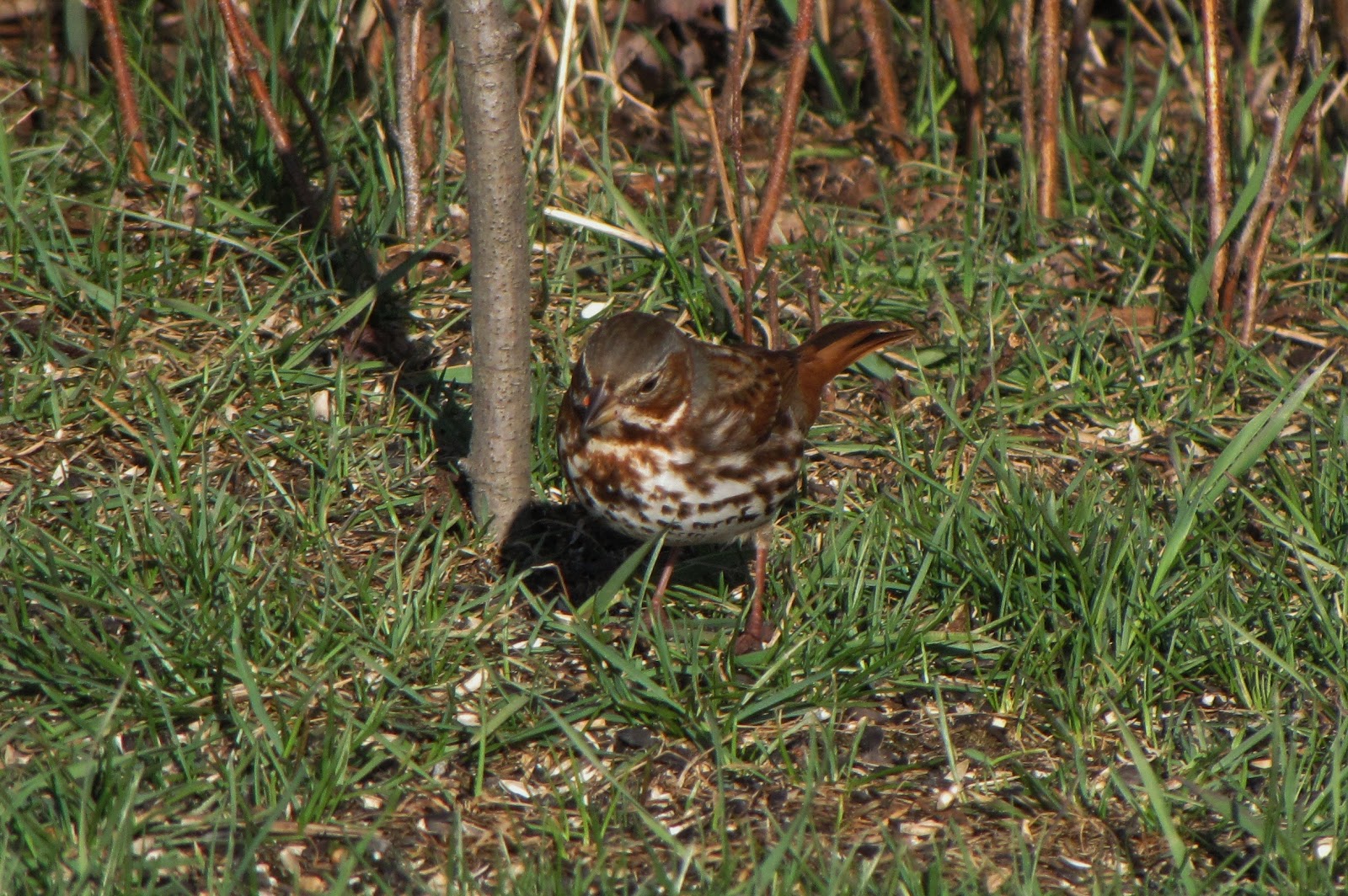
More Fox Sparrow Love

By Cory Ritter

It's just really hard not to love Fox Sparrows. All of the Fox Sparrows have gone from Whitefish Point, but I was looking back and reminiscing about the good old days when I could go sit by the feeders after the hawk count and watch these guys.


Monday, May 7, 2012

Photo Quiz 5/3/12 Solution


Another interesting bird.  Steve Howell saw me showing this photo to a friend of mine in November and jokingly remarked, "Well, it's either a Baltimore Oriole or a Yellow-throated Vireo, so it's a Pine Warbler," and he was right.  The large bill, long tail, yellow wash, and bold eye-ring are all very typical of Pine Warbler.

The classic tough fall warbler trio is Pine, Blackpoll, and Bay-breasted, but female fall Blackburnian Warblers can look quite similar as well.  I'm going to avoid taking the time to explain why it's not these species, but instead explain why it is a Pine Warbler.

One of the first things I look for to distinguish Pine Warbler from the others is the eye ring.  This bird has a fairly obvious one.  This bird is relatively large-billed and long-tailed.  That is another helpful way to rule out the others.  The white spots on the tail created by black edges to the rectrices and a black border to the undertail coverts is also typical.  Also note the relatively weak wingbars.

Lot's of good answers and tries, and congrats to the winners:
Mike Biros
Conor Higgins
Ryan Ford
Ryan McDermott

Feel free to comment on this post or email us at boomchachalaca@gmail.com with questions or concerns.

~Luke

Friday, May 4, 2012

Two Shorebirds

By Luke Musher
Our first day in the field for my shorebird technician position was slow (and buggy!!!) today, but at least we got to handle two species.  The first bird was a Least Sandpiper, and the second was a Short-billed Dowitcher.  Check it -

Expect more of this soon.  We should catch upwards of 1500 Semipalmated Sandpipers by the begining of June along with Dunlin, Semipalmated Plover, and these two.  There's always the chance of Curlew Sandpiper at Heislerville!

Thursday, May 3, 2012

Photo Quiz

Brewster county, Texas in November
Time for another photo quiz!  Identify this bird by Sunday, May 6.  Email us with your answers at boomchachalaca@gmail.com.  The solution and the names of the winners will be posted thereafter.

~Luke

Wednesday, May 2, 2012

Photo Quiz 4/25/12 Solution

Well, to start I have to say I am extremely sorry for taking so long to get this up.  To be completely honest, I started to doubt that I knew what this bird was, and I can honestly say, I'm still not 100%.  However, I'll go through the field marks and discuss what the options are, and hopefully come up with an answer.  Shall we take a closer look?
Okay, the photo I gave you is horrible, bad lighting and angle.  But it's pretty clear that it's a tern, which one is far more unclear.  The first thing that I notice in this photo is the primaries.  They appear to have narrow black tips causing a thin black edge to the underwing.  This feature alone would suggest Arctic Tern.  But there's a lot more to think about here.  The bird appears to have a large bill, relatively uniform upperwing, white secondaries, and the from underneath, white primaries and secondaries.  The leading edge of the upperwing appears somewhat darker than the rest of the wing but not black or showing any extreme contrast.

I received a fair number of responses for this, considering how difficult it was, and the most frequent answer I got was Common Tern.  Despite the long bill, I would argue this is not a Common Tern but an Arctic Tern.  Common Tern should show dark secondaries and a dark contrasting (almost black if not black) ulnar bar.  This bird has a fairly uniform upperwing with white secondaries.

Although the lighting is crap and there is a dark shadow over the underwing, I think the important underwing field marks can be made out.  First is, as I pointed out, the narrow black tips to the primaries.  I would expect much broader tips to Common Tern, giving a wedge shaped black band on the primaries.  Though this is not always the case, it is true of most.  The other important character is that all secondaries and primaries are translucent from underneath as opposed to the grayish and contrastingly dark secondaries of Common.  The head also appears small and rounded, but because of the angle I am hesitant to use these characters.

Here is a slightly better photo of a more typical non-breeding Arctic Tern from a better angle.  Note short bill, thin black primary tips, translucent remiges, rounded head, short neck...
And here is another photo of the quiz individual from above.  The better look at the upperwing strongly supports Arctic Tern in my opinion - note overall uniform coloration and white secondaries.  Bill also feels within the norm of a typical Arctic as well.
This is my argument for Arctic Tern.  However, I feel I could benefit from a good discussion on this since my Arctic Tern experience is limited, so if anyone still stands by Common Tern, has anything to add, or just thinks I'm stupid and completely wrong, comment on this post or email me at boomchachalaca@gmail.com.

¡Winners! - 
Markothy Markus Aurelius "Mark" Dettling
Ryan Ford

Thanks for playing -

~Luke Musher

Tuesday, May 1, 2012

White-faced Ibis and Stilt Sandpiper at Heislerville

By Luke Musher

At the end of the day today I went over to Heislerville with my co-workers/roommates, Steph and Nick.  Lots of new shorebirds out and about including Black-bellied and Semipalmated Plovers, Dunlin, Short-billed Dowitcher, Semipalmated and Least Sandpipers, a single Stilt Sandpiper (pretty rare in spring), Willet, Greater and Lesser Yellowlegs, and Ruddy Turnstone.  Someone else had White-rumped Sandpipers (making a total of 12 species).  I'll definitely be back in the morning to check it out again.

A White-faced Ibis was present with the Glossy Ibis on the south impoundment.  I digiscoped some photos with my iPhone.


I'm adding this photo a little late, but it's just to show that I've had all three North American Ibises in two days!  This White Ibis was present all day yesterday, 4/30/2012, at the Wetlands Institute near Stone Harbor, NJ.  
On a separate note, the solution to the tern photo quiz will be up tonight or tomorrow.  I sincerely apologize about the delay but I've been pretty busy with my new job.