Showing posts with label boomcha. Show all posts

Friday, August 30, 2013

Duluth's Common Nighthawk Migration

By Cory Ritter

Let's get real, Common Nighthawks are pretty awesome. They have striking plumage, make sweet peent calls, eat insects that may otherwise annoy us, fly erratically, and their apparently small bills open up to reveal a mouth resembling that of a muppet. Plus, they're the ABA 2013 Bird of the Year. What's not to like?

Duluth is a great place to watch Common Nighthawks during migration, and this year didn't disappoint. Last Wednesday, the 21st, Karl Bardon counted over thirty thousand Common Nighthawks—with the help of Dave Carman and others. However, that was just the peak, and the nighthawk migration continues.
Common Nighthawk in Flight
Common Nighthawk; Hawk Ridge Bird Observatory; St. Louis County, MN; 22 August 2013
Common Nighthawk Underside
Common Nighthawk; Hawk Ridge Bird Observatory; St. Louis County, MN; 22 August 2013
Common Nighthawk
Common Nighthawk; Hawk Ridge Bird Observatory; St. Louis County, MN; 27 August 2013
Common Nighthawk
Common Nighthawk; Hawk Ridge Bird Observatory; St. Louis County, MN; 27 August 2013

Wednesday, August 28, 2013

Jaegers at Wisconsin Point

By Cory Ritter

I'm back in Duluth for the fall hawk count season at Hawk Ridge, and I arrived a bit early so I could get some general birding in before my season starts. Some Parasitic Jaegers had been sighted a number of times from Wisconsin Point this month, and, since Jaegers are pretty sweet, I figured that would be a good place to check out. Karl Bardon and I headed over there last Friday, and the trip was a success. We had two light Parasitic Jaegers. This was of course in addition to the other regulars. We had some Ring-billed, Herring, and Bonaparte's Gulls, one Franklin's Gull, Bald Eagle, Green-winged Teal......anyway, the jaegers:
Wisconsin Point Jaeger From Below
Parasitic Jaeger; Wisconsin Point; Douglas County, WI; 23 August 2013
Parasitic Jaeger Underside
Parasitic Jaeger; Wisconsin Point; Douglas County, WI; 23 August 2013
Parasitic Jaeger in Superior Wisconsin
Parasitic Jaeger; Wisconsin Point; Douglas County, WI; 23 August 2013
Light Adult Parasitic Jaeger Upperwing
Parasitic Jaeger; Wisconsin Point; Douglas County, WI; 23 August 2013
Parasitic Jaeger
Parasitic Jaeger; Wisconsin Point; Douglas County, WI; 23 August 2013
Parasitic Jaeger in Flight
Parasitic Jaeger; Wisconsin Point; Douglas County, WI; 23 August 2013
Parasitic Jaeger Flight Feathers
Parasitic Jaeger; Wisconsin Point; Douglas County, WI; 23 August 2013

Friday, August 2, 2013

Yeah, yeah, it’s molting. So what…right?

Right guys?  Right?...Guys?... 

As the title implies a molting bird, in and of itself is not of much interest to a birder let alone anyone with any sense of natural history or levelheadedness.  The regular occurrence of the growing of new feathers is a simple fact of nature; a necessity for the physical laws of flight.  As feathers age, they become worn and brittle.  They no longer provide the bird with streamlining or the perfect airfoil wing-shape needed for dynamic flight, and instead produce extra turbulence and leave an otherwise healthy bird aeronautically indisposed.  So yes, the fact that feather molt evolved is interesting.  The physics of flight is interesting.  But a molting bird is just, well, a consequence of breaking though an amniotic eggshell with a horny, toothless beak.
A Mangrove Swallow visibly molting primaries.  The difference between the outer juvenile primaries (9 and 10) and the fresh basic plumage flight feathers is blatant.  Given that this bird is replacing very worn juvenile flight feathers, what age is this bird?  Try to use some of the information in this post to tell this bird's story.

So why is calling out or talking about a bird’s molt de rigueur amongst "good" birders?  What’s the freaking point? Yeah it’s inner primaries are shorter.  They’re growing.  It's outer primaries are browner.  They're old.  That’s what feathers inevitably do.  But can we learn something from a molting bird relative to, say, identifying or aging it?  Well, I am by no means an expert on molt, but I can tell you this: you can learn a lot about a bird from the timing and extent of its molt, from identifying its age, to distinguishing similar species in the field.  In these contexts, molt is both relevant to the average birder seeking to identify birds in the field, and to biologists (e.g. studying survivorship or reproductive success) looking at birds in the hand.  In some cases, being certain of a bird's age, sex, or species may be contingent on the timing and extent of its current molt.

We have touched on molt and especially with regards to molt limits (an outcome of molt) in the past, and bringing it up again merely stresses its importance.  I will not give you a detailed description of all molt cycles, stages, types, etc, nor the patterns or timing associated with specific families or groups of birds.  However, to start your own investigation of molt, it is helpful to get a little of the basics.  Molt, by definition, is the periodic growing of new feathers not the replacement of feathers.  Therefore anytime I refer to molting feathers, I do not mean feathers that are falling off, I refer to feathers that are growing.  
Here is an extreme example of a bird that critically needs to molt.  This Pigeon Guillemot's  remiges are worn to a point in which the feather shafts are all that remain.  This bird cannot fly, and chances are it cannot maneuver well underwater either since alcids use their wings to help them "fly" subsurface and catch food.  In fact we watched this bird for most of fall 2012 as it swam in the waters just off of Southeast Farallon Island.  The bird began molting quite late, but unfortunately never was able to finish.  The bird was eventually found dead on the island mid-molt.  Thus I imagine birds may often face the dilemma, molt or die.  Reason's why a bird might forgo molt include malnutrition, parasites, or disease among others.  I imagine this bird was struggling with at least one of these issues.
General Sequence for birds showing Complex Basic Strategy for molt (I suggest you read Howell's 2003 essays from Birding and his book, Molt in North American Birds, to really begin to understand the complexities in detail):

Pre-juvenal Molt (now referred to as first pre-basic, and includes all body and flight feathers, and is generally grown in the nest) --> Juvenal plumage (more often than not, much browner, streakier, and of poorer quality) --> Pre-formative Molt (generally within a few months of leaving the nest replacing most or all body feathers and no or some flight feathers) --> formative plumage (birds in this plumage are generally referred to as immature or "first year" rather than juvenal) --> pre-basic molt (the term definitive PB molt refers to the molt that results in the adult plumage: generally the following calendar year replacing all  feathers) --> basic plumage --> pre-basic molt (generally the following calender year all feathers)...

This molt pattern, in my opinion is the most important to get down.  Keep in mind that generally if you insert pre-alternate molts into the life cycle (complex alternate strategy) or remove the pre-formative (simple basic strategy) you have then pretty much addressed every species North American landbird.  Also keep in mind that, generally birds only have one complete molt (i.e. all feathers including flight feathers) per year.  So if we are looking at molting flight feathers, which is generally the case, we know it's probably a pre-basic molt or probably not a pre-formative molt (some exceptions to this rule).  This will almost never be pre-alternate molt (if ever?)
Knowledge of molt and their subsequent plumages can be helpful even in birds you've had no experience with.  This bird is bizarre in that during it's preformative molt, it replaced tertials, outer primaries, and the first secondary.  I had no experience with Garyish Saltators prior to this bird in my hand, but the contrast in colors resulting from two generations of feathers is glaringly obvious.  With no prior knowledge of how this species molts or looks as a juvenal, I can tell that the greener, worn feathers are juvenal (first basic).  Thus, the bird must be in formative plumage since during it's next basic molt (should happen soon) it should replace all flight feathers.  The eccentric molt seen here is further complicated by that middle replaced feather, but that may be a feather that was lost and replaced later (adventitious molt).  Keep in mind tropical birds may behave differently than their temperate counterparts. 
Here are some things to think about when looking at a bird showing flight-feather molt:

1) What time of year is it and where are you?  Birds typically molt their costly flight feathers after major life-cycle events like breeding or migration.  This is because many of these events require a lot of resources.  During the breeding season, birds put all their energy into creating and raising offspring. During migration birds put all their energy into...migrating.  So depending on when and where you are, molt can tell you something about a bird's age or even species.  For example, some species molt their feathers on the wintering grounds, some on the breeding grounds, and less commonly some during migration.  Knowing where species molt can sometimes help you rule out similar species.

I can think of two classic examples: 1) Jaegers molt on their wintering waters (I believe this to be universally true off the top of my head, but if anyone has a correction I would really like to know). During the fall in California, it may be possible to see all three jaegers in migration, but only Pomarine Jaeger winters along the CA coast. Therefore a molting jaeger in CA waters is almost certainly a Pomarine on its wintering grounds.  2) Similarly, most Empidonax flycatchers molt on the wintering grounds.  However, Hammond's Flycatcher molts on the breeding grounds.  Therefore any Empidonax with freshly molted plumage in fall in Western North America is likely Hammond's.  There are many other examples that I won't get into here (frankly I don't know a lot of it).  They include separating shorebirds in migration and winter, separating nighthawks in southern California (Common molts on the wintering grounds), and swallows in TX.

2) What feathers are molting? Tertials? Secondaries? Primaries? Coverts?  For example, it is very common for birds to molt tertials and secondary coverts, but no other wing and flight feathers during pre-formative molt. Thus you can generally age a bird in pre-formative molt as a hatching year.

3) What do other feathers in the wing look like compared to the feathers that are growing.  Are other feathers similar in color or much browner?  Browner, and often more tapered, feathers can often be attributed to juvenal plumage.  Feathers grown in the nest are grown rapidly and are of much poorer quality than adult feathers.  The difference is often quite clear, although not always.  The photo below shows very clearly three generations of feathers.)
Clay-colored Thrush with three generations of feathers in the wing.  The brown and very worn outer primaries and middle secondaries are retained juvenal feathers.  The olive green and moderately worn tertials (inner secondaries) were replaced during the pre-formative molt.  This bird was symmetrically molting the first few primaries and secondaries.  Notice how the juvenile feathers contrast in both color and wear with other feathers, but the formative feathers only contrast in wear (i.e. not color) to the brand new adult feathers.  Understanding the complex basic molt pattern (above) helped us to age this bird as a second year and understand the contrasts we were seeing in the wing.
4) What is the bird doing regarding it's life cycle?  Is the bird on it's breeding grounds? Is the bird on it's wintering grounds?  Is the bird migrating?  As I pointed out earlier, molting is energetically costly. As it turns out so is migration.  Interestingly, some species of birds have been identified as molt migrants, birds that molt at migration stopover sites.  Understanding where a bird molts has important implications for conservation.  Traditionally we like to think that looking at breeding and wintering grounds pretty much represents the whole picture.  If you protect those two areas, you are protecting the birds. Critically, however, molt stopover sites (e.g. Mono Lake for Wilson's Phalaropes and Eared Grebes) represent another consideration for successful conservation.

Practice looking at molt at your feeder in mid-late summer, and by taking or looking at photos.  Or by banding birds, but not everyone has that luxury.  While you're practicing, go back to that first photo of the Mangrove Swallow here.  Tell its story.  How old is it? Try to map out its life cycle thus far.  

Tuesday, June 25, 2013

Almost Paradise: Tortuguero

By Lukas Musher
American Pygmy Kingfisher, Tortuga Lodge, Tortuguero, Costa Rica
This morning while checking nets at one of our sights in primary forest in Tortuguero, it hit me, this is pretty much as close to paradise as you can get.  It began to rain lightly, and the duetting roars of both thunder and howler monkeys echoed around me.  The nets were mostly empty except for an American Pygmy Kingfisher and a White-breasted Wood-Wren.  While extracting the kingfisher, I tried not to flinch as the tiny pricks of mosquitoes drawing blood plagued my hands and face.  As they gorged and I fiddled with the bird trying to figure out the secret to its removal, my mind went blank as I finally couldn't take the agitation any longer, letting go of the bird with one hand to slap the mosquitoes from my cheeks and neck.  My hand returned to the bird, now with bright red stains and minuscule black lines that once were legs.
Wedge-billed Woodcreeper, Tortuga Lodge, Tortuguero, Costa Rica
No, it wasn't perfect, or comfortable, or luxurious by any means, but there is something about this crazy place that has held a particularly special place in my heart (and in my brain; I find the tropics fascinating) since I first visited the tropical rainforest as a young teenager.  Droplets of sweat, like condensation on a cold bottle of water, littered my forehead and upper lip.  I breathed slowly, trying to block out the dizziness and slight headache from dehydration.  I know it sounds horrible, but it truly is an amazing place.

Purple-throated Fruitcrows began calling above me.  The female flew over and paused to stare with nesting material in her mouth – a life bird.  Somewhere not too far away a Laughing Falcon began calling, guaco guaco guaco, over and over.  Tiny poison dart frogs, bright red with blue hind legs (called bluejeans frogs) jolted spasmodically over the leaf-covered forest floor.  Finally the bird was out.  I put it in one of our cloth bags and tied the draw string, then returned to the banding station.
Female Purple-crowned Woodnymph, Tortuguero National Park, Tortuguero, Costa Rica (iPhone photo)
Since I got to Tortuguero 5 days ago I've seen and done a lot.  Although it rains a lot, and I haven't been able to get too many photos, we've caught all kinds of interesting species, and seen some cool birds.  Gartered and Slaty-tailed Trogons, Keel-billed and Black-mandabled Toucans, Mealy and Red-lored Parrots, Black-cowled Oriole, and lots of other species have been seen regularly.  On the boat ride here we saw an adult and juvenal King Vulture.
Grayish Saltator with an interesting molt limit in the remiges (flight feathers of the wing).  Notice primaries 1-3 and secondaries 1-3 are retained.  This bird is a member of the family, Cardinalidae, related to grosbeaks and cardinals.  Not sure why it would show eccentric molt like this.  The other wing showed molt in primaries 1-3 and secondaries 2-4.  The tropics are crazy.
Banding has been slow, and we've had some trouble opening nets due to rain, but the birds we catch are quite special and interesting.  Hummingbird captures have included Blue-throated Goldentail, Rufous-tailed Hummingbird, Bronzy, Stripe-throated, and Long-billed Hermits.  White-capped Manakins are our most common species and well-studied by CRBO biologists.  Other cool captures here have included Wedge-billed Woodcreeper, Great Kiskadee, Common Tody-Flycatcher, Grayish Saltator, among others.
Juvenal Bare-throated Tiger-Heron, Caribbean Conservation Corporation, Tortuguero, Costa Rica
Pale-vented Pigeon, Caribbean Conservation Corporation, Tortuguero, Costa Rica

Monday, June 24, 2013

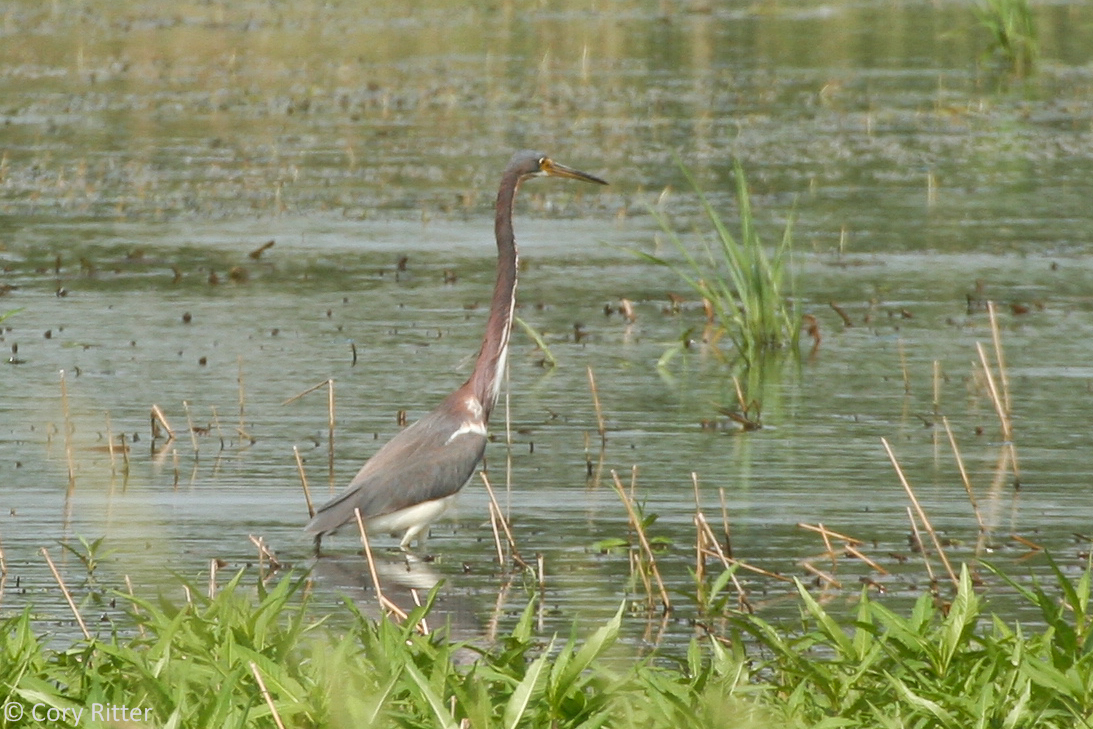
Tricolored Heron Visits Wisconsin

By Cory Ritter

I just arrived back to southern Wisconsin, where I'll be spending the summer, and the timing couldn't have been any better. A Tricolored Heron has been hanging around Findlay VPA just southeast of Fort Atkinson in Jefferson County--which is only a 45 minute drive from my home.

"What is a VPA?" you might ask. VPA stands for Voluntary Public Access, and is a program where landowners allow public access to their land for recreational purposes in return for financial incentives.

I made my way out to Findlay VPA around mid-day on Sunday. The two spots mentioned on the listserv produced some quality birds including Dickcissel, Bobolink, Grasshopper, Savannah and Song Sparrow,  Eastern Meadowlark, House Wren, Tree and Barn Swallow, Great Blue Heron, American Robin, and Red-winged Blackbird. It wasn't until a couple hours later, when I ran into fellow birders Nancy and Patrick, that we located the Tricolored Heron--and it was certainly worth the wait!

Jefferson County, WI
Tricolored Heron, Vindlay VPA, Jefferson County, Wisconsin

Jefferson County, WI
Tricolored Heron with Blue-winged Teal, Vindlay VPA, Jefferson County, WI

Jefferson County, WI

Jefferson County, WI

Jefferson County, WI

Jefferson County, WI

Jefferson County, WI

Jefferson County, WI


Saturday, June 22, 2013

PEFAntastic!

By Cory Ritter

Whitefish Point might be known for its Rough-legged Hawks, but this year it was the spring of the Peregrine Falcon. In fact, we set the all-time season high count for peregrines with 76, beating the previous record of 73 set in 2005. As I was saying, birders don't come to Whitefish Point to see peregrines, as other sites can easily see 76 in a day--or an hour if you're in the Florida Keys. However, it is exactly this scarcity that makes peregrines so exciting here at the point.

That all being said, enjoy the photos.

Whitefish Point

Peregrine Falcon upperside

Chippewa County, MI

Whitefish Point Bird Observatory

Whitefish Point

Adult upperside

gliding

Adult soaring

Face shot

Adult side-on

Adult

Oh, did I mention we get mostly adults here in the spring?

Wednesday, June 19, 2013

Costa Rica: The Talamanca Highlands

By Lukas Musher
Barred Becard, Madre Selva, Talamanca Highlands, Costa Rica
I just got back (though still in Costa Rica) from two-and-a-half weeks in the Talamanca Highlands banding resident landbirds.  We didn't have internet most of the time so I never had a chance to post about all the great stuff I was seeing and catching.

To start, I was living on a finca consisting of hundreds of acres of primary and secondary cloud forest, a dairy farm, and three small lakes.  Needless to say I kept myself busy birding and banding, (and sleeping, waking up early is rough, ok...).

One of the interesting things about the Central Cordillera of Central America is the large number of northern or temperate taxa that inhabit the highlands.  Many of these species evolved from species that were able to disperse south during cold periods in earth's history. Examples of temperate taxa that call the Costa Rican highlands their home include Contopus (pewees; Ochraceous Pewee), Selasphorus (genus of hummingbirds; e.g. Volcano Hummingbird), Empidonax (genus of Tyrant Flycatchers; e.g. Black-capped Flycatcher), and Catharus (genus of Thrushes; e.g. Black-billed Nightingale Thrush).  Furthermore, the fact that the Costa Rican highlands, along with those of western Panama are well separated from other highlands in Latin America, allowed for speciation to occur in many taxa, meaning many endemic species to Costa Rica and western Panama.

Here is a complete list of birds seen and/or banded during my 18-day stint at CRBO Madre Selva, 2500 meters (>1.5mi) high in the Central Cordillera of Costa Rica:

Least Grebe
Black Guan (endemic to CR and western Panama)
Spotted Wood-Quail
Black Vulture
Turkey Vulture
Swallow-tailed Kite
Short-tailed Hawk
Red-tailed Hawk
Ornate Hawk-Eagle (Quite rare in the highlands and a super lucky find by Sara, my banding partner.  It flew into a tree at our banding site and stuck around for less than a minute before taking off again.)
Barred Forest Falcon (In the hand, sweet)
Barred Forest-Falcon
Band-tailed Pigeon
Ruddy Pigeon (In the Primary Forest at Tapanti National Park)
Bare-shanked Screech-Owl (Endemic to CR and western Panama)
White-collared Swift
Fiery-throated Hummingbird (endemic to CR and W Panama)
Magnificent Hummingbird
Green-fronted Lancebill
White-throated Mountain-Gem (Endemic to CR and W Panama)
Volcano Hummingbird (Endemic to CR and W Panama)
Collared Trogon
Collared Trogon
Resplendent Quetzal
Acorn Woodpecker
Hairy Woodpecker
Red-faced Spinetail
Ruddy Treerunner (Endemic to CR and W Panama)
Buffy Tuftedcheek
Spot-crowned Woodcreeper
Silvery-fronted Tapaculo (endemic to CR and W panama; heard only in Tapanti)
Paltry Tyrannulet (a common bird in CR but super rare in Madre Selva)
Paltry Tyrannulet
Mountain Elaenia
Olive-striped Flycatcher
Torrent Tyrannulet
Yellowish Flycatcher
Black-capped Flycatcher (Endemic to CR and W Panama)
Black-capped Flycatcher
Black Phoebe
Great Kiskadee
Tropical Kingbird
Barred Becard 
Brown-capped Vireo
Yellow-winged Vireo (endemic from CR to W Panama)
Blue-and-white Swallow
Ochraceous Wren (endemic to CR and W Panama)
House Wren
Gray-breasted Wood-Wren
Black-billed Nightingale-Thrush (endemic to CR and W Panama)
Black-billed Nightingale Thrush
Ruddy-capped Nightingale-Thrush
Black-faced Solitaire (endemic to CR and W Panama)
Black-faced Solitaire
Clay-colored Thrush
Mountain Thrush
Long-tailed Silky-Flycatcher (endemic to CR and W Panama)
Long-tailed Silky-Flycatcher
Black-and-yellow Silky-Flycatcher (endemic to CR and W Panama)
Black-and-yellow Silky-Flycatcher
Flame-throated Warbler (endemic to CR and W Panama)
Collared Redstart (endemic to CR and W Panama)
Collared Redstart
Black-cheeked Warbler (endemic to CR and W Panama)
Common Bush-Tanager
Sooty-capped Bush-Tanager (endemic to CR and W Panama)
Juvenal and Adult Sooty-capped Bush-Tanagers
Flame-colored Tanager
Spangle-cheeked Tanager (endemic to CR and W Panama)
Spangle-cheeked Tanager
Slaty Finch
Large-footed Finch (endemic to CR and W Panama)
White-naped Brush-Finch
Yellow-thighed Finch (endemic to CR and W Panama)
Chestnut-capped Brush-Finch
Rufous-collared Sparrow
Juvenal Rufous-collared Sparrow
Black-thighed Grosbeak (endemic to CR and W Panama)
Black-thighed Grosbeak
Bronzed Cowbird
Golden-browed Chlorophonia (heard only...damn)
This is just a species of Lizard that was everywhere.  No idea what it is though.