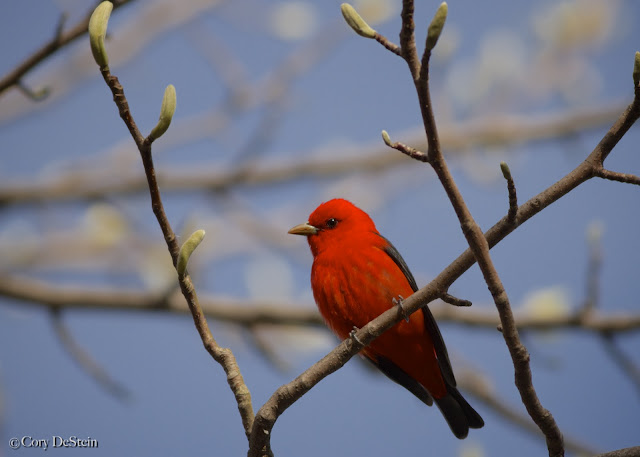
Right guys?
Right?...Guys?...
As the title implies a molting bird, in and of itself is not
of much interest to a birder let alone anyone with any sense of natural history
or levelheadedness. The regular
occurrence of the growing of new feathers is a simple fact of nature; a
necessity for the physical laws of flight. As feathers age, they become worn and brittle. They no longer provide the bird with
streamlining or the perfect airfoil wing-shape needed for dynamic flight, and
instead produce extra turbulence and leave an otherwise healthy bird
aeronautically indisposed. So yes,
the fact that feather molt evolved is interesting. The physics of flight is interesting. But a molting bird is just, well, a
consequence of breaking though an amniotic eggshell with a horny, toothless beak.
 |
| A Mangrove Swallow visibly molting primaries. The difference between the outer juvenile primaries (9 and 10) and the fresh basic plumage flight feathers is blatant. Given that this bird is replacing very worn juvenile flight feathers, what age is this bird? Try to use some of the information in this post to tell this bird's story. |
So why is calling out or talking about a bird’s molt de rigueur amongst "good" birders?
What’s the freaking point? Yeah it’s inner primaries are shorter. They’re growing. It's outer primaries are browner. They're old. That’s what feathers inevitably
do. But can we learn something
from a molting bird relative to, say, identifying or aging it? Well, I am by no means an expert on molt, but I can tell you
this: you can learn a lot about a bird from the timing and extent of its molt, from identifying its age, to distinguishing similar species in the field. In these contexts, molt is both
relevant to the average birder seeking to identify birds in the field, and to
biologists (e.g. studying survivorship or reproductive success) looking at birds in the hand. In some cases, being certain of a bird's age, sex, or species may be contingent on the timing and extent of its current molt.
We have touched on molt and especially with regards to molt limits (an outcome of molt) in the past, and bringing it up again merely stresses its importance. I will not give you a detailed description of all molt cycles, stages, types, etc, nor the patterns or timing associated with specific families or groups of birds. However, to start your own investigation of molt, it is helpful to get a little of the basics. Molt, by definition, is the periodic growing of new feathers not the replacement of feathers. Therefore anytime I refer to molting feathers, I do not mean feathers that are falling off, I refer to feathers that are growing.
 |
| Here is an extreme example of a bird that critically needs to molt. This Pigeon Guillemot's remiges are worn to a point in which the feather shafts are all that remain. This bird cannot fly, and chances are it cannot maneuver well underwater either since alcids use their wings to help them "fly" subsurface and catch food. In fact we watched this bird for most of fall 2012 as it swam in the waters just off of Southeast Farallon Island. The bird began molting quite late, but unfortunately never was able to finish. The bird was eventually found dead on the island mid-molt. Thus I imagine birds may often face the dilemma, molt or die. Reason's why a bird might forgo molt include malnutrition, parasites, or disease among others. I imagine this bird was struggling with at least one of these issues. |
General Sequence for birds showing Complex Basic Strategy for molt (I suggest you read Howell's 2003 essays from Birding and his book, Molt in North American Birds, to really begin to understand the complexities in detail):
Pre-juvenal Molt (now referred to as first pre-basic, and includes all body and flight feathers, and is generally grown in the nest) --> Juvenal plumage (more often than not, much browner, streakier, and of poorer quality) --> Pre-formative Molt (generally within a few months of leaving the nest replacing most or all body feathers and no or some flight feathers) --> formative plumage (birds in this plumage are generally referred to as immature or "first year" rather than juvenal) --> pre-basic molt (the term definitive PB molt refers to the molt that results in the adult plumage: generally the following calendar year replacing all feathers) --> basic plumage --> pre-basic molt (generally the following calender year all feathers)...
This molt pattern, in my opinion is the most important to get down. Keep in mind that generally if you insert pre-alternate molts into the life cycle (complex alternate strategy) or remove the pre-formative (simple basic strategy) you have then pretty much addressed every species North American landbird. Also keep in mind that, generally birds only have one complete molt (i.e. all feathers including flight feathers) per year. So if we are looking at molting flight feathers, which is generally the case, we know it's probably a pre-basic molt or probably not a pre-formative molt (some exceptions to this rule). This will almost never be pre-alternate molt (if ever?)
Here are some things to think about when looking at a bird showing flight-feather molt:
1) What time of year is it and where are you? Birds typically molt their costly flight feathers after major life-cycle events like breeding or migration. This is because many of these events require a lot of resources. During the breeding season, birds put all their energy into creating and raising offspring. During migration birds put all their energy into...migrating. So depending on when and where you are, molt can tell you something about a bird's age or even species. For example, some species molt their feathers on the wintering grounds, some on the breeding grounds, and less commonly some during migration. Knowing where species molt can sometimes help you rule out similar species.
I can think of two classic examples: 1) Jaegers molt on their wintering waters (I believe this to be universally true off the top of my head, but if anyone has a correction I would really like to know). During the fall in California, it may be possible to see all three jaegers in migration, but only Pomarine Jaeger winters along the CA coast. Therefore a molting jaeger in CA waters is almost certainly a Pomarine on its wintering grounds. 2) Similarly, most Empidonax flycatchers molt on the wintering grounds. However, Hammond's Flycatcher molts on the breeding grounds. Therefore any Empidonax with freshly molted plumage in fall in Western North America is likely Hammond's. There are many other examples that I won't get into here (frankly I don't know a lot of it). They include separating shorebirds in migration and winter, separating nighthawks in southern California (Common molts on the wintering grounds), and swallows in TX.
2) What feathers are molting? Tertials? Secondaries? Primaries? Coverts? For example, it is very common for birds to molt tertials and secondary coverts, but no other wing and flight feathers during pre-formative molt. Thus you can generally age a bird in pre-formative molt as a hatching year.
3) What do other feathers in the wing look like compared to the feathers that are growing. Are other feathers similar in color or much browner? Browner, and often more tapered, feathers can often be attributed to juvenal plumage. Feathers grown in the nest are grown rapidly and are of much poorer quality than adult feathers. The difference is often quite clear, although not always. The photo below shows very clearly three generations of feathers.)
This molt pattern, in my opinion is the most important to get down. Keep in mind that generally if you insert pre-alternate molts into the life cycle (complex alternate strategy) or remove the pre-formative (simple basic strategy) you have then pretty much addressed every species North American landbird. Also keep in mind that, generally birds only have one complete molt (i.e. all feathers including flight feathers) per year. So if we are looking at molting flight feathers, which is generally the case, we know it's probably a pre-basic molt or probably not a pre-formative molt (some exceptions to this rule). This will almost never be pre-alternate molt (if ever?)
 |
| Knowledge of molt and their subsequent plumages can be helpful even in birds you've had no experience with. This bird is bizarre in that during it's preformative molt, it replaced tertials, outer primaries, and the first secondary. I had no experience with Garyish Saltators prior to this bird in my hand, but the contrast in colors resulting from two generations of feathers is glaringly obvious. With no prior knowledge of how this species molts or looks as a juvenal, I can tell that the greener, worn feathers are juvenal (first basic). Thus, the bird must be in formative plumage since during it's next basic molt (should happen soon) it should replace all flight feathers. The eccentric molt seen here is further complicated by that middle replaced feather, but that may be a feather that was lost and replaced later (adventitious molt). Keep in mind tropical birds may behave differently than their temperate counterparts. |
1) What time of year is it and where are you? Birds typically molt their costly flight feathers after major life-cycle events like breeding or migration. This is because many of these events require a lot of resources. During the breeding season, birds put all their energy into creating and raising offspring. During migration birds put all their energy into...migrating. So depending on when and where you are, molt can tell you something about a bird's age or even species. For example, some species molt their feathers on the wintering grounds, some on the breeding grounds, and less commonly some during migration. Knowing where species molt can sometimes help you rule out similar species.
I can think of two classic examples: 1) Jaegers molt on their wintering waters (I believe this to be universally true off the top of my head, but if anyone has a correction I would really like to know). During the fall in California, it may be possible to see all three jaegers in migration, but only Pomarine Jaeger winters along the CA coast. Therefore a molting jaeger in CA waters is almost certainly a Pomarine on its wintering grounds. 2) Similarly, most Empidonax flycatchers molt on the wintering grounds. However, Hammond's Flycatcher molts on the breeding grounds. Therefore any Empidonax with freshly molted plumage in fall in Western North America is likely Hammond's. There are many other examples that I won't get into here (frankly I don't know a lot of it). They include separating shorebirds in migration and winter, separating nighthawks in southern California (Common molts on the wintering grounds), and swallows in TX.
2) What feathers are molting? Tertials? Secondaries? Primaries? Coverts? For example, it is very common for birds to molt tertials and secondary coverts, but no other wing and flight feathers during pre-formative molt. Thus you can generally age a bird in pre-formative molt as a hatching year.
3) What do other feathers in the wing look like compared to the feathers that are growing. Are other feathers similar in color or much browner? Browner, and often more tapered, feathers can often be attributed to juvenal plumage. Feathers grown in the nest are grown rapidly and are of much poorer quality than adult feathers. The difference is often quite clear, although not always. The photo below shows very clearly three generations of feathers.)
 |
| Clay-colored Thrush with three generations of feathers in the wing. The brown and very worn outer primaries and middle secondaries are retained juvenal feathers. The olive green and moderately worn tertials (inner secondaries) were replaced during the pre-formative molt. This bird was symmetrically molting the first few primaries and secondaries. Notice how the juvenile feathers contrast in both color and wear with other feathers, but the formative feathers only contrast in wear (i.e. not color) to the brand new adult feathers. Understanding the complex basic molt pattern (above) helped us to age this bird as a second year and understand the contrasts we were seeing in the wing. |
4) What is the bird doing regarding it's life cycle? Is the bird on it's breeding grounds? Is the bird on it's wintering grounds? Is the bird migrating? As I pointed out earlier, molting is energetically costly. As it turns out so is migration. Interestingly, some species of birds have been identified as molt migrants, birds that molt at migration stopover sites. Understanding where a bird molts has important implications for conservation. Traditionally we like to think that looking at breeding and wintering grounds pretty much represents the whole picture. If you protect those two areas, you are protecting the birds. Critically, however, molt stopover sites (e.g. Mono Lake for Wilson's Phalaropes and Eared Grebes) represent another consideration for successful conservation.
Practice looking at molt at your feeder in mid-late summer, and by taking or looking at photos. Or by banding birds, but not everyone has that luxury. While you're practicing, go back to that first photo of the Mangrove Swallow here. Tell its story. How old is it? Try to map out its life cycle thus far.
Practice looking at molt at your feeder in mid-late summer, and by taking or looking at photos. Or by banding birds, but not everyone has that luxury. While you're practicing, go back to that first photo of the Mangrove Swallow here. Tell its story. How old is it? Try to map out its life cycle thus far.


.JPG)