Showing posts with label California. Show all posts

Thursday, June 27, 2013

News-ish from California on our SEFI Records

Not really sure how late I am to the scene here but my friend Jim Tietz just informed me that our Little Bunting sight record from last fall on Southeast Farallon Island, a bird we got no photos of, but was definitely a Little Bunting passed the California Bird Records Committee in the first round!  This was very unexpected because many if not most bird records committees are wary to accept a record of a review species without some sort of photo of audio documentation.  Here are some excerpts from Jim's "Update to Rare Birds of California" of the birds we had that were reviewed (by the way I saw all of them!)


Tuesday, November 27, 2012

Goodbye Farallones

As you may have gathered, I have departed from the Farallones.  Although it is weird being back in civilization, it's good to be home.  Overall I had a great first season on the Farallones, with 193 species on my Farallist.  I was hoping to break 200, but I missed a few good birds early in the season, that I just couldn't make up for during my 10-week tenure on the island.  My list includes 12 species of waterfowl, 8 tubenoses, 2 Sulids, 5 Hawks, 17 shorebirds, 9 gulls, 7 alcids, 5 owls, 9 flycatchers, 6 thrushes, 24 warblers, 19 Emberizid sparrows, 6 Cardinalids, 8 Icterids, and 7 finches!  I got 38 year birds on the Farallones (marked with stars), putting my total at 430 for 2012 (now 432 with 2 species I've gotten since leaving the Farallones, Barnacle Goose and White-winged Crossbill, both in Long Island, NY).  Here is my complete 2012 Farallist of species, including some photo highlights.

Greater White-fronted Goose (3 October)
Brant (2 November)
Cackling Goose (9 October)
BLUE-WINGED TEAL (17 September)
CINNAMON TEAL(17 September)
Northern Shoveler (29 September)
Northern Pintail (8 September)
Green-winged Teal (7 November)
Surf Scoter (30 October)
COMMON GOLDENEYE (30 October)
Red-breasted Merganser (7 November)
RUDDY DUCK (27 September)
Pacific Loon (15 September)
Common Loon (4 October)
Horned Grebe (7 November)
Eared Grebe (15 September)
Western Grebe (27 September)
*Northern Fulmar (21 October)
*Pink-footed Shearwater (11 September)
*Flesh-footed Shearwater (16 October)
*Buller's Shearwater (21 October)
*Sooty Shearwater (8 September)
*Short-tailed Shearwater (7 November)
*Black-vented Shearwater (16 October)
*Ashy Storm-Petrel (13 September)
*Brown Booby (13 October)
NORTHERN GANNET (8 September)
Brandt's Cormorant (8 September)
Double-crested Cormorant (8 September)
Pelagic Cormorant (8 September)
Brown Pelican (8 September)
Great Blue Heron (5 October)
Great Egret (12 September)
White-tailed Kite (13 October)
Northern Harrier (18 September)
Sharp-shinned Hawk (12 October)
COOPER'S HAWK (25 October)
*Rough-legged Hawk (25 October)
Black-bellied Plover (8 September)
Semipalmated Plover (8 September)
Killdeer (12 September)
Black Oystercatcher (8 September)
Spotted Sandpiper (15 September)
Wandering Tattler (8 September)
Willet (8 September)
Whimbrel (8 September)
Black Turnstone (8 September)
Sanderling (15 September)
SEMIPALMATED SANDPIPER (8 October)
Pectoral Sandpiper (8 October)
Short-billed Dowitcher (9 October)
Long-billed Dowitcher (28 September)
Wilson's Snipe (18 October)
Red-necked Phalarope (8 September)
*Red Phalarope (10 September)
Black-legged Kittiwake (2 November)
Bonaparte's Gull (7 November)
Heermann's Gull (9 September)
Mew Gull (7 October)
Western Gull (8 September)
California Gull (8 September)
Herring Gull (27 September)
Thayer's Gull (30 October)
Glaucous-winged Gull (22 October)
*Elegant Tern (27 September)
*Pomarine Jaeger (15 September)
Parasitic Jaeger (11 September)
Common Murre (8 September)
*Pigeon Guillemot (8 September)
Ancient Murrelet (23 October)
*Cassin's Auklet (8 September)
Rhinoceros Auklet (8 September)
*HORNED PUFFIN(3 November)
*Tufted Puffin (11 September)
Eurasian Collared-Dove (8 September)
Mourning Dove (12 September)
Barn Owl (8 September)
Burrowing Owl (23 September)
*Long-eared Owl (8 November)
Short-eared Owl (12 October)
*Northern Saw-whet Owl (8 November)
*Vaux's Swift (28 September)
Anna's Hummingbird (8 September)
Rufous Hummingbird (8 September)
Belted Kingfisher (19 October)
Northern Flicker (7 October)
American Kestrel (12 September)
Merlin (8 September)
Peregrine Falcon (8 September)
*Olive-sided Flycatcher (12 September)
Western Wood-Pewee (8 September)
Willow Flycatcher (14 September)
*Least Flycatcher (8 September)
*HAMMOND'S FLYCATCHER (18 September)
Pacific-slope Flycatcher (18 September)
Black Phoebe (15 September)
Say's Phoebe (23 September)
Ash-throated Flycatcher (12 October)
Hutton's Vireo (3 November)
Warbling Vireo (12 September)
Common Raven (18 September)
Horned Lark (18 October)
Northern Rough-winged Swallow (12 September)
Violet-green Swallow (11 Ocotober)
Cliff Swallow (10 September)
Red-breasted Nuthatch (9 September)
Brown Creeper (7 October)
*Rock Wren (8 September)
House Wren (3 October)
Pacific Wren (14 September)
Blue-gray Gnatcatcher (17 September)
Golden-crowned Kinglet (9 October)
Ruby-crowned Kinglet (25 September)
*ARCTIC WARBLER (28 September)
*TOWNSEND'S SOLITAIRE (11 October)
*GRAY-CHEEKED THRUSH (4 October)
*Swainson's Thrush (18 September)
Hermit Thrush (18 September)
American Robin (4 November)
Varied Thrush (25 September)
Northern Mockingbird (8 September)
European Starling (2 October)
American Pipit (12 September)
Cedar Waxwing (12 September)
*Lapland Longspur (19 October)
Ovenbird (25 September)
Black-and-white Warbler (16 September)
*Tennessee Warbler (11 September)
Orange-crowned Warbler (8 September)
Nashville Warbler (25 September)
*MacGillivray's Warbler (17 September)
Common Yellowthroat (13 September)
American Redstart (12 September)
*Cape May Warbler (8 September)
Magnolia Warbler (12 September)
*Bay-breasted Warbler (12 September)
Blackburnian Warbler (12 September)
Yellow Warbler (8 September)
Chestnut-sided Warbler (12 September)
Blackpoll Warbler (10 September)
Black-throated Blue Warbler (29 September)
Palm Warbler (26 September)
Yellow-rumped Warbler (15 September)
YELLOW-THROATED WARBLER (14 September)
Prairie Warbler (21 September)
Black-throated Gray Warbler (16 September)
Townsend's Warbler (12 September)
Hermit Warbler (13 September)
Black-throated Green Warbler (4 October)
Wilson's Warbler (12 September)
Spotted Towhee (1 October)
Chipping Sparrow (8 September)
Clay-colored Sparrow (8 September)
Brewer's Sparrow (8 September)
*Vesper Sparrow (17 September)
Lark Sparrow (8 September)
*Lark Bunting (8 September)
Savannah Sparrow (8 September)
Grasshopper Sparrow (18 October)
Fox Sparrow (21 September)
Song Sparrow (11 November)
Lincoln's Sparrow (11 September)
Swamp Sparrow (12 October)
White-throated Sparrow (3 October)
*Harris's Sparrow (18 October)
White-crowned Sparrow (22 September)
Golden-crowned Sparrow (25 September)
Dark-eyed Junco (24 September)
*LITTLE BUNTING (14 November; Pending acceptance by CBRC)
Summer Tanager (14 November)
*Western Tanager (16 September)
Rose-breasted Grosbeak (12 September)
Black-headed Grosbeak (10 September)
Lazuli Bunting (9 September)
Indigo Bunting (17 September)
*PAINTED BUNTING (18 September)
DICKCISSEL (17 September)
Bobolink (8 September)
Red-winged Blackbird (7 October)
Western Meadowlark (23 September)
Yellow-headed Blackbird (9 September)
*RUSTY BLACKBIRD (14 November)
Brewer's Blackbird (7 October)
Brown-headed Cowbird (11 September)
Baltimore Oriole (11 September)
Purple Finch (11 October)
House Finch (18 October)
RED CROSSBILL (13 September)
Pine Siskin (28 September)
Lesser Goldfinch (8 September)
American Goldfinch (7 October)
*EVENING GROSBEAK (11 October)

Wednesday, November 14, 2012

The One that Got Away (Little Bunting)

By Luke Musher

Today was an unexpectedly good day for us on Southeast Farallon Island.  We had a Rusty Blackbird, which is a CBRC species and a Summer Tanager, which is also a rather good bird for the island.
Rusty Blackbird, Southeast Farallon Island, CA.
However, it was also an unexpectedly horrible day.  We saw a Little Bunting.  I know what you are thinking.  "That doesn't sound so bad.  Little Bunting has only occurred in North America outside of Alaska two other times, once of which was on the very island you are on now.  You guys found an extremely rare bird."  No; it was horrible because nobody photographed it.  The bird will almost certainly not be accepted by the CBRC without a photograph, and there is little we can do about it.
At least we can prove that this bird exists.
Jim Tietz initially found the bird and radioed to us to bring our cameras immediately.  When we got there the bird had just flown.  Jim described the bird to us, small emperezid sparrow with a lot of chestnut on the face, light streaking on the underparts, white outer tail feathers, eye ring, and call a faint tsip.  Then we searched a little more, but were unable to relocate the bird.  I kept looking and found a Pine Siskin with another bird.  I couldn't see the bird well, but I distinctly heard a call just like Jim had described so I kept on it.  The bird then flew straight at me.  I could clearly see the chestnut face, eye ring and white outer tail feathers, and the call matched Jims description.  I ran after the bird while radioing the rest of the crew.  The bird then flew back over my head towards where it came from and was never seen again. I just listened to several recordings of the their calls from asia, and was pleased to see that most of the recordings matched what I heard.

I am hopeful that the bird is still on the island and that we will see it tomorrow (unlikely).


Here's a link to our ebird checklist today including Jim's description of the bunting:

Ebird Checklist

Saturday, September 29, 2012

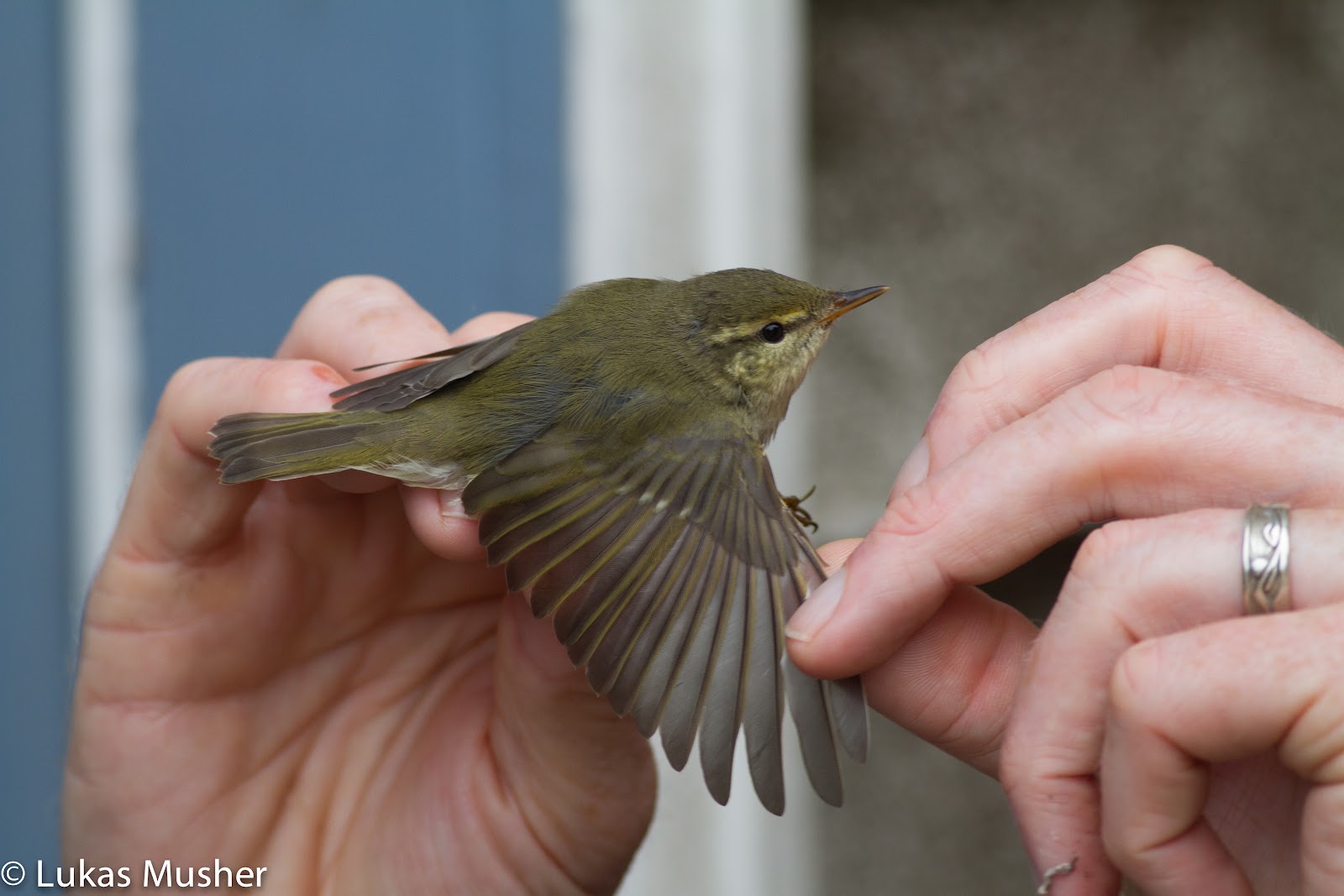
Mega: Arctic Warbler


I woke up this morning to fog and south winds, and soon after, the fog lifted, and the wave began.  We banded 42 Red-breasted Nuthatches today, and 70 birds all together.  We saw a total of 69 species.  Oh and did I mention?  We had an Arctic Warbler hit one of our mist nets.  This mega rarity represents the 2nd record for the island and 8th for California.  Still, we all just found out about the Common Cuckoo in Santa Cruz, CA...that bird wins.


Wednesday, September 19, 2012

Recent Farallon Finds

Magnolia Warbler, Southeast Farallon Island, CA
It's been busy as ever lately, with lots of new birds coming to the island.  Today is our first slow day in over a week, so allow me to fill you in on some of the goodies that have been turning up.

The migrant passerines continue to move through with Yellow, Chestnut-sided, Hermit, Magnolia, Blackpoll, Bay-breasted, Townsend's, Black-throated Gray, Yellow-throated, Black-and-white, Tennessee, Orange-crowned, MacGillivray's, and Wilson's Warblers, American Redstart (including one stunning adult male), Common Yellowthroat, Bobolink, Vesper Sparrow, Indigo Bunting, Dickcissel, Red Crossbill (there are very few records of this for the island, but this fall has been especially good since it is an irruption year for at least one type on the west coast), Blue-gray Gnatcatcher (less than 40 records for the island), Swainson's and Hermit Thrushes, Warbling Vireo, Baltimore Oriole, Western tanager, Lincoln's Sparrow, Pacific Wren, and Hammond's Flycatcher as some of the migrants we've seen since my last post.

We are banding dozens of Red-breasted Nuthatches as well, with more coming in each day.  When they come in off the ocean they land on the lighthouse, and begin to glean microscopic invertebrates off of the lichen that grows on it.  They allow very close approach, and one even let me feed it dead kelp flies (slapped from my arms), off of the tip of a pencil.

On the 17th Dan Maxwell and I were up on the lighthouse when we heard over the radio, "ducks flying by the terrace!"  We immediately got on the flock of six birds, and began calling things out.  I immediately said Blue-winged Teal, and over the radio Jim Tietz said, "I think we've got a mixed flock of teal."  Although at the time I thought they were all uniform in size, shape, and plumage, Jim was right, and thanks to some photos by Dan Maxwell (below), we confirmed that we had three Cinnamon Teal, and three Blue-winged Teal. Can you pick out which ones are which?  Here's a hint, look at bill size and shape, and face pattern.  I think you'll find that the wing pattern on these two species is nearly identical.  The Cinnamon Teal were the first for the island in more than 12 years, and the Blue-winged Teal represent the 11th (or 12th?) record for the island ever.
Mixed Teal Flock, Southeast Farallon Island, CA [Photo by Daniel Maxwell]
The Northern Gannet is still around.
One of the few Bobolinks we've had this year.

Saturday, September 15, 2012

Farallon Yellow-throated Warbler

Thanks to this web cam on top of the Farallon lighthouse (below), Matt Brady found a Yellow-throated Warbler for us while most of us were still sleeping yesterday morning.  I woke up to Jim Tietz exclaiming, "Yellow-throated Warbler on the lighthouse!" I subsequently rolled out of bed, threw on some clothes and made my way up the hill to begin looking.  It was an easy target. This is the sixth record for the island of this species, and only the third record for fall.

This Chestnut-sided Warbler, a new arrival, was also present this morning up at the lighthouse.


Thursday, September 13, 2012

Some Vagrants: My First Farallon Wave

Blackburnian Warbler at the Lighthouse.
Tuesday night the conditions were good for a small wave to hit the Farallons yesterday.  The light south winds and low overcast sky made made my fourth day on the island a good one.  As I was eating breakfast this morning, the first landbirds started dropping in to the lighthouse, with reports of Bay-breasted and Blackburnian Warblers, American Redstart, Olive-sided Flycatcher, and Rose-breasted Grosbeak over the radio.  After my morning sea watch, where I picked up my year Pink-footed Shearwater, I began searching the island for birds, turning up several new arrivals including two Clay-colored Sparrows, several Townsend's Warblers, and the Blackburnian Warbler.  However, it wasn't until I made it up to the lighthouse for my shark-watching shift that I got to see almost all of the vagrants reported on the island for the day.  The only one I missed was Ovenbird.

Tuesday afternoon was good as well, with a couple vagrants arriving in the afternoon including Baltimore Oriole and Tennessee Warbler.

This Tennessee Warbler was present since Tuesday, along with one new arrival on Wednesday.
Bay-breasted Warbler on Lighthouse Hill.
 Magnolia Warbler at the lighthouse
Townsend's Warbler at the Lighthouse
American Redstart at the Lighthouse

Rose-breasted Grosbeak on Lighthouse Hill
Magnolia Warbler
Chestnut-sided Warbler at the lighthouse

Wednesday, August 29, 2012

Ode to The Farallons

Oh you beautiful, rocky islands, covered in mice and smelling like shit,
I made it within reach and you taunted me once before.
But this time, I'll be staying.  See you soon.

That three-line masterpiece (^^^) was inspired by the fact that I am GOING TO THE FREAKING FARALLONS!  Holy crap, I'm getting so psyched about this.  I know it's been a slow summer (Cory and I officially suck), but get ready, because extremely epic and cool things are going to happen (currently knocking on wood), and I intend to share them with you folks.

Countless amazing vagrants have shown up on these Islands, including Brown Shrike and Common Rosefinch among others, and the annual eastern warblers and other landbirds.  Seabirds migrate by the islands throughout fall, as do cetaceans.  Pinnipeds call the islands home, and thus attract (great) white sharks to the nearby waters.  I cannot wait to be part of this wonderful place.

So I hope you haven't forgotten about us.  We're still here, and the blogging will continue shortly.  I leave for California Sep. 5, and arrive on the island Sep. 8.

Until then, here are some photos you may have seen from the day I was supposed to get on the island, but couldn't.


Stay tuned, dear friends.

Luke Musher