Showing posts with label Southeast Farallon Island. Show all posts

Wednesday, November 14, 2012

The One that Got Away (Little Bunting)

By Luke Musher

Today was an unexpectedly good day for us on Southeast Farallon Island.  We had a Rusty Blackbird, which is a CBRC species and a Summer Tanager, which is also a rather good bird for the island.
Rusty Blackbird, Southeast Farallon Island, CA.
However, it was also an unexpectedly horrible day.  We saw a Little Bunting.  I know what you are thinking.  "That doesn't sound so bad.  Little Bunting has only occurred in North America outside of Alaska two other times, once of which was on the very island you are on now.  You guys found an extremely rare bird."  No; it was horrible because nobody photographed it.  The bird will almost certainly not be accepted by the CBRC without a photograph, and there is little we can do about it.
At least we can prove that this bird exists.
Jim Tietz initially found the bird and radioed to us to bring our cameras immediately.  When we got there the bird had just flown.  Jim described the bird to us, small emperezid sparrow with a lot of chestnut on the face, light streaking on the underparts, white outer tail feathers, eye ring, and call a faint tsip.  Then we searched a little more, but were unable to relocate the bird.  I kept looking and found a Pine Siskin with another bird.  I couldn't see the bird well, but I distinctly heard a call just like Jim had described so I kept on it.  The bird then flew straight at me.  I could clearly see the chestnut face, eye ring and white outer tail feathers, and the call matched Jims description.  I ran after the bird while radioing the rest of the crew.  The bird then flew back over my head towards where it came from and was never seen again. I just listened to several recordings of the their calls from asia, and was pleased to see that most of the recordings matched what I heard.

I am hopeful that the bird is still on the island and that we will see it tomorrow (unlikely).


Here's a link to our ebird checklist today including Jim's description of the bunting:

Ebird Checklist

Monday, November 5, 2012

Farallonia's Common and Scarce

By Luke Musher
HY Anna's Hummingbird, a common bird on the Farallons.
Since I first arrived, I have found it incredibly interesting how some species that are fairly abundant just 30 miles east on the mainland can be incredibly rare, and are thus highly coveted by us Faralisters here in Farallonia.  Then there are birds that are much more likely to turn up here than on the mainland.  For example we get far more Least Flycatchers, an eastern vagrant, than Dusky or Hammond's Flycatchers, which are relatively common species in the west.  We recently had two Farallon megas, Common Goldeneye and Cooper's Hawk that are doubtfully any birder's idea of chase birds.  However, birders who spend time on the Farallons take their island lists very seriously, so when I called out the goldeneye over the radio, the others came sprinting to me as if it were an Arctic Warbler (not surprisingly also induced a rapid and shamefully twitchy response).
NOT the Loch Ness Monster, but the 20th Island record and 6th Fall record of Common Goldeneye for Southeast Farallon Island.  Nearly all records are in winter.
Cooper's Hawk, one of roughly 30 records for the island [Photo by Ryan DiGaudio]
Despite the fact that the birding has been slow due to various amounts of wind and/or fog, we've had a a trickle of arrivals over the past few weeks, including new Grasshopper Sparrow, Lapland Longspur, Short-eared Owls (almost daily), Rough-legged Hawk, Blackburnian Warbler (a good vagrant anytime, but especially this late in the season), and Surf Scoters to name a few. 
Lapland Longspur, the most likely species of longspur here, but still a relatively uncommon bird.
Short-eared Owl, a common species but an outstanding bird every time.
We have butterflies too, like this west coast lady....
...and this painted lady.
We haven't seen many Pigeon Guillemots lately, but this individual, Hermen, has been here since the breeding season, and is finally molting in a much-needed new set of remiges.
One of my favorite recent birds was a Horned Puffin yesterday (pow! that's a lifer) that was spotted while we were operating the crane to bring the boat on shore.  Ryan DiGaudio, Nora Livingston, Maggie Spilatro and I all basically spotted the bird at exactly the same time and realized it wasn't a Tufted Puffin, which breed on the island and would be far more likely, but a Horned.  Jim Tietz got this as an island bird while still waiting on the boat he was arriving on.  Note the white underparts, pinched base of the bill, and obvious paleness in the face–much different than any Tufted Puffin.  What a BAMF.
Eh not the best photo ever, but a great bird anyway.  Horned Puffin just chillin'.  One of less than 30 records for the island, 8th fall record.  This bird is far more likely in Spring, but rare any time, and scarce in any part of coastal California.  

Sunday, October 14, 2012

Wave Days are the Best

Today is my first real break since a four day wave starting on October 10 with only a few arriving birds and peaking on the 11th and 12th with hundreds of arriving landbirds, including likely over 100 Ruby-crowned Kinglets and perhaps more than 150 (>200?) Zonotrichia sparrows (mostly Golden-crowned with one third as many White-crowned and a few White-throated), many first of fall birds, and a few rarities.
"Western" Palm Warbler, Southeast Farallon Island, CA
Rock Wren, Southeast Farallon Island, CA
Aleutian Cackling Goose, one of seven total seen, Southeast Farallon Island, CA
HY Peregrine Falcon
White-throated Sparrow, Southeast Farallon Island, CA
"Bicolored" Red-winged Blackbird, Southeast Farallon Island, CA
One of the few dozen Pine Siskins during the wave
We continue to band Burrowing Owls every night, and continue to find unbanded owls each day.  This is apparently the best year ever for Burrowing Owls on the island in terms of numbers.  Our daily high count is 17, shattering the previous record of 11.
This rather late Olive-sided Flycatcher was one of the first birds I saw on wave day (October 11th).
As I said, the wave pretty much started on the 10th with a few new birds such as Cackling Goose, Golden-crowned Kinglet, and several other new arriving songbirds.  However, the 11th was the big day.  I rolled out of bed expecting nothing new, or at least very little in terms of arriving birds, since the the winds were very strong.  However, the cloud ceiling was low enough that the mainland wasn't visible, and when I walked out the door to start my AM area search, there were dozens of sparrows and kinglets flitting about and calling in the tree and shrubbery by the house.  As I continued my search, I turned up more and more new arrivals such as Olive-sided Flycatcher and Townsend's Solitaire (less than 50 records on the island; anything under 100 records is a pretty good bird), among the hundreds of other birds.

Common Raven on wave day, Southeast Farallon Island, CA
Townsend's Solitaire, Southeast Farallon Island, CA
My favorite bird of the day, though, was found at the lighthouse just 30 minutes or so after I got down from doing my shark watch from there.  Sophie Webb radioed down that she was looking at a "lovely male Evening Grosbeak sitting on the lighthouse."  We spent some time attempting to scope it from below, but could never find it, and the bird eventually flew somewhere that Sophie could not tell.  I spent the next hour or so hiking around the island looking for the bird.  It began raining, so the rocks on all the hills were slippery, and I had to keep my camera under my shirt to keep it from getting too wet.  Just when I was ready to give up, I heard it call from the lighthouse, and I saw it flying in my direction.  The bird landed about 20ft from me, and I was able to get some okay photographs given the rain and lack of light.  There are only 5 previous records for Evening Grosbeak on Southeast Farallon Island.  Of course after all that effort, the bird flew into one of our nets, and I got to band it.
Adult male Evening Grosbeak, Southeast Farallon Island, CA
It was hard to beat the wave on the 11th, but the 12th still brought in a number of new birds, including a few island birds for me.  Ash-throated Flycatcher and Swamp Sparrow were among them.  On the 13th we were treated to a few new birds, and a Brown Booby that loafed around all day with the cormorants on Sugarloaf (small island/large rock just off of the island).

The best bird of the day was a probable Yellow-bellied Sapsucker (would be 3rd record for the island)/possible Red-naped Sapsucker (would be 6th record for island).  I saw the bird flying around the lighthouse (but to me only identifyable as a woodpecker), but Jim Tietz was at the lighthouse and was able to photograph (photos here) the bird during it's brief stay at the lighthouse before it flew off never to be seen again.  Of course there is always the possibility of hybridization, and the experts don't seem to agree on the identity of this individual, some going so far as to say they won't put a name on it from the photos.  Several people think it is Yellow-bellied, though.  The back pattern, to me looks great for Yellow-bellied, but I haven't seen enough Red-naped, and don't know enough about hybridization in these taxa to make a call myself.  Comment with your opinion.
Ash-throated Flycatcher, Southeast Farallon Island, CA
Swamp Sparrow [Photo by Dan Maxwell]
Brown Booby [Photo by Dan Maxweel]
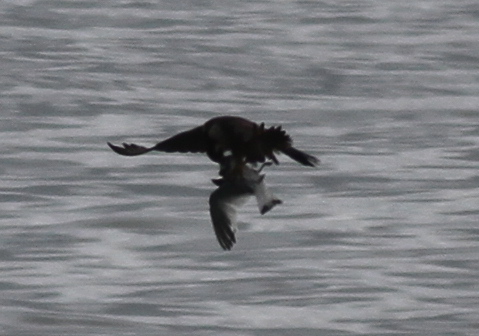
One of the most interesting occurrences on the 12th was seen only by Dan Maxwell, as this adult Peregrine Falcon snatched a Sabine's Gull (I need that bird for the year!) off the water.  This cropped, distant shot is still identifiable. [Photo by Dan Maxwell]
Until next time –

Luke

Saturday, October 6, 2012

Two Vagrants

Gray-cheeked Thrush, Southeast Farallon Island, CA
Dan Maxwell seems to have the uncanny ability to walk up to a mist net and find a rare bird.  First the Arctic Warbler and yesterday a Gray-cheeked Thrush.  Sure, the second is incomparable to the first, but  it is still a great bird, and a review list species for the California Bird Records Committee. We also had Black-throated Green Warbler yesterday, though never caught it.  Both of these vagrants from the east are quite rare on the island.
Black-throated Green Warbler, Southeast Farallon Island, CA


Should have made it a Photo Quiz – too late.

Wednesday, October 3, 2012

Past Few Days in Farallonia

This Greater White-fronted Goose showed up today. Not sure what's wrong with its eye but it doesn't look good for this poor fella.
We had one great day in the past couple weeks (Arctic Warbler, 'nuff said), but the weather simply won't cooperate for another good wave.  We've been inundated with fog, and when that finally lifted we had sunny skies and 60 miles of visibility.  Any land bird that had any chance of landing on the island could easily see the luxuriant, sunny banks of Point Reyes and had no reason to stop in this granite wasteland.

Still, a few new arrivals over the past few days helped boost my Faralist (all species seen on the island).  My island list is up to 135 in less than a month on the island, but imagine what it could be with some overcast skies and light winds.  Good thing I have some more time.
Another new arrival today, House Wren.
Cassin's Auklet
Cassin's Auklets nest on the island and are quite common.  However, sometimes nests are abandoned or parents die, and juvenile birds (such as this one above) head out of their burrows in search of food.  They become a quick and easy meal for Western Gulls, which we've seen swallowing whole chicks on more than one occasion.  I don't know the fate of this bird, but I can't imagine it ended harmoniously.
California sea lions – they're still out here.
Hatch-year Rock Wren
No joke, we have been trying to catch a Rock Wren on this island since I arrived.  We have 3-4 on the island now and they have resisted all efforts to capture them.  Finally, we got one (above).  We've also been banding Burrowing Owls most nights this past week.  Today we have at least ten of these strange birds on the island.
Finally a re-sight on one of the banded ones.
Ah yes, A66, this is the one I banded.
As I mentioned, it has been too clear.  In fact it was so clear, that the Golden Gate Bridge was easily visible (above) from the lighthouse.  The benefit to the good visibility is that cetaceans can are also easy to spot.  In addition to our resident gray whales, yesterday, we had a pod of 50 short-beaked common dolphins, and a humpback whale.
Adult White-crowned Sparrow
Finally got a photo of a/the Vesper Sparrow
Nursing Steller's sea lion pups 
Whimbrel
Clay-colored Sparrow
Stay tuned for more, I swear we'll get something crazy soon...

Monday, October 1, 2012

Farallon Pinnipeds

Harbor Seal (Phoca vitulina).  Yes, they always look this frightened.
I was recently asked to put some photos up of the seals and sea lions (Pinnipeds) on the island, and, despite my predisposition to photographing animals with feathers and beaks, I have decided to embrace these furry and cute, though smelly, noisy, and peculiar marine mammals.  Afterall, I walk by them daily and rarely take the time to photograph or study them.  

Northern fur seals (Callorhinus ursinus) are difficult to view at close range on the island, however I commonly see the other species at close range on the island – California sea lions (Zalophus californianus), Steller's sea lion (Eumetopias jubatus), Harbor Seal (Phoca vitulina), and northern elephant seal (Mirounga angustirostrus).  All but the elephant seals are easily disturbed on the island, so we have to take special care not to flush them when doing bird surveys.  I have taken a particular liking to the immature male elephant seals which look like aliens, sound like crazy people, and smell horrible.

California sea lions and an elephant seal
Sleeping elephant seal
Elephant seals
Elephant seal
Harbor Seal
Steller's sea lion (the blonde one), with California sea lions