Showing posts with label fall. Show all posts

Wednesday, November 6, 2013

All about "Crane Crane" the Sandhill Crane

The date was September 26, 2013.  It was a windy day.  Bad weather had pretty much dominated the forecast for several days.  I was outside when I heard Jim's thunderous voice come through the radio, "Sandhill Crane, there's a Sandhill Crane over East Landing."  I ran out the door and there was a crane flying in closer and closer.  This was the second record of Sandhill Crane so everyone was ecstatic.  

Eventually the bird landed, and we crept up to get some photos.  Little did we know, this bird would stay with us for a while.
Craney Crane
We all felt sorry for this poor juvenile crane who must have gotten separated from her flock, and blown off course to end up on this place – surely a wasteland for any crane.  But on the first day, Don Mastwell took a dead mouse from the mouse trap, chirped a sweet trill the bird's direction, and dangled the tiny rodent by its tail out for the bird to see.  The crane, soon to be named Craney Crane, followed by Crane Crane, approached skeptically and plucked the mouse from Donald's hand.  It was love at first sight.  Crane Crane loved Dan, and Dan loved Crane Crane.
Before long all of us were feeding this lucky bird straight from our hands.  But we knew that wasn't right.  This was a wild animal after all and it had to learn how to forage by herself.  I began giving her foraging lessons.  I would sit down and start digging under rocks, turning up beetles and brown funnel-web spiders plump and ripe to a Crane's tastes.  But still, she was getting too close.  She took too much of a liking too us.  
Dan and his bag of crane food and water
One day we had a huge wave of migrants and all of us were up on the hill looking through flocks of sparrows and Hermit Thrush (and one Williamson's Sapsucker) only to look out at Crane Crane circling up higher and higher then circling around us.  She tried to land at the lighthouse a few times, chirping at us all along.  She was jealous of the other birds.

We all decided that the crane, Crane Crane, had overstayed her welcome.  We stopped feeding her and foraging with her hoping that she would begin fending for herself.  We loved the Crane, sure, and that's why we needed her to forage alone.  She needed to build up enough energy to get away, but not have a reason to stay.
We saw her foraging often, then, even catching her own mice and her own spiders.  We chased her away from our nets so that she wouldn't try to eat our captured birds, and she grew afraid of us.  She started paying close attention to the Brown Pelicans as they flew over, often tilting her head up towards them and calling to them.  Eventually she began flying out over the ocean with them.  Each time she got further and further away before heading back.  She was ready to go. One day Don woke up and looked outside at Crane Crane foraging as usual.  Later that morning she was nowhere to be found.  Two days later a juvenile Sandhill Crane was seen in Napa.  I like to think that that was our Crane Crane.

Sunday, October 14, 2012

Wave Days are the Best

Today is my first real break since a four day wave starting on October 10 with only a few arriving birds and peaking on the 11th and 12th with hundreds of arriving landbirds, including likely over 100 Ruby-crowned Kinglets and perhaps more than 150 (>200?) Zonotrichia sparrows (mostly Golden-crowned with one third as many White-crowned and a few White-throated), many first of fall birds, and a few rarities.
"Western" Palm Warbler, Southeast Farallon Island, CA
Rock Wren, Southeast Farallon Island, CA
Aleutian Cackling Goose, one of seven total seen, Southeast Farallon Island, CA
HY Peregrine Falcon
White-throated Sparrow, Southeast Farallon Island, CA
"Bicolored" Red-winged Blackbird, Southeast Farallon Island, CA
One of the few dozen Pine Siskins during the wave
We continue to band Burrowing Owls every night, and continue to find unbanded owls each day.  This is apparently the best year ever for Burrowing Owls on the island in terms of numbers.  Our daily high count is 17, shattering the previous record of 11.
This rather late Olive-sided Flycatcher was one of the first birds I saw on wave day (October 11th).
As I said, the wave pretty much started on the 10th with a few new birds such as Cackling Goose, Golden-crowned Kinglet, and several other new arriving songbirds.  However, the 11th was the big day.  I rolled out of bed expecting nothing new, or at least very little in terms of arriving birds, since the the winds were very strong.  However, the cloud ceiling was low enough that the mainland wasn't visible, and when I walked out the door to start my AM area search, there were dozens of sparrows and kinglets flitting about and calling in the tree and shrubbery by the house.  As I continued my search, I turned up more and more new arrivals such as Olive-sided Flycatcher and Townsend's Solitaire (less than 50 records on the island; anything under 100 records is a pretty good bird), among the hundreds of other birds.

Common Raven on wave day, Southeast Farallon Island, CA
Townsend's Solitaire, Southeast Farallon Island, CA
My favorite bird of the day, though, was found at the lighthouse just 30 minutes or so after I got down from doing my shark watch from there.  Sophie Webb radioed down that she was looking at a "lovely male Evening Grosbeak sitting on the lighthouse."  We spent some time attempting to scope it from below, but could never find it, and the bird eventually flew somewhere that Sophie could not tell.  I spent the next hour or so hiking around the island looking for the bird.  It began raining, so the rocks on all the hills were slippery, and I had to keep my camera under my shirt to keep it from getting too wet.  Just when I was ready to give up, I heard it call from the lighthouse, and I saw it flying in my direction.  The bird landed about 20ft from me, and I was able to get some okay photographs given the rain and lack of light.  There are only 5 previous records for Evening Grosbeak on Southeast Farallon Island.  Of course after all that effort, the bird flew into one of our nets, and I got to band it.
Adult male Evening Grosbeak, Southeast Farallon Island, CA
It was hard to beat the wave on the 11th, but the 12th still brought in a number of new birds, including a few island birds for me.  Ash-throated Flycatcher and Swamp Sparrow were among them.  On the 13th we were treated to a few new birds, and a Brown Booby that loafed around all day with the cormorants on Sugarloaf (small island/large rock just off of the island).

The best bird of the day was a probable Yellow-bellied Sapsucker (would be 3rd record for the island)/possible Red-naped Sapsucker (would be 6th record for island).  I saw the bird flying around the lighthouse (but to me only identifyable as a woodpecker), but Jim Tietz was at the lighthouse and was able to photograph (photos here) the bird during it's brief stay at the lighthouse before it flew off never to be seen again.  Of course there is always the possibility of hybridization, and the experts don't seem to agree on the identity of this individual, some going so far as to say they won't put a name on it from the photos.  Several people think it is Yellow-bellied, though.  The back pattern, to me looks great for Yellow-bellied, but I haven't seen enough Red-naped, and don't know enough about hybridization in these taxa to make a call myself.  Comment with your opinion.
Ash-throated Flycatcher, Southeast Farallon Island, CA
Swamp Sparrow [Photo by Dan Maxwell]
Brown Booby [Photo by Dan Maxweel]
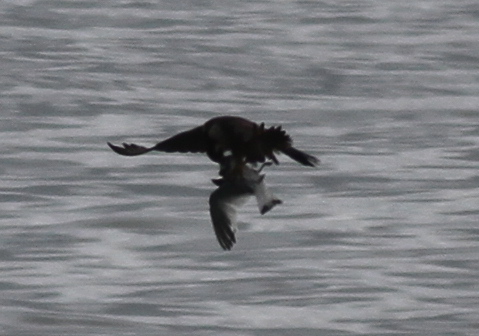
One of the most interesting occurrences on the 12th was seen only by Dan Maxwell, as this adult Peregrine Falcon snatched a Sabine's Gull (I need that bird for the year!) off the water.  This cropped, distant shot is still identifiable. [Photo by Dan Maxwell]
Until next time –

Luke

Saturday, September 29, 2012

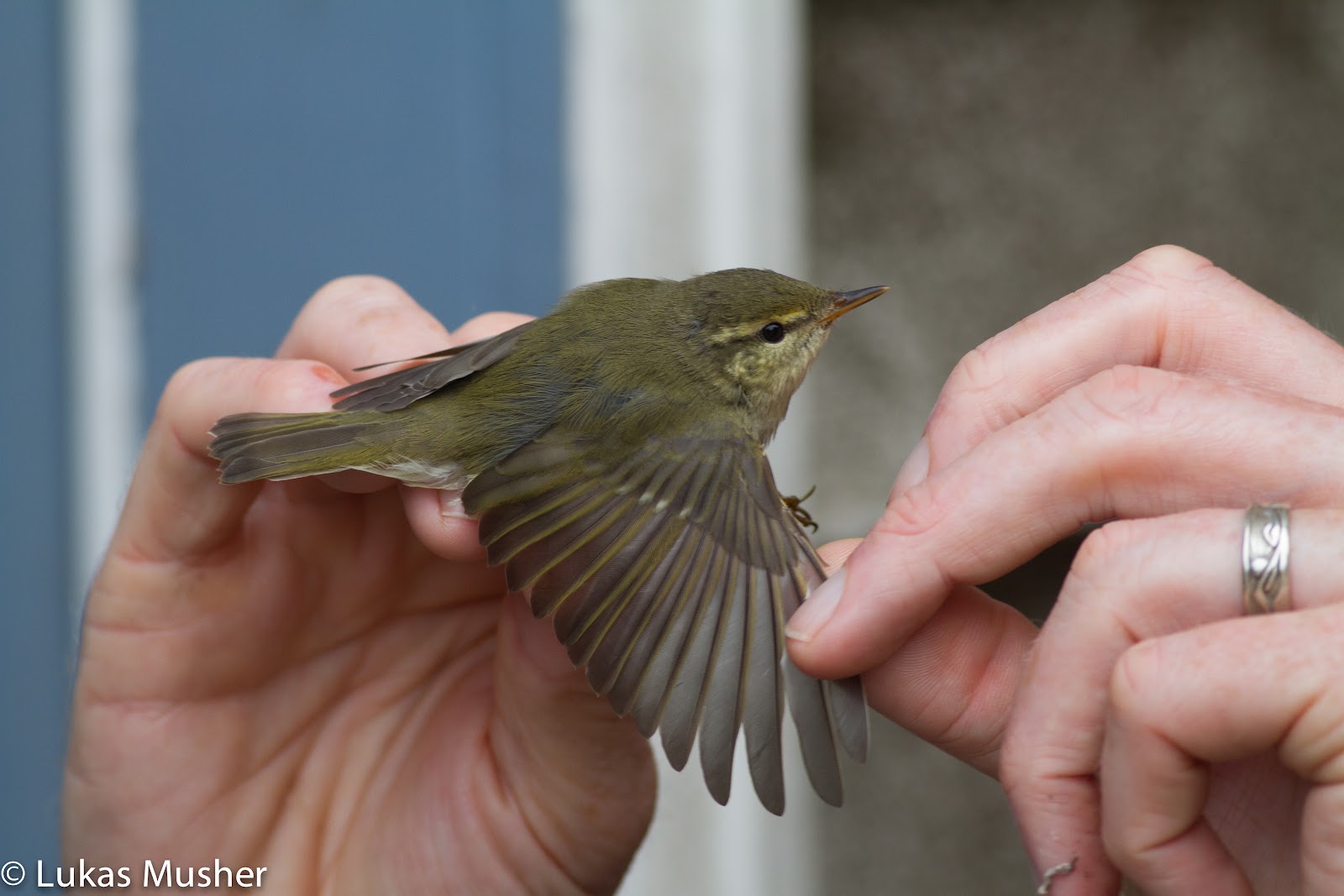
Mega: Arctic Warbler


I woke up this morning to fog and south winds, and soon after, the fog lifted, and the wave began.  We banded 42 Red-breasted Nuthatches today, and 70 birds all together.  We saw a total of 69 species.  Oh and did I mention?  We had an Arctic Warbler hit one of our mist nets.  This mega rarity represents the 2nd record for the island and 8th for California.  Still, we all just found out about the Common Cuckoo in Santa Cruz, CA...that bird wins.


Wednesday, September 19, 2012

Recent Farallon Finds

Magnolia Warbler, Southeast Farallon Island, CA
It's been busy as ever lately, with lots of new birds coming to the island.  Today is our first slow day in over a week, so allow me to fill you in on some of the goodies that have been turning up.

The migrant passerines continue to move through with Yellow, Chestnut-sided, Hermit, Magnolia, Blackpoll, Bay-breasted, Townsend's, Black-throated Gray, Yellow-throated, Black-and-white, Tennessee, Orange-crowned, MacGillivray's, and Wilson's Warblers, American Redstart (including one stunning adult male), Common Yellowthroat, Bobolink, Vesper Sparrow, Indigo Bunting, Dickcissel, Red Crossbill (there are very few records of this for the island, but this fall has been especially good since it is an irruption year for at least one type on the west coast), Blue-gray Gnatcatcher (less than 40 records for the island), Swainson's and Hermit Thrushes, Warbling Vireo, Baltimore Oriole, Western tanager, Lincoln's Sparrow, Pacific Wren, and Hammond's Flycatcher as some of the migrants we've seen since my last post.

We are banding dozens of Red-breasted Nuthatches as well, with more coming in each day.  When they come in off the ocean they land on the lighthouse, and begin to glean microscopic invertebrates off of the lichen that grows on it.  They allow very close approach, and one even let me feed it dead kelp flies (slapped from my arms), off of the tip of a pencil.

On the 17th Dan Maxwell and I were up on the lighthouse when we heard over the radio, "ducks flying by the terrace!"  We immediately got on the flock of six birds, and began calling things out.  I immediately said Blue-winged Teal, and over the radio Jim Tietz said, "I think we've got a mixed flock of teal."  Although at the time I thought they were all uniform in size, shape, and plumage, Jim was right, and thanks to some photos by Dan Maxwell (below), we confirmed that we had three Cinnamon Teal, and three Blue-winged Teal. Can you pick out which ones are which?  Here's a hint, look at bill size and shape, and face pattern.  I think you'll find that the wing pattern on these two species is nearly identical.  The Cinnamon Teal were the first for the island in more than 12 years, and the Blue-winged Teal represent the 11th (or 12th?) record for the island ever.
Mixed Teal Flock, Southeast Farallon Island, CA [Photo by Daniel Maxwell]
The Northern Gannet is still around.
One of the few Bobolinks we've had this year.

Saturday, September 15, 2012

Farallon Yellow-throated Warbler

Thanks to this web cam on top of the Farallon lighthouse (below), Matt Brady found a Yellow-throated Warbler for us while most of us were still sleeping yesterday morning.  I woke up to Jim Tietz exclaiming, "Yellow-throated Warbler on the lighthouse!" I subsequently rolled out of bed, threw on some clothes and made my way up the hill to begin looking.  It was an easy target. This is the sixth record for the island of this species, and only the third record for fall.

This Chestnut-sided Warbler, a new arrival, was also present this morning up at the lighthouse.


Thursday, September 13, 2012

Some Vagrants: My First Farallon Wave

Blackburnian Warbler at the Lighthouse.
Tuesday night the conditions were good for a small wave to hit the Farallons yesterday.  The light south winds and low overcast sky made made my fourth day on the island a good one.  As I was eating breakfast this morning, the first landbirds started dropping in to the lighthouse, with reports of Bay-breasted and Blackburnian Warblers, American Redstart, Olive-sided Flycatcher, and Rose-breasted Grosbeak over the radio.  After my morning sea watch, where I picked up my year Pink-footed Shearwater, I began searching the island for birds, turning up several new arrivals including two Clay-colored Sparrows, several Townsend's Warblers, and the Blackburnian Warbler.  However, it wasn't until I made it up to the lighthouse for my shark-watching shift that I got to see almost all of the vagrants reported on the island for the day.  The only one I missed was Ovenbird.

Tuesday afternoon was good as well, with a couple vagrants arriving in the afternoon including Baltimore Oriole and Tennessee Warbler.

This Tennessee Warbler was present since Tuesday, along with one new arrival on Wednesday.
Bay-breasted Warbler on Lighthouse Hill.
 Magnolia Warbler at the lighthouse
Townsend's Warbler at the Lighthouse
American Redstart at the Lighthouse

Rose-breasted Grosbeak on Lighthouse Hill
Magnolia Warbler
Chestnut-sided Warbler at the lighthouse