To all you nutty birders out there chasing hurricane birds, good luck and stay safe. I wish I were there to join in the fun.
Be safe and smart, but of course enjoy the storm birding. I will be vicariously enjoying the storm birds you all find. Maybe this fog will clear and I'll get some action on Southeast Farallon Island as well tomorrow.
~Luke Musher

Long-tailed Jaeger
Showing posts with label Bird Watching. Show all posts
Showing posts with label Bird Watching. Show all posts
Monday, October 29, 2012

Wednesday, September 26, 2012
Birds in the Fog
 |
| White-crowned Sparrow |
Today, though, will not be one of those days. Birding in the haze not only clouds our vision such that seeing birds at a distance becomes more challenging, but also makes birding slow for us. We expect few birds on days like these, and generally find few as well. Despite the poor weather, we have been able to turn up a few new arrivals here and there.
 |
| Monday we found this damp American Redstart in the company of a Warbling Vireo we banded over a week ago. |
 |
| Burrowing Owls have finally arrived on the island, and we captured and banded one individual so far. |
 |
| Ruby-crowned Kinglet at the Lighthouse |
 |
| Lincoln's Sparrow |
 |
| It has been an amazing year for Red-breasted Nuthatches here. |
 |
| One of our first Golden-crowned Sparrows of the fall. |
 |
| Another first of fall bird and arrival in the fog, I found this Varied Thrush late in the day. |
 |
| Even through the dense fog, this Common Raven is unmistakable. |
Wednesday, August 29, 2012
Ode to The Farallons
Oh you beautiful, rocky islands, covered in mice and smelling like shit,
I made it within reach and you taunted me once before.
But this time, I'll be staying. See you soon.
That three-line masterpiece (^^^) was inspired by the fact that I am GOING TO THE FREAKING FARALLONS! Holy crap, I'm getting so psyched about this. I know it's been a slow summer (Cory and I officially suck), but get ready, because extremely epic and cool things are going to happen (currently knocking on wood), and I intend to share them with you folks.
Countless amazing vagrants have shown up on these Islands, including Brown Shrike and Common Rosefinch among others, and the annual eastern warblers and other landbirds. Seabirds migrate by the islands throughout fall, as do cetaceans. Pinnipeds call the islands home, and thus attract (great) white sharks to the nearby waters. I cannot wait to be part of this wonderful place.
So I hope you haven't forgotten about us. We're still here, and the blogging will continue shortly. I leave for California Sep. 5, and arrive on the island Sep. 8.
Until then, here are some photos you may have seen from the day I was supposed to get on the island, but couldn't.


Stay tuned, dear friends.
Luke Musher
Thursday, June 14, 2012
Cape May Point Beach in June
By Luke Musher
 |
| American Oystercatcher, Cape May, NJ |
This afternoon, I went out to Cape May Point State Park to watch the terns that have been hanging around. Species seen have included Common, Forster's, Least (these first three breed commonly in the area), Royal (Tom Reed watched two copulate a few days ago, but where are they breeding?), Black, Sandwich, and Roseate over the past week or two. I walked the beach, but didn't find the terns for a little while. They were in the roped in Piping Plover/Least Tern nesting area roosting with Black Skimmers, at least one of which, but likely several more, was on a nest.
 |
| American Oystercatcher, Cape May, NJ |
 |
| Northern Rough-winged Swallow leaving its nest in the WWII Bunker with a fecal sac, Cape May, NJ |
 |
| Laughing Gull, Cape May, NJ |
I checked the flock of terns and waited around for about 20 minutes, but no Roseate or Black terns were present. I was leaving when I bumped into Tom Reed who was on his way out to watch the terns until sunset. I decided I'd stick around. After some patience Tom noticed a Black Tern that somehow snuck by us and was now roosting with the flock. That kept us busy for a while, but at around 8 o'clock a gorgeous Roseate Tern also joined. We also had one third-cycle Lesser Black-backed Gull way up the beach (in front of the meadows?).
 |
| Black Skimmers (and Black Tern behind), Cape May, NJ |
 |
| Black Tern, Cape May, NJ |
 |
| Black Tern, Cape May, NJ |
 |
| Roseate Tern (center) with Common Terns, Cape May, NJ |
 |
| Roseate Tern (center) with Common Terns, Cape May, NJ |
 |
| Roseate Tern (center) with Common Terns, Cape May, NJ |
 |
| Roseate Tern (center) with Common, Forster's, and Black Tern (way right), Cape May, NJ |
Saturday, May 19, 2012
The Fortescue Feeding Frenzy
 |
| Red Knots, Dunlin, Sanderling, Semipalmated Sandpiper, Short-billed Dowitcher, Laughing Gull, etc. See if you can pick out all these species. |
 |
| Red Knots, Dunlin, Sanderling, Short-billed Dowitcher, and Laughing Gull |
 |
| More of the same |
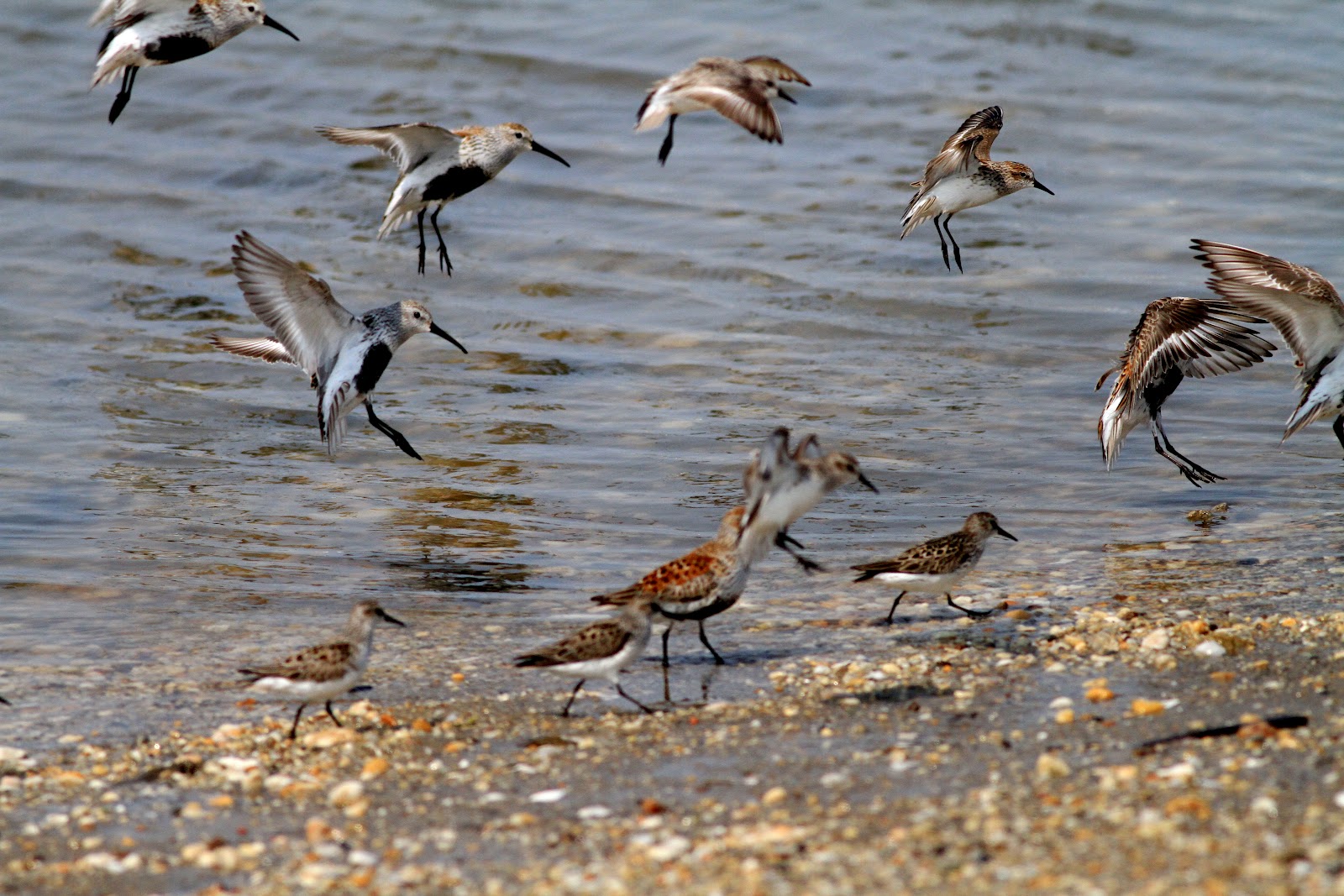 |
| Dunlin and Semis (Semipalmated Sandpipers) coming in for a landing |
 |


Tuesday, May 1, 2012
White-faced Ibis and Stilt Sandpiper at Heislerville
By Luke Musher
At the end of the day today I went over to Heislerville with my co-workers/roommates, Steph and Nick. Lots of new shorebirds out and about including Black-bellied and Semipalmated Plovers, Dunlin, Short-billed Dowitcher, Semipalmated and Least Sandpipers, a single Stilt Sandpiper (pretty rare in spring), Willet, Greater and Lesser Yellowlegs, and Ruddy Turnstone. Someone else had White-rumped Sandpipers (making a total of 12 species). I'll definitely be back in the morning to check it out again.
A White-faced Ibis was present with the Glossy Ibis on the south impoundment. I digiscoped some photos with my iPhone.


 |
| I'm adding this photo a little late, but it's just to show that I've had all three North American Ibises in two days! This White Ibis was present all day yesterday, 4/30/2012, at the Wetlands Institute near Stone Harbor, NJ. |
Sunday, April 29, 2012
Before the Levee Breaks...
By Luke Musher
As the weather continues to be poor for migration, birding continues to be relatively slow around Cape May county. The wise bird-master and much revered veterinarian-in-training, Ryan Ford, came into town today to bird with me. We started the morning off at Higbees Beach, expecting it to be slow, and had an okay morning anyway. 2 Ruby-throated Hummingbird, an American Redstart and an Indigo Bunting were first of years for us. We also had a few Ruby-crowned Kinglet, Black-and-white Warbler, Great-crested Flycatcher and the ubiquitous Prairie Warblers were other good spring birds. There were a number of White-throated Sparrows around as well, which, for whatever reason, was fairly surprising to me.
After that we head to Beaver Swamp to look at ibises - ibi? - with the hopes of pulling out a White-faced. When we arrived somebody claimed to have seen one, and perhaps he did. We looked for a LONG time, but most of the birds were far out and the heat distortion made it that much more difficult. Lots of Glossy Ibis, though, so definitely lots of potential. I'll probably be back. A Pine Warbler and singing Yellow-rumped Warbler were present in the patch of woods at the end of the trail.
Our last stop of the day was Heislerville. I was glad to see that the water levels had dropped a little since the last time I was there, though they still seemed high. Some shorebirds were present, though nothing of note - Greater and Lesser Yellowlegs, Semipalmated and Least Sandpipers, Dunlin, and Short-billed Dowitcher. 26 Black Skimmer were roosting on the middle island with the Herring, Ring-billed, Laughing, and Great Black-backed Gulls, and Forster's Terns. Heading back out along the dirt road, we saw our FOY Orchard Oriole.
Tonight, as I'm now looking at the radar, I'm thinking tomorrow we should get a number of new birds as the flood gates open tonight. I'm sure Drew Weber at Nemesis Bird will have a post on the night's migration in the AM. Until then, happy birding folks and check out the radar right now!
As the weather continues to be poor for migration, birding continues to be relatively slow around Cape May county. The wise bird-master and much revered veterinarian-in-training, Ryan Ford, came into town today to bird with me. We started the morning off at Higbees Beach, expecting it to be slow, and had an okay morning anyway. 2 Ruby-throated Hummingbird, an American Redstart and an Indigo Bunting were first of years for us. We also had a few Ruby-crowned Kinglet, Black-and-white Warbler, Great-crested Flycatcher and the ubiquitous Prairie Warblers were other good spring birds. There were a number of White-throated Sparrows around as well, which, for whatever reason, was fairly surprising to me.
 |
| Prairie Warbler, Higbees Beach, Cape May, NJ |
 |
| Prairie Warbler, Higbees Beach, Cape May, NJ |
 |
| Indigo Bunting, Higbees Beach, Cape May, NJ |
After Higbee we birded around Cape Island, but to be honest not too much of note was around. We checked everywhere from Sunset Beach to Poverty Beach to Bunker Pond to the Beanery to the Meadows. The only birds of note were a Prothonotary Warbler at the Beanery, Purple Sandpipers at the Canal jetty at Higbees beach, and the 3 Eurasian Collared-Doves at their usual spot.
 |
| Ryan told me that he has had trouble getting photos of Red-winged Blackbirds. Of course he didn't take his camera out for the meadows so I took this one just to rub it in. |
We then drove north through Wildwood, checking the coast guard ponds, Two-mile landing, and back bays, but turning up very little. We made our way north to Nummy Island where a number of shorebirds were hanging out. The only highlight here were about ten Whimbrel and a beautiful breeding plumage Red Knot in the few hundred other shorebirds that included Dunlin, Short-billed Dowitchers, and Black-bellied Plovers.
 |
| Red Knot (middle) with other shorebirds, Nummy Island, NJ |
 |
| Red Knot, Nummy Island, NJ |
Our last stop of the day was Heislerville. I was glad to see that the water levels had dropped a little since the last time I was there, though they still seemed high. Some shorebirds were present, though nothing of note - Greater and Lesser Yellowlegs, Semipalmated and Least Sandpipers, Dunlin, and Short-billed Dowitcher. 26 Black Skimmer were roosting on the middle island with the Herring, Ring-billed, Laughing, and Great Black-backed Gulls, and Forster's Terns. Heading back out along the dirt road, we saw our FOY Orchard Oriole.
Tonight, as I'm now looking at the radar, I'm thinking tomorrow we should get a number of new birds as the flood gates open tonight. I'm sure Drew Weber at Nemesis Bird will have a post on the night's migration in the AM. Until then, happy birding folks and check out the radar right now!
 |
| Radar Right Now (~9PM) from NOAA website. |
Saturday, April 28, 2012
Cape May to West Cumberland County Birding
By Luke Musher
I went birding today with Nick Tolopka, whom I work with on the shorebird banding project for Dr. David Mizrahi at NJ Audubon. We drove down the bay shore looking for shorebirds, but no Red Knots at either Reeds or Kimbles Beach. At Reed's Beach there were lots of Sanderling and Dunlin, though, along with, oddly enough, two Snow Geese, one adult and one juvenal, on the jetty.
We then drove down to Cape May where we stopped at the point and the Meadows. Still lot's of swallows around the area, mostly Barns, but all expected species were present. We couldn't seem to find any Piping Plovers on the beach (but they're certainly there), but had great views of several American Oystercatchers. Not much of note around Cape Island, and the wind was strong and cold so we decided to head north.
We drove up to Stone Harbor passing through Wildwood and Nummy Island. In Wildwood a Yellow-crowned Night-Heron flew over the car, and then we stopped by a spot where they've been nesting for a few years. Nummy Island was relatively quiet, as was Stone Harbor. We weren't there long, but the only shorebirds we could find at Stone Harbor were Sanderling, Dunlin, and Semipalmated Sandpipers.
To top the morning off we followed up a KeeKeeKerr alert for an American Golden-Plover (thanks to Brian Johnson for posting) on Shep Davis Road in Cumberland county. I needed it for the year, and Nick for life, so we head over to try our luck. We drove down the few miles of road, checking every inch of farmland (at least trying to), but had no luck. We got literally to the end of the road and noticed a Killdeer flying around and calling above a large grassy field on the edge of a recently harvested asparagus field. We scanned the grassy area hard and eventually turned up two large plovers very far away. I got out to scope and walked a little closer. As I walked out though, I flushed about 5 or so Black-bellied Plovers that we had somehow missed when scanning. I had at least one American Golden-Plover in the fields, and possibly two. I have distant, crappy photos of the second bird, that I am fairly sure is another one, but I'm not positive that it is. If anyone wants to see the photos and give an opinion, email me (boomchachalaca@gmail.com).
On our way back we stopped briefly at Turkey Point, but the tide was high so we didn't stay long.
 |
| American Oystercatcher, Cape May Migratory Bird Refuge, Cape May, NJ |
We then drove down to Cape May where we stopped at the point and the Meadows. Still lot's of swallows around the area, mostly Barns, but all expected species were present. We couldn't seem to find any Piping Plovers on the beach (but they're certainly there), but had great views of several American Oystercatchers. Not much of note around Cape Island, and the wind was strong and cold so we decided to head north.
 |
| American Oystercatcher, Cape May Migratory Bird Refuge, Cape May, NJ |
 |
| Yellow-crowned Night-Heron, Wildwood Crest, NJ |
 |
| Mixed Shorebirds, Stone Harbor, NJ |
 |
| Black-bellied Plovers, Shep Davis Rd., Cumberland Co., NJ |
 |
| American Golden-Plover, Shep Davis Rd., Cumberland Co., NJ |
 |
| Willet, Turkey Point, Dividing Creek, NJ |
 |
| Sure, Herring Gulls are a "Trash Bird," but you have to admit that they can look pretty stunning from time to time. |
Subscribe to:
Posts (Atom)