Showing posts with label Shorebirds. Show all posts

Friday, May 24, 2013

Shorebirding on the Delaware Bay and an ID quiz of sorts

By Lukas Musher

On Tuesday I drove down to southern NJ to help David Mizrahi of NJ Audubon with his shorebird project that I worked on last year.  He didn't have me do any banding, bleeding, netting, or flagging.  Instead he had me go onto the beach and re-sight flagged Semipalmated Sandpipers.  The beaches are off limits this time of year due to shorebird migration, so I was very lucky to be able to get up and close with the birds themselves, and to get some phenomenal photographic opportunities.  

As I have talked about in the past, several species of shorebirds stage along Delaware Bay each Spring in coincidence with the spawning of the horseshoe crabs.  The fat-rich horseshoe crab eggs provide an invaluable calorie source for the migrating shorebirds, enabling them to finish their journey north to the breeding grounds in the high arctic.  

Fortescue is often one of the best places on the Delaware Bay shore to see the staging shorebirds, and that's where I was.  Above, you can see a few thousands shorebirds or several species (predominantly Semipalmated Sandpiper, Red Knot, Ruddy Turnstone, Sanderling, and Dunlin) roosting on the beach, and getting ready to begin feeding as the tide goes out.
Ruddy Turnstones are one of my favorite shorebirds, and what they lack in rareness, they make up for with charisma – or as Richard Crossley puts it, they are "the sausage dog of birds."
 Semipalmated Sandpipers greatly outnumber all other species, and yet they are one of the most severely declining shorebirds on Delaware Bay.  Red Knots are more famous, but in fact their numbers may be recovering, perhaps due to a strict moratorium on the harvesting of horseshoe crabs in the bay.  David Mizrahi has been studying this small and plain, albeit fascinating Calidris sandpiper for twenty years.  One of the biggest conservation concerns for this species has always been rampant hunting for food many countries throughout Latin America.

 I spent a lot of time scoping and sorting through the tens of thousands of birds looking for flags.  I found Red Knots from Argentina, Ruddy Turnstones and Sanderlings banded in previous years on Delaware Bay, and Semipalmated Sandpipers banded on the bay and two that were banded in Brazil.  I got tired of scoping, though, and took asylum behind the remnants of a disintegrating wooden fence covered in mold and algal residue.  It provided me with enough cover so that I could sit patiently as the shorebirds walked within ten feet of me allowing for fantastic photo ops.
A group of mostly Dunlin and Red Knot begin to take flight as I am noticed from behind the wooden remains.

A Semi banded on Delaware Bay!


One of several Red Knots I found that were flagged in Argentina!
Another D-bay Semi!


Exhausted by their long flights from South America and in preparation for the long flight to the arctic, Semipalmated Sandpipers recover and feed ferociously on the fatty crab eggs.

Incoming!  The Semipalmated Sandpiper landing on the right was flagged on Delaware bay by David's team.
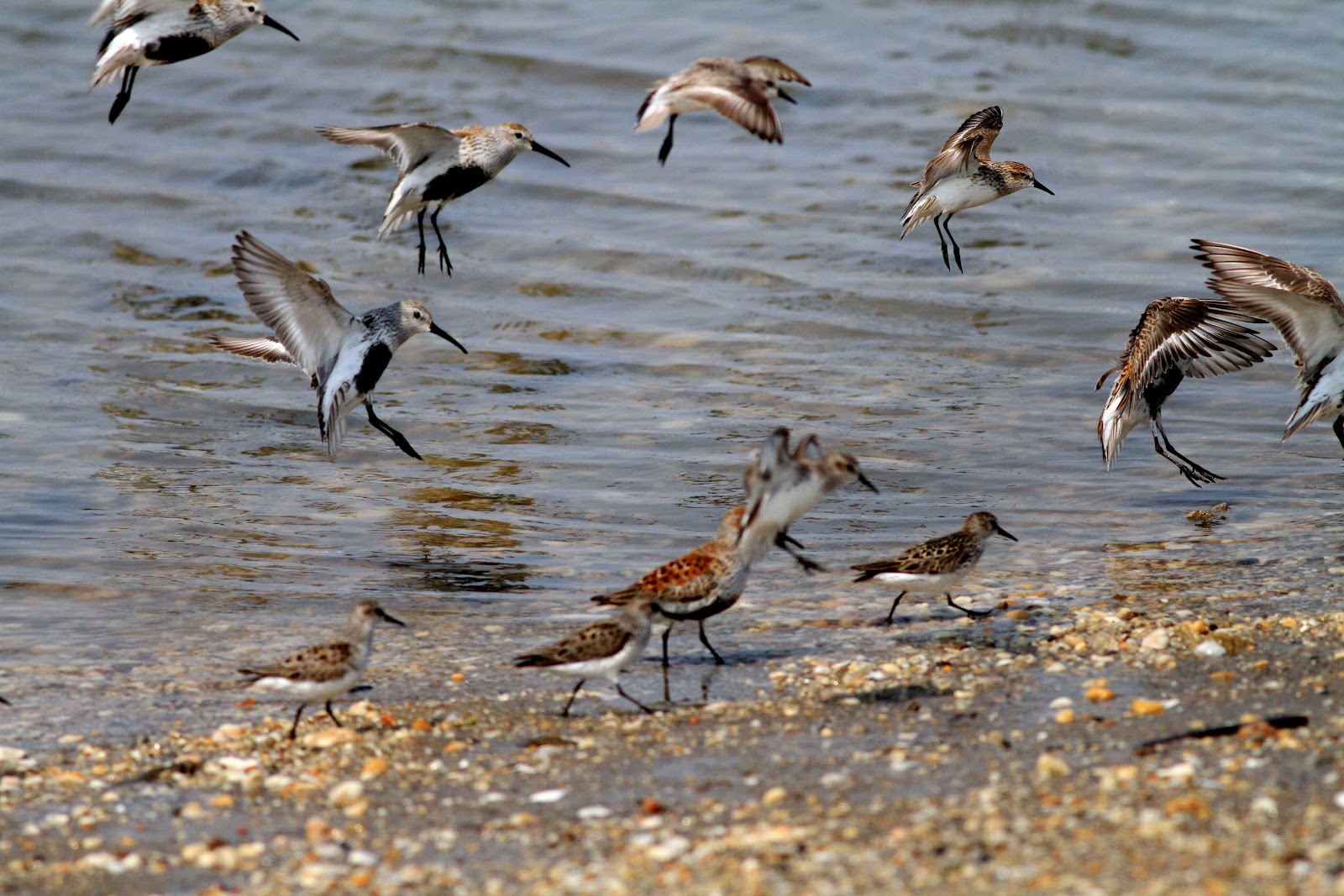
Dunlin, Semi Sandpipers, and a Red Knot take flight, as the rest of the weary flock, including a couple of Short-billed Dowitchers, anxiously scamper forward.
Perhaps the most charismatic and infamous of North American shorebirds, a Red Knot in flight steals the frame from the other species taken to wing.
I may have spooked these Dunlin and Semis, but they know where they want to feed (AKA where the eggs are) and they come right back in to where they were before after two to three laps around the beach.
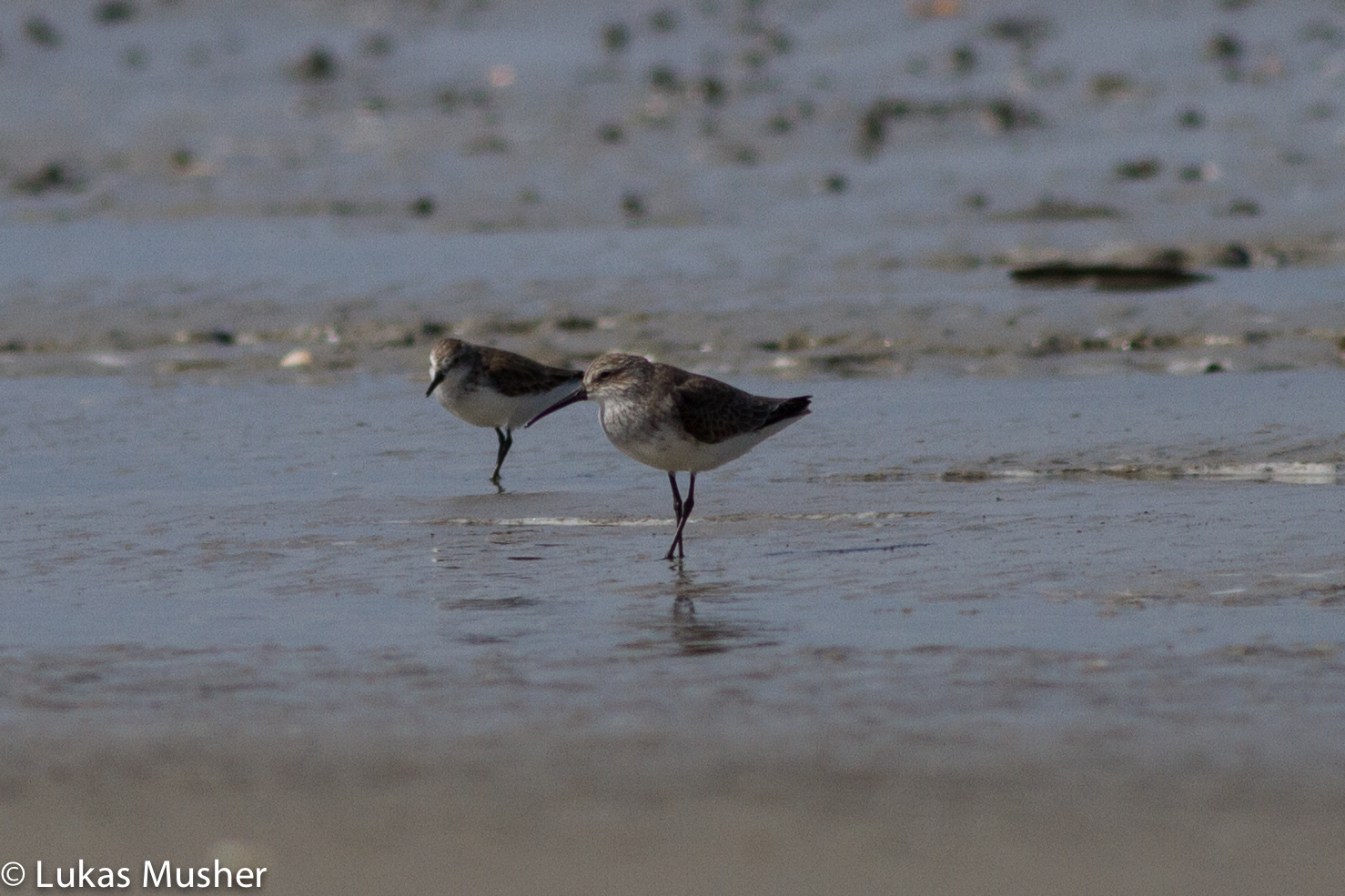
Finally, I leave you with a few photos of this bird.  I believe this to be a male Western Sandpiper, and upon consulting an expert, he agreed, though said he could not be 100% certain without photos of the underside.  I can tell you this, though, the bird was stockier and ever so slightly larger than the other Semis, and I remember thinking right away that it could be a Western based on build, rufous tones on the upper parts, and longer breast streaking than the typical Semi.  I welcome other opinions on this bird so feel free to post thoughts in the comments.  If it is a Western Sandpiper, this late date in NJ would make it very, very rare.  I will also be consulting more experts over the next few days, so maybe we can figure something out....most likely there won't be consensus.
Note rufous tones on scapulars, cheek, and cap, relatively long bill (though on the small side for Western, making it a likely male if confirmed), and blocky (not round like Semi) head.  I personally see some streaking making its way down the flanks, which Semi doesn't have.

He looks fat from this angle, more in favor of Western in my opinion.
I hope you enjoyed this post.  Don't forget to follow us on our new Twitter @boomchachalaca and like our facebook page.


Wednesday, February 13, 2013

The Shorebirds of Coroa Dos Ovos

Well I'm back from Brazil, and excited to start posting again.  As I mentioned, the main purpose of my visit to northern Brazil was as part of a project run by David Mizrahi at New Jersey Audubon to band and flag Semipalmated Sandpipers (Calidris pusilla) on their wintering grounds.  We had a very successful trip, banding 1600 birds in just 8 days of netting.
Semipalmated Sandpipers on Coroa Dos Ovos
The island we were on was called Coroa Dos Ovos, which is Portugese for Crown of the Eggs.  It is a very long sandspit that becomes an island at high tide and connects to the mainland during low tide.  There are several species of regularly occurring shorebirds here such as American Oystercatcher, Whimbrel, Willet, Greater Yellowlegs, Sanderling, Red Knot, Semipalmated, Black-bellied, Wilson's, and Collared Plovers, Short-billed Dowitcher, and of course Semipalmated Sandpiper.  Interestingly enough, all of these species (except American Oystercatcher, Wilson's Plover, and Collared Plover) can be seen feeding in the mangroves at low tide, a behavior that is very difficult for us to imagine in North America.

The tides in this area are extreme.  Low tides expose rich substrate in the mangroves, and create extensive mudflats between Coroa Dos Ovos and the mainland on which the shorebirds forage.  At high tides, birds are pushed up into the mangroves and onto the island to roost.  It was not uncommon to see Whimbrel and Willet roosting in mangrove trees (weird to those of us used to seeing them in salt marsh)!  At extreme high tides, many more birds are forced out of the mangroves to roost on Coroa Dos Ovos.
Whimbrel and Semipalmated Sandpipers roosting in the mangroves
We concentrated our efforts right around the full moon, allowing for the highest tides, and we were not disappointed.  Up to 10,000 Semipalmated Sandpipers, and hundreds of Willets, Whimbrels, Sanderling, and Black-bellied Plover, dozens of Short-billed Dowitcher and Red Knot, and several other species of shorebirds and terns were found roosting on the island.  We caught sometimes more than 300 birds in a night.

One of the Western Sandpipers we captured – an after second year (adult).  Note the dark centers to the back feathers, dark tertials, and little bit of rufous on one or two scapulars (leftover from breeding plumage).
The most exciting part about this was the number of rare shorebirds that could be found in these flocks. While scanning for flagged Semipalmated Sandpipers, I located a Curlew Sandpiper (Calidris ferruginea), and Tom Magarian spotted the first few Bar-tailed Godwits of which we eventually had a high count of 14!  We captured a total of 4 Western Sandpipers, and I found one long-billed individual mixed in with the semis once as well.
Curlew Sandpiper
Curlew Sandpiper
Curlew Sandpiper
Up until last year there were no records for Western Sandpiper on the Atlantic coast of South America (last year our team minus me caught two).  There are not many records for Bar-tailed Godwit for Brazil (not certain of the exact number), but last year the team had the first record for the state of Maranhão with a count of 12 individuals.  There are no published Curlew Sandpiper records for Brazil, but we just found out about a photograph of an individual from 2010.  That makes our bird the 2nd for Brazil, and the first for the state of Maranhão.
Whimbrels and 13 Bar-tailed Godwits (and a Willet that you can't really see)
And again, can you find all 13?
Here's 1-8
...and here is 5-13
And here is the 14th Bar-tailed Godwit, with Whimbrel and Gull-billed Terns (the tern in the bottom left is a Yellow-billed Tern)

~Luke

Thursday, January 17, 2013

Off to Brazil

I'm off to Brazil for three weeks to band shorebirds.  I'll post photos and stories when I return.

Take care, and happy birding –

Luke

Monday, May 28, 2012

Photo Study of Semipalmated Sandpipers at Kimble's Beach, NJ

By Luke Musher
As you may know we've been banding lots of Semipalmated Sandpipers, so naturally I've had a lot of opportunities to photograph them.  Here are some recent photos I took at Kimble's Beach in Cape May county, while banding some Semis caught in cannon nets by the international shorebird team earlier this week.
With a Ruddy Turnstone.
Eating tasty horseshoe crab eggs

The word semipalmated means partially webbed.  Here you can see the webbing in between their toes.


Saturday, May 26, 2012

Banded Shorebirds on Delaware Bay

By Luke Musher

Since the mid 1990's biologists have been banding shorebirds along the Delaware Bay shore, a body of water that is an incredibly important stopover site for hundreds of thousands of shorebirds including Red Knot, Ruddy Turnstone, Sanderling, Semipalmated Sandpiper, and many other species.  The main reason that the bay is so critical is the coincidence of shorebird migration and the spawning of horseshoe crabs. Many shorebirds double their weight during their time spent at Delaware Bay, building important fat stores for migration by consuming the crab eggs that become exposed on the beaches, river mouths, and even marshes.
Part of the 1%.  A Semipalmated Sandpiper banded along the Delaware Bay shore in 2010  or earlier that  we recaptured last week.
One method that biologists are using, including the team I work on studying Semipalmated Sandpipers (hereafter SESA), is putting colored flags with unique codes on the birds.  These birds can then be re-sighted by birders.  The recapture rate of these banded shorebirds is roughly 1%, but by flagging the birds biologists can get a 10% return.  Thousands of Red Knots, SESA, Sanderling, and Ruddy Turnstone have been flagged both on Delaware Bay, and on their wintering grounds in South America, and each location has its own flag color.  For example, while woosh-netting at Fortescue this week, we re-sighted a Red Knot with an orange flag.  Although we could not get a combination from it, we knew it had been banded in Argentina by the color of the flag.
One of a few hundred Red Knot present at Fortescue last week, and one of only a few that was flagged.  [Photo by Luke Musher]
Biologists have long pointed out that the shorebirds are feeding almost exclusively on the horseshoe crab eggs while they are here, but certainly many thousands of birds feed elsewhere, away from exposed eggs such as on mudflats in the back bays and marshes at low tide.  The work I am doing with NJ Audubon is continuing what has been done along Delaware Bay for the past two and a half decades, but also supplementing those data with information on what these birds, specifically SESA, are eating.

By taking blood from the shorebirds, we can not only use genetics to find out the sex of each individual we capture, but also fairly accurately evaluate the diet of these shorebirds as they stopover along the bay.  For example, horseshoe crab eggs and marine invertebrates that shorebirds feed on in mudflats have different isotopic signals.  I wont go into too many details about how stable isotopes work or what they even are (this will most certainly bore you and me and probably stable isotope chemists as well), but I will tell you some basics.

Essentially, you are what you eat.  Organisms are made up of, molecularly speaking, the organisms they consume.  If a SESA eats strictly horseshoe crab eggs for days, its blood plasma will contain fatty acids that match the proportion of stable isotopes that are found in the eggs.  This is important because biologists want to know what will happen if horseshoe crab populations continue to plummet.  Will shorebirds be able to replace a diet of mainly crab eggs with other food sources?
A Semipalmated Sandpiper on Kimble's Beach, NJ just after I bled it.
Needless to say, it is very stressful for shorebirds to be netted, handled, and bled.  They already have a long, highly energy-demanding journey to complete without being consumed by predators such as Peregrine Falcons or Merlins.  They only have a short period of time to build the fat stores they need to get to the arctic, and even begin breeding (early arriving individuals may precede the availability of invertebrate prey in the arctic).  However, the more we can learn about how shorebirds utilize migrations stopover sites and wintering grounds, the more we can help to manage their populations and maximize conservation efforts.

One of the greatest parts of this project is that you, aka birders, can help too!  Many people see flagged or banded birds and report them to the USGS or biologists working in Delaware bay, and are helping tremendously with shorebird conservation efforts. Still, many people see flagged birds and never report them.  Perhaps they don't know how to do so, or don't think it matters.  If you see a flagged bird along the east coast (or anywhere for that matter), try to write down the code and flag color.  It is now incredibly easy to report flagged birds.  Delaware Bay shorebird biologists created a website, bandedbirds.org.  Go on and check it out.  There's lots of great information on the project, the birds, and how to report the flags you see.  So if you're going out this month, or ever, looking at shorebirds, don't forget to look at the legs of the birds as well as plumage and structure, and write down your sightings.  Good birding1

Saturday, May 19, 2012

The Fortescue Feeding Frenzy

Red Knots, Dunlin, Sanderling, Semipalmated Sandpiper, Short-billed Dowitcher, Laughing Gull, etc.  See if you can pick out all these species.
Thursday and Friday this week we were woosh-netting and mist-netting at Fortescue Beach along the Delaware Bay Shore, a great spot to see the horseshoe crabs spawning and the shorebirds feeding on their fat-rich eggs.  One of the main parts of my job is taking blood from the shorebirds we catch.  The blood is then used to detect what the birds are feeding on.  Horseshoe crab eggs have a stable isotope signal that is different from that of other prey items (e.g. polychaete worms) and is detectable in the blood.  The birds at Fortescue are undoubtably feeding almost entirely on horseshoe crab eggs, and that is why we see thousands of birds there while the crabs spawn.  We had a good amount of luck there those two days, catching close to 200 birds total.  Here are some photos of the beautiful masses of shorebirds you can see there.
Red Knots, Dunlin, Sanderling, Short-billed Dowitcher, and Laughing Gull
More of the same
Dunlin and Semis (Semipalmated Sandpipers) coming in for a landing