Showing posts with label boom. Show all posts

Thursday, May 23, 2013

BOOM....Grassland Birds

By Cory DeStein


The Imperial Grasslands in Allegheny County is a large reclaimed strip mind with impressive grasslands, wetlands, and shrub habitat. The area has a long history when it comes to property development,  trespassing and some remarkable bird records for the county. In the past Blue Grosbeak and Short-eared Owls bred in the area. In the winter White-winged Crossbills, Common Redpolls, Northern Shrike, and Rough-legged Hawks can be viewed here. The area known to local birders as Main Pond has held impressive records such as; Snowy Plover, American Avocet, Whimbrel, Western Sandpiper, Buff-breasted Sandpiper and all three phalaropes. For my walk this week I was able to enjoy breeding birds such as Bobolink, Eastern Meadowlarks, Prairie Warbler, Blue-winged Warbler, Henslow's Sparrow, Vesper Sparrow, Savannah Sparrow and Grasshopper Sparrows.
Just 1 of 30 Grasshopper Sparrows
Hitting the area at sunrise I immediately stumbled upon a Black Rat Snake being scolded by Prairie, Yellow, and Blue-winged Warblers. With my accidental interruption the reptile retreated to denser cover and the birds went back to their business. Coming to extensive grasslands I could hear Eastern Meadowlarks, Grasshopper Sparrows, and Vesper Sparrows singing. A Red-winged Blackbird chased a male Bobolink across a small pond where 4 Lesser Yellowlegs were feeding. Scanning the fields I spotted another male Bobolink singing, the bird was exceptionally tame and allowed me to approach within a respectable distance for some photography.
Male Bobolink
While photographing the Bobolink, I began to hear a new song being sung nearby, Henlow's Sparrow! This was a new bird in Allegheny County for me. I ended with at least 6 birds total for the day, including a very cooperative male singing from a nearby shrub.
Allegheny County Henslow's Sparrow!
Baltimore and Orchard Orioles, Yellow Warbler, Hooded Warbler, Wood Thrush, Great-crested Flycatcher as well as a Yellow-breasted Chat were singing from a nearby woodlot as I worked my way back to the car. Sadly this ever shrinking grasslands continues to be threatened with development  The ponds are drained, new roads are paved, and new construction flags seem to appear daily. I am only enjoying a small portion of what the grasslands was when birders began heavily using it in the 90's. Interesting in one of the new industrial parks a small pond was developed which held a pair of Ross's Geese in 2011, Red Phalarope in February of 2012!!? And breeding Sora this past summer. Time will tell what development holds in store for this unique area.
Eastern Meadowlark 

Male Bobolink

Eastern Meadowlark 

Thursday, May 16, 2013

An Introduction to Fayette County

By Cory DeStein


Hi everybody! My name is Cory DeStein, I am a birder from Pittsburgh, Pennsylvania. I have joined Cory and Luke here as the newest contributor to Boom. Unlike these guys, I actually do not work in the bird field, I am a nurse at a pediatric hospital in Pittsburgh. I bird strictly for hobby! My goal is to be able to share with you all my birding adventures in Pennsylvania, birding trips through out the country, photography, and my amusing adventures with attempting to increase my yard list. 

This spring I have dedicated nearly all of my time birding to Fayette County in the southwest region of Pennsylvania. For the month of May I have reached 90 species for an area, State Game Lands 51 near the town of Dunbar. This large game lands contains rhododendron lined thickets along Dunbar Creek with a nearly 800ft elevation gain to the Zebley Flats area, a primarily secondary growth forest with multiple access roads along the Chestnut Ridge. It's a great area for countless hours of exploring. I began birding this particular patch in 2009 when I first got into birding. I went without any maps or knowledge of the area and began exploring, each day I continue to find new and interesting gems in the massive location. Golden-winged Warblers have bred through out Zebley Flats, and I have had 2 sightings of Northern Goshawk over the years. Mammal highlights have included American Black Bear, Gray Fox, and Fisher! Allegheny Woodrat breeds in the area, but I have not found one...yet! I have also had 9 species of reptile and 7 species of amphibians.
Kentucky Warbler along Dunbar Creek. 
I started the morning off along Dunbar Creek, the drive in was loaded with Kentucky Warblers, Louisiana Waterthrush, Worm-eating Warblers and Wood Thrush. From the parking area I picked up plenty of Magnolia Warblers, Song Sparrow, House Wren, as well as a Great-blue Heron fishing in the creek. Working my way up the ridge through the hemlocks I caught sight of a Swainson's Thrush lurking in the underbrush. Climbing up the ridge I continued to enjoy plenty of Worm-eating Warblers as well as Northern Parula singing from the eastern hemlocks. 
Worm-eating Warbler
At the mid-way point up the mountain you come to a clearing with multiple food plots, fruit trees, and dense underbrush. This has worked out to be one of the better migrant traps I have come across here. Kentucky Warblers continued to call in all directions as well as Louisiana Waterthrush. A Wilson's Warbler popped up from the brush along with the White-crowned and White-throated Sparrows. Red-breasted Nuthatches were calling from the larches a bird I have never had breeding here, but appears that this year they are. Accompanying the nuthatches in the trees were at least 5 Rose-breasted Grosbeaks feeding with the males singing up a storm. Carefully checking the fruit trees I was able to add Magnolia, Nashville, Tennessee, Hooded, Black-and-white, and Black-throated Green Warblers to my day list as well as a nearby singing Winter Wren. 
1 of 5 Rose-breasted Grosbeaks in a single tree!
Conquering the final stretch of the climb to the flats I was able to grab Blue-headed, Red-eyed, Yellow-throated and Warbling Vireos as well as Ovenbirds calling non-stop. Upon reaching the top of the ridge I could hear Yellow-billed Cuckoo calling, but it was hot as hell and I wasn't going to go looking for it. Covering just a short distance along the access road the growth along the path was filled with Indigo Buntings, Chestnut sided and Hooded Warblers with plenty of Field and Chipping Sparrows adding to the mix before I ventured back down to my car. I ended today with 62 species during my hike and reached 97 species for SGL 51 this year. 
Chestnut-sided Warbler were EVERYWHERE

The most cooperative Winter Wren

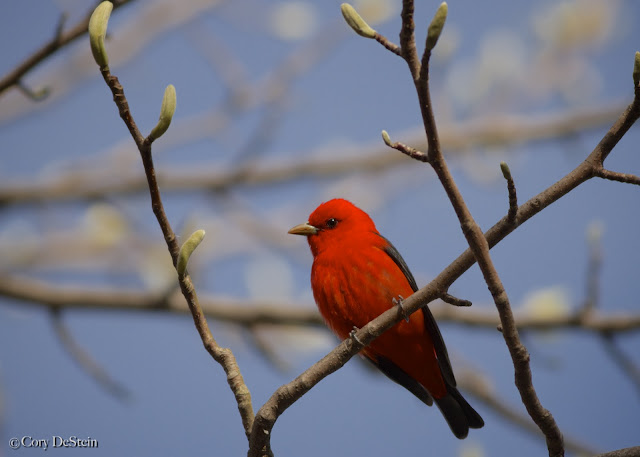
Scarlet Tanager
I hope everyone enjoyed this introduction to me as well as spring birding in Fayette County, I hope to be able to add more from this area (like when I find a Swainson's Warbler!!) and much more! Thanks for reading! 

Tuesday, December 27, 2011

Still scrambling to pick up a few more year birds but with no luck!

Anna Fasoli of Speed Birding recently pointed out to me that I was in the eBird top 100 for my 2011 ABA (American Birding Association) area list.  I hadn't been checking my ranking since before I came out to California, but I'm glad she noticed that I was barely hanging on, now tied for 92nd place with 424 species (that's just over 50% of all the birds seen in the ABA area this year).  It's been a great year, but several birds relatively common in California remain to be added to the list.  Yesterday afternoon I went looking for Pygmy Nuthatches at the Bolinas Cemetery, although with no luck.  Nothing spectacular was around, but I did get to spend time watching and photographing some of the more common species; more than 6 White-throated Sparrows (a fairly good count for this part of CA), Song, White-crowned, Golden-crowned and Fox Sparrows, a few California Towhees, loads of Dark-eyed "Oregon" Juncos, Downy and Acorn Woodpeckers, Anna's Hummingbirds, Bushtits, and Chestnut-backed Chickadees. I also had 2 first winter male Eurasian Wigeons with the usual wigeon flock across the street from the Bolinas school.

Here are a couple of photos from yesterday:
California Towhee, Bolinas Cemetery, Bolinas, CA [Photo by Lukas Musher]
Dark-eyed Junco, Oregon race, Bolinas Cemetery, Bolinas, CA [Photo by Lukas Musher]

Tuesday, December 20, 2011

Gull Watching: Little Gull

So I'm taking a break from the large white-headed gulls to show you Little Gull.  This is one of my favorite gulls.  These photos were taken on an overcast, snowy day this past February, so please excuse the slightly off focus and mediocre lighting on some of them.
First cycle Little Gull.  Note black ulnar bars creating M on upperparts, light gray mantle and scapulars, slate-colored cap, and dark black carpal patch.  Size, although not obvious here, is smaller than Boneparte's and Black-headed Gulls. Feb. 2011, Dunkirk, NY [Photo by Lukas Musher]
First cycle Little Gull. Note wing pattern (as above), short tail, short, relatively straight bill, and rounded wings. Feb. 2011, Dunkirk, NY [Photo by Lukas Musher
First cycle Little Gull.  Note shape, structure, and pattern of upperparts same as above.  Feb. 2011, Dunkirk, NY [Photo by Lukas Musher]
Adult Little Gull.  Note structure same as above. gray upperparts with pale wingtips. Feb 2011, Dunkirk, NY [Photo by Lukas Musher]
Adult Little Gull.  Note, underwing pattern distinctive, all black.  No other North American gull shows this combination of pale upperparts and dark underwing.  Wings rounded, bill short and straight. Feb. 2011, Dunkirk, NY [Photo by Lukas Musher]
By Luke Musher

Friday, December 16, 2011

Gull Watching: Glaucous Gull

So I don't have any photos of adult Glaucous Gulls, but I have some photos of a first cycle bird that I think could be cool to share on the blog.  I wish I had some adults to share, but we'll have to do without.  Adults will have the same structural features and will be very pale gray on the upperparts with white wing tips and yellow bill.  Let's look at the first cycle bird though.
First cycle Glaucous Gull. Note long heavy bill, flat crown, large and stocky in size and shape, and mostly white plumage.  Bill brightly bicolored, pink-based and black-tipped.  February 2011.  Pelagic out of Lewes, DE. [Photo by Lukas Musher]
Glaucous Gull with Herring Gull. Note whitish plumage and wings.  February 2011. Pelagic out of Lewes, DE. [Photo by Lukas Musher]
See previous posts for species list in this photo.  First cycle Glaucous Gull (center-right).  Note that this bird is large and heavy-bodied with broad wings and a large pink and black bicolored bill, flat crown with bulging forehead.  White with brown wash, and nearly white flight feathers. February 2011. Pelagic out of Lewes, DE. [Photo by Lukas Musher]
Presumed "Nelson's" Gull, Herring X Glaucous Gull hybrid.   Note structural features similar to pure Glaucous Gull, with darker plumage (though still rather pale), brownish flight feathers, and heavy bicolored bill.  February 2011.  Pelagic out of Lewes, DE. [Photo by Lukas Musher]

Compare these photos with first cycle Iceland Gull (to come).

By Luke Musher

Wednesday, December 14, 2011

Gull Watching: Lesser Black-backed Gull

Our next gull is a cool one, Lesser Black-backed Gull.  This dark-backed can be superficially similar to other dark-mantled gulls and even Herring Gull.  Let's look at some photos, including one interesting bird in Spain.
Four Gull Species.  Clockwise from left (ignore right-most cut-off gull): adult Herring Gull, adult Lesser Black-backed Gull (LBBG), adult Herring Gull, 2 Adult Herring Gull, first cycle Great Black-backed Gull, first cycle Glaucous Gull, Adult Herring Gull, second Cycle (?) Herring Gull.  For LBBG, note darker upperparts than adult Herring Gulls, lone white spot on P10 (outermost primary) only, long slender wings, white tail.  February 2011. Pelagic out of Lewes, DE. [Photo by Lukas Musher]
Adult Lesser Black-backed Gull (right) with first cycle Great Black-backed Gull (GBBG, left).  For LBBG, note relatively short yellow bill with red gonydeal spot, rounded head, slender neck (although this character is amplified by the fact that its neck is outstretched), yellow legs, heavy streaking on head and neck, especially around the eye, primaries and secondaries appear dark gray from underneath.  Compare heavy-set, stocky appearance to GBBG February 2011. Pelagic off of Lewes, DE. [Photo by Lukas Musher]
Molting adult Lesser Black-backed Gull.  Note, obvious molt occurring in primaries, primary coverts, rectrices, and greater coverts.  Shortened greater coverts expose white bases to secondaries giving the appearance of white patches where there usually are none.  Primary coverts are white, although this is unusual in American birds as far as I know (Steve Howell says it's common in Europe).  Also note many of the same features as above. September 2010.  Cadiz, Spain. [Photo by Lukas Musher]
Adult/third cycle Lesser Black-backed Gull (center), first cycle Great Black-backed Gull (left center), and Herring Gulls (most other gulls).  For LBBG note, mostly same features as above except for black splotch on bill.  February 2011. Pelagic off of Lewes, DE. [Photo by Lukas Musher]
Herring Gulls, adult Great Black-backed Gull (bottom left), and second cycle Lesser Black-backed Gull (indicated by arrow).  For LBBG note fairly clean white uppertail coverts contrasting with black tail, brown wings with dark gray back, same structural characters as above (e.g. slender, round headed, etc.). February 2011.  Pelagic off of Lewes, DE. [Photo by Lukas Musher]
Feel free to post with questions, comments or concerns.

By Luke Musher

Tuesday, December 13, 2011

Gull Watching: Herring Gull

Sorry about the delay on my second gull post.  In the future, I'll try to post a new gull every day, but I may take two days to do so from time to time.  Anyway, back to the gulls.  Let's look at some photographs of Herring Gulls.  I unfortunately couldn't find any photos of Herring Gulls standing or even sitting on the water in my files, so bear with the photographs.
Adult Herring Gull (left) with Great Black-backed Gull.  Note size, fairly large, although clearly smaller than Great Black-backed Gull, relatively skinny compared to other large gulls, pale gray upperparts, white tail, heavily streaked head and neck, pink legs. February 2011, Pelagic out of Lewes, DE. [Photo by Lukas Musher]
Adult Herring Gull. Note shallow forehead, relatively long bill, pale iris, pink legs, pale gray upperparts with black outer primaries, neatly streaked head and neck, red gonydeal spot.  February 2011.  Pelagic off of Lewes, DE. [Photo by Lukas Musher]
Herring Gulls of mixed ages. Clockwise from left, first cycle, second cycle, first (probably) cycle, adult, adult.  For all, note same structural features as above.  First cycle: note, black bill, pink legs, mostly brown plumage with nearly black primaries (not visible from underwing), indistinct streaks on breast and flanks.  Second cycle: note, dark outer primaries with contrastingly pale inner primaries, nearly black tail, pink-based and black-tipped bill, gray scapulars and mantle.  Adult (nonbreeding): note pale gray upperparts with neatly delineated black wing-tips, extensive streaking on head and neck, neat white tips on primaries. February 2011. Pelagic out of Lewes, DE. [Photo by Lukas Musher]
First cycle Herring Gull.  This individual is rather pale, but note relatively long, black bill, dark eye, indistinct streaking on breast/belly, shallow forehead, and other structural features same as above. March 2006, Platte River, NE. [Photo by Lukas Musher]
Feel free to post questions or comments.

By Luke Musher

Sunday, December 11, 2011

Gull Watching: Ring-billed Gull

Adult Ring-billed Gull, Lake Merit, Oakland, CA, November 2011. Note relatively small, yellow, tapered bill with black ring and lacking red gonydeal spot, dark orbital ring, pale iris, finely streaked head and nape.
First cycle Ring-billed Gull, Berkley, CA, February 2006.  Note relatively small, pink, tapered bill (yet stouter than Mew Gull) with black tip, dark iris, pink legs.  This bird is fairly typical, but also note retained juvenal upper wing coverts, distinct streaking on white head, and short to medium wing projection (shorter than California Gull).
Adult Ring-billed Gull (right) with Glaucous-winged Gull (left), Lake Merit, Oakland, CA, November 2011.  Note small size, yellow legs (brighter than adult California), small yellow bill with black band, pale gray mantle, distinct streaks on head and nape, short-medium wing projection.

By Lukas Musher

Friday, December 9, 2011

Gull Watching: Intro

As autumn quickly becomes winter, it's time to start watching gulls.  Rare gulls have been turning up across the country including a Black-tailed Gull in Ohio and Slaty-backed Gull in New York.  Recent reports from back in PA, NJ, and NY have me craving gulls here in CA.  I've been going out every so often to try to learn more about gull ID.  I am no expert, and many of the gulls that I see are never completely identified.  I used to be way overconfident about gull ID, but the more I watch gulls, the more I realize that there are so many bird out there that don't match the guides; hybrids are common and variation within species seems almost infinite.  Yet the more I watch, the more watching I want to do.

One of the great parts about living in Bolinas, CA is that the lagoon is only eight or so minutes away, and especially at low tide, all the main pacific gull species can be found.  I've seen California, Ring-billed, Mew, Herring, Western, and Glaucous-winged Gulls here, and many birds that looked good for Thayer's but never had a positive ID.  Nearby, in Petaluma, I've had a few of them, but I still have lots to learn about IDing gulls.  I have decided to write a short post every day for the next week or so showing a few photos of one species per day.  Again, I am no expert when it comes to gulls, but I accept the fact that I cannot ID every gull that comes my way, and am willing to work with that.  For most large, white-headed gulls I prefer to use structure first to ID, and then plumage/coloration, but there are obviously some exceptions here.  I won't even come close to showing every age, plumage or possible species, but I will share a few photos of some expected winter gulls in the lower 48.

For now, enjoy these photos of some gulls I have taken.  Look at the photos, and try to figure out what it is you are looking at.  If there are multiple birds in a photo, are they all the same species or mixed species? What species do you see?  What field marks do you see, even if you can't ID the bird downright?  Flip through your field guides, and see what you can learn and figure out.  Or perhaps you don't need a field guide to identify these birds.  That is fine, too.  I will post about the species in each photo tomorrow.
Feb. 2005, Berkley, CA [Photo by Lukas Musher]
Feb. 2011, Pelagic off of Lewes, DE [Photo by Lukas Musher]
Feb. 2011, Pelagic out of Lewes, DE [Photo by Lukas Musher]
Nov. 2011, Lake Merit, Oakland, CA [Photo by Lukas Musher]

By Luke Musher