Showing posts with label photos. Show all posts

Sunday, February 19, 2012

Recent Birding in the North Bay Area

Black-necked Stilt, Las Gallinas Wastewater Treatment Area, Marin county, CA 1/16/2012
It's been hard to find time to get birding in recently.  With all the recent bad weather we've had to make up a lot of banding days.  Most of our birding this week has been restricted to an hour or so in the late afternoon. Thursday, though, Cory and I were able to get a day off and do some birding around the North Bay area in Marin and Sonoma Counties.  Some of our recent highlights include Yellow-bellied Sapsucker (more on this to come), Burrowing Owl (Cory and I have spent a lot of time visiting and revisiting a good spot right by PRBO with no success until Tuesday), Blue-winged Teal (another bird we've been trying for in Marin county with no success until recently), Cattle Egret, Lewis' Woodpecker, Ancient Murrelets (two flyby individuals seen from Bodega head), Lesser Yellowlegs (a hard bird to get this time of year in the North Bay area), Golden Eagle, Nashville Warbler, Yellow Warbler, and Common Poorwill (seen along Mesa Road in Bolinas on the drive back to PRBO one night).
Nashville Warbler, Bodega Bay, CA 2/16/12 [Photo by Lukas Musher]
Orange-crowned Warbler, Bodega Bay, CA 2/16/12 [Photo by Lukas Musher]
This bobcat (so blurry) watched us as we walked back to our car after watching the Burrowing Owl on 2/14/12
Immature Lewis' Woodpecker, Sebastopol, CA 2/16/12 [Photo by Lukas Musher]
Cory's and my Marin county Northern Mockingbird, Las Gallinas WTA, 2/16/12 [Photo by Lukas Musher]
Yellow-rumped Warbler, Las Gallinas WTA, Marin county, CA 2/16/12
Very distant shot of Cory's and my Marin county Common Gallinule, Las Gallinas WTA, Marin county, CA 2/16/12
Say's Phoebe, Las Gallinas WTA, Marin county, CA 2/16/12 [Photo by Lukas Musher]
Turkey Vulture, Las Gallinas WTA, Marin county, CA 2/16/12 [Photo by Lukas Musher]
Adult male Northern Harrier, Las Gallinas WTA, Marin county, CA 2/16/12

By Luke Musher

Sunday, February 12, 2012

What's your Thayer's-type?

What a headache.  After spending a total of around ten hours this week looking at gulls at Fort Baker near Sausalito, CA this week, I have just about nothing to show for it.  We missed the Iceland Gull seen well early this week by many, and missed Slaty-backed Gull, of which there were as many as three!  Sure we had two different Glaucous Gulls on two different days (one first cycle, one second cycle), but I can't help but feel bitter, like I wasted my time.  Then again, I saw more Thayer's Gull's this week than I ever had in my entire life (roughly x100).  Though these were mostly first cycle birds, there were a lot of adults and in-betweeners as well.
Typical (?) First-cycle Thayer's Gull. Note: Short, relatively thin, straight, solid black bill, gently curved culmen, dome-shaped, dove-like head, though slightly sloped forehead, dark pink legs, dark iris, primaries darker than body and tertials with pale crescents at tips, tertial centers darker than coverts, checkered/barred wing coverts, scapulars mostly pale with dark centers giving a checkered appearance, tail with broad terminal dark band. [Photo by Lukas Musher]
Adult Thayer's Gull. Note: Bill and head structure as above, pale gray mantle, mostly gray primaries.  Very large subterminal mirror (white spot) on P10 (outermost primary) and relatively large mirror on P9 (second most distal primary), black restricted to outer web of primaries.  Streaked head (winter). [Photo by Lukas Musher]
Adult Thayer's Gull.  Head and bill structure as above.  Fairly dark iris, bright pink legs, apical spots (terminal white marks on primaries) relatively even generally becoming larger as you move anteriorly (tail to head) along the folded wing. [Photo by Lukas Musher]
Adult Thayer's Gull.  [Photo by Lukas Musher]
A somewhat dark first cycle Thayer's.  Pale crescents at tips of primaries beginning to wear off.  [Photo by Lukas Musher]
First cycle Thayer's Gull.  Note: Dark secondaries with pale tips, dark outer primaries, pale inner primaries.  Rather checkered-looking median coverts. [Photo by Lukas Musher]
Adult Thayer's Gull.  Note: Bill/head structure as above, small gonydeal bulge (variable, but generally smaller than  herring and other larger-billed gulls), deep pinkish-purple orbital ring, dark yellow-honey iris. [Photo by Lukas Musher]
First cycle Thayer's Gull.  [Photo by Lukas Musher]
First cycle "Kumlin's" Iceland Gull for comparison.  Kumlien's Gull has been treated variously as a hybrid Iceland x Thayer's, and a subspecies of Thayer's or Iceland.  Currently it is categorized as a subspecies of Iceland Gull: Larus glaucoides kumlieni.  [Photo by Lukas Musher]
Kumlien's Gull again. [Photo by Lukas Musher]

By Luke Musher

Friday, February 3, 2012

Sierras Birding Trip with the Gang

Cory and I have been wanting to take a trip to the Sierra Nevada mountains for a while, now, and on Tuesday all the PRBO interns took off so that we could do so.  There were a few lifers that we were hoping to get and lots of year birds.  We started the trip off by listening for owls, hoping for Northern Pygmy-Owl, Northern Saw-whet Owl, and Spotted Owl among others.  However we only got Northern Saw-whet, Great Horned, and Barn Owls.  Not a bad start.  For whatever reason, birds were mostly NOT cooperative, and most of Luke's photos were pretty poor from the trip, but enjoy them anyway!
Clark's Nutcracker, Fay-Luther Trail, CA [Photo by Lukas Musher]
We camped in the eastern foothills just south of Lake Tahoe on BLM (Bureau of Land Management) land on the border of Nevada and California.  Tuesday Morning we hiked up the Fay-Luther Trail specifically looking for Townsend's Solitaire and White-headed Woodpecker.  Although we missed the solitaire, we found a number of good birds including White-headed Woodpecker, Williamson's Sapsucker, Clark's Nutcracker, Pygmy and White-breasted Nuthatches, Ruby-crowned Kinglet (apparently fairly uncommon in winter), White-crowned Sparrow, Golden-crowned Sparrow, Black-billed Magpie, and lots of Red-tailed Hawks (including a dark morph).


Williamson's Sapsucker (terrible photo), Fay-Luther Trail, CA [Photo by Lukas Musher]
White-headed Woodpecker, Fay-Luther Trail, CA [Photo by Lukas Musher]
After our short hike we headed to the Carson City, NV area to look for Pinyon Jay and Juniper Titmouse.  We saw large numbers of Pinyon Jays, but couldn't locate any Juniper Titmice.  We also had Lesser Goldfinch at this spot.

We then drove north to the Sierra Valley of California stopping briefly along the Truckee River outside of Reno to look for American Dipper.  We heard one distant individual, but couldn't locate it.  We also had two Common Goldeneye.


The sierra valley is a large expanse of marsh and farmland north of Lake Tahoe.  It is an excellent spot to look for raptors and Northern Shrike in winter.  We had somewhere around ten Rough-legged Hawks, ten Ferruginous Hawks, and many Northern Harriers and Red-tailed Hawks.  Although we couldn't find any Northern Shrikes we did see one Loggerhead Shrike, which has few winter records in this area on ebird.  We also searched extensively for Mountain Bluebird and Townsend's Solitaire in the appropriate habitat but had no luck on either front.  A group of five to ten Red Crossbills feeding in a yellow pine were a nice consolation.
Red-tailed Hawk (first winter), Sierra Valley, CA [Photo by Lukas Musher]
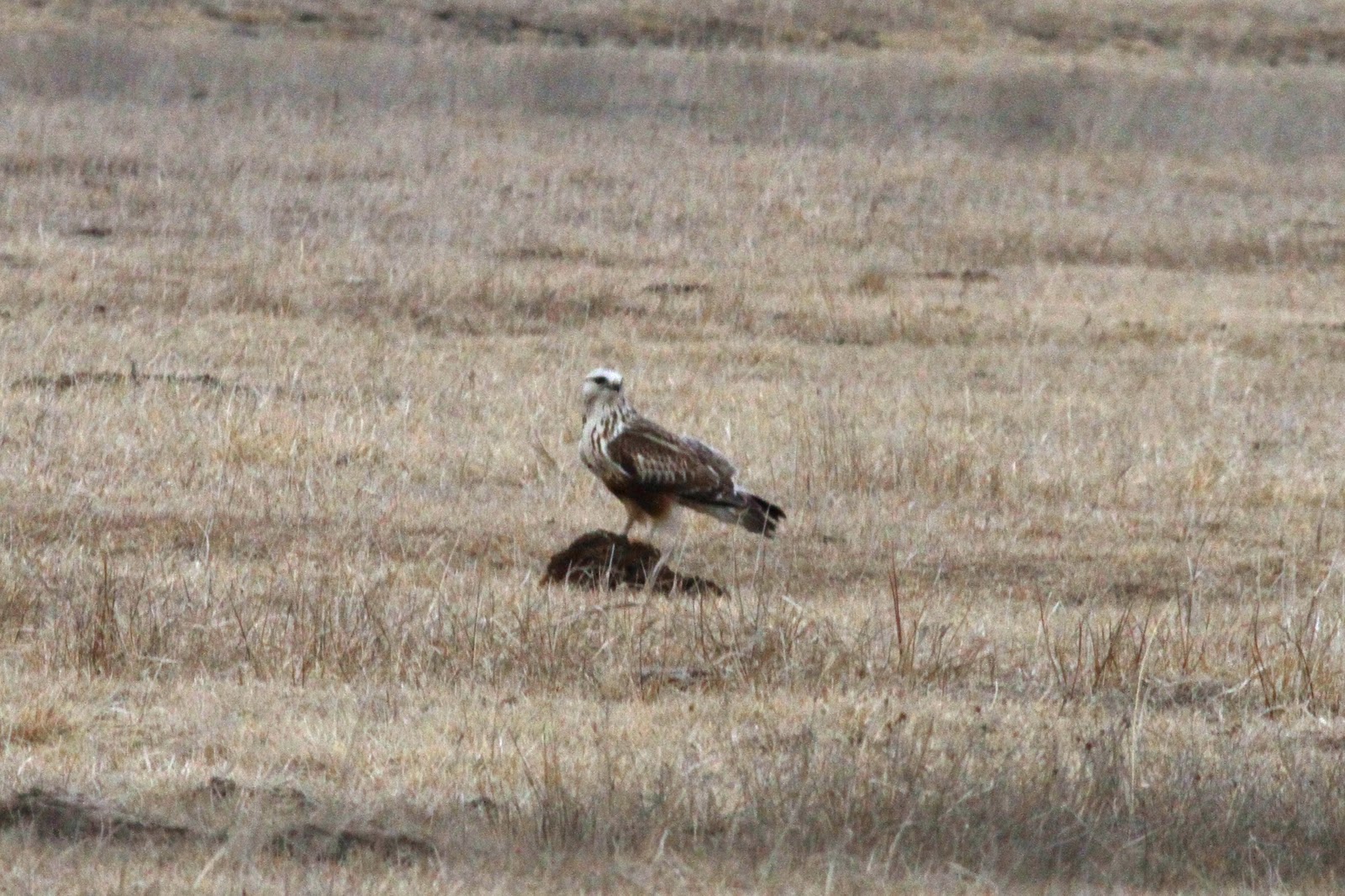
Rough-legged Hawk, Sierra Valley, CA [Photo by Lukas Musher]
Loggerhead Shrike, Sierra Valley, CA [Photo by Lukas Musher]
Ferruginous Hawk, Sierra Valley, CA [Photo by Lukas Musher]
Rough-legged Hawk (first winter), Sierra Valley, CA [Photo by Lukas Musher]

By Luke Musher and Cory Ritter

Tuesday, January 17, 2012

More Like Boom Red-shouldered Hawka

Generally speaking, only birds up to a certain size will get caught in mist-nets meant for trapping passerines.  That size constraint is usually around the size of an American Robin, or the occasional male Sharp-shinned Hawk--as you have seen.  Birds that are any larger will usually not get tangled in the small-sized mesh of the mist-net, and are able to free themselves with a little struggle--or simply break through the net if large or strong enough.  So then, on Saturday, Dan and Cory were pleasantly surprised when they were on the closing net run and came upon this SY Red-shouldered Hawk in one of our nets. It was barely caught, so we were lucky that she didn't free herself before Dan and Cory were able to grab her. 
SY female Red-shouldered Hawk


Luke and the RSHA
Dan with the RSHA. They both look pretty confused.


Cory and the RSHA
After processing and banding the bird we did a quick search through PRBO's data and found that there have only been nine individual RSHA banded at Palomarin in the forty-six years of its existence, and only 12 captures total (i.e. some were recaptures of the same individual).  We are pretty lucky.  Even luckier was the fact that yesterday Dan and Frenchie caught another most likely second year RSHA, this time a male, at one of our offsites, Pine Gulch.  That makes two RSHA in three days (needless to say Cory and I were pretty jealous)!  To make matters more interesting, the bird has features that are quite similar to Broad-winged Hawk.  We are currently trying to confirm this bird's identity, and although we are leaning towards RSHA, it is certainly an interesting bird.  We will have more on this within the next few days.

By Cory Ritter and Luke Musher
Photos mostly by Dan Lipp

Thursday, January 12, 2012

Binge Birding: Part 2


So...where was I?  Oh yes, the ominously approaching waves.  So I have about ten seconds to get back up onto the wall and not get drenched or worse, swept off the jetty entirely.  I sprinted up to the next section of wall and dove onto it, shielding my camera from spray and trying not to bash it against any rocks.  The waves came in one after another but I was protected on the wall.  I continued this method for the entire length of the jetty - walking along the wall, navigating over the rocks where possible and sprinting up the lower portion where the wall and rocks were too dangerous to endeavor.  After fifteen minutes of this I reached the end of the jetty.  I found a flock of roosting shorebirds including Semipalmated Plover and Western Sandpiper, but no Rock Sandpipers.  

The distant end of the breakwater was elevated and wide, surrounded by a barricade of rubble and cement.  I was safe of the waves, for now, but my scope was all by itself on the beach and I needed to find the birds fast to get back to it.  I walked around looking, but couldn't find my sandpipers.  Three male Harlequin Ducks drifted just twenty meters of so from the jetty, a good year bird, but my focal species wouldn't show.  I was getting anxious and checking every crevice for feeding birds, but none showed themselves.  Then as I was ready to give up, a flock of Surfbirds was roosting in the rocks.  I got closer and started taking photos.  I realized then that there were more than just surfbirds in this flock, but all the birds were sleeping.  I fabricated an alarm call that somewhat resembled that of a Greater Yellowlegs, whistling do-do-do-do-do-do-do-do-do.  The birds all stood up and lifted their heads from behind their wings.  Two Wandering Tattler, were lifers for me, and I was beyond happy to see them, but they weren't Rock Sandpipers.  I scanned the flock again, and there they were.  Four Rock Sandpipers stood in front of me wondering what the ruckus was all about.  Yes!  I continued doing the alarm call because they kept trying to go to sleep (I needed photos after all).  I crept up and braced myself on a rock, laying there and snapping off dozens of photos.  Luckily the fog disappeared for about five minutes so I could lower my ISO and get some quality photos!
Wandering Tattler, Humboldt Bay North Jetty, CA. 01/10/2012/ [Photo by Lukas Musher]
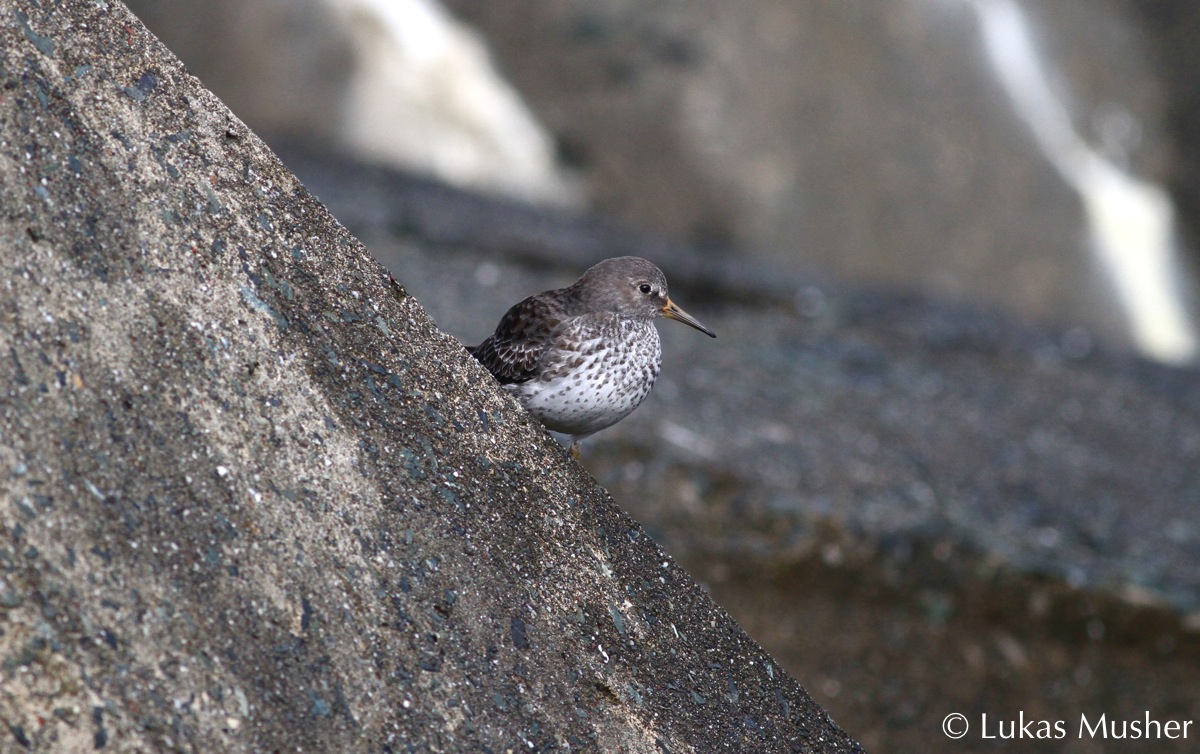
Rock Sandpiper (center) with Surfbirds. [Photo by Lukas Musher]
Surfbird (also notice the two sleeping Rock Sandpipers in the back ). [Photo by Lukas Musher] 
Rock Sandpiper (!) [Photo by Lukas Musher]
Harlequin Duck, through the fog and cropped. [Photo by Lukas Musher]
So now I had to get back.  I managed to get most of the way back without any problems.  But then I looked through my binoculars to check on my scope and saw a man standing around right by it.  CRAP!  I sped up my walk.  As I approached, the surf came up and washed over my legs, but luckily wasn't strong enough to knock me over.  Two large white SUV's pulled up and men in uniforms approached the man at my scope.  What on earth was going on.  I got back and explained that this was my scope, and I had merely left it so that I could safely make it to the end of the jetty to see a bird.  The man who had been with my scope had called the coast guard.  The coast guard proceeded to explain to me that people fall off the jetty ALL THE TIME and that locals call in anything suspicious in case somebody had slipped or been knocked off.  Last year a group of teenagers was washed off the jetty by a large wave.  When I asked if everyone was alright he said, "Yes, except for one kid had a broken arm and femur." Well, good thing I had such a good system for getting across the jetty (?).  Thankfully, I was fine, and even if something had went wrong, it's nice to know that the coast guard would have been there promptly.  A large coast guard vessel in the inlet turned around, and an orange helicopter flew over, back towards the base.  Whoops... Probably not the last time I risk it for a bird, but 'tis the life of a lister!

So after apologizing profusely and thanking them, and hearing, "No big deal, happens all the time," I made my way back up the beach to my car and continued birding.
Savannah Sparrow, Ferndale, CA. 01/10/2012. [Photo by Lukas Musher] 
Clay-colored Sparrow, Ferndale, CA. [Photo by Lukas Musher]
So I went to several spots looking for birds such as Red Crossbill, Northern Shrike, Gray Jay, Golden Eagle, Ferruginous Hawk, Rough-legged Hawk, and Snow Bunting, but struck out on all fronts.  I did manage to add Caspian Tern, Double-crested Cormorant and Bald Eagle, though, and followed up on Rob Fowler's tip out the Clay-colored Sparrow.  A beautiful bird.  I made it back to PRBO by nine and ended with 128 species for the trip.
Clay-colored Sparrow, Ferndale, CA. [Photo by Lukas Musher]
By Luke Musher