Showing posts with label ID. Show all posts
Monday, May 7, 2012
Photo Quiz 5/3/12 Solution
Another interesting bird. Steve Howell saw me showing this photo to a friend of mine in November and jokingly remarked, "Well, it's either a Baltimore Oriole or a Yellow-throated Vireo, so it's a Pine Warbler," and he was right. The large bill, long tail, yellow wash, and bold eye-ring are all very typical of Pine Warbler.
The classic tough fall warbler trio is Pine, Blackpoll, and Bay-breasted, but female fall Blackburnian Warblers can look quite similar as well. I'm going to avoid taking the time to explain why it's not these species, but instead explain why it is a Pine Warbler.
One of the first things I look for to distinguish Pine Warbler from the others is the eye ring. This bird has a fairly obvious one. This bird is relatively large-billed and long-tailed. That is another helpful way to rule out the others. The white spots on the tail created by black edges to the rectrices and a black border to the undertail coverts is also typical. Also note the relatively weak wingbars.
Lot's of good answers and tries, and congrats to the winners:
Mike Biros
Conor Higgins
Ryan Ford
Ryan McDermott
Feel free to comment on this post or email us at boomchachalaca@gmail.com with questions or concerns.
~Luke
Wednesday, May 2, 2012
Photo Quiz 4/25/12 Solution
Okay, the photo I gave you is horrible, bad lighting and angle. But it's pretty clear that it's a tern, which one is far more unclear. The first thing that I notice in this photo is the primaries. They appear to have narrow black tips causing a thin black edge to the underwing. This feature alone would suggest Arctic Tern. But there's a lot more to think about here. The bird appears to have a large bill, relatively uniform upperwing, white secondaries, and the from underneath, white primaries and secondaries. The leading edge of the upperwing appears somewhat darker than the rest of the wing but not black or showing any extreme contrast.
I received a fair number of responses for this, considering how difficult it was, and the most frequent answer I got was Common Tern. Despite the long bill, I would argue this is not a Common Tern but an Arctic Tern. Common Tern should show dark secondaries and a dark contrasting (almost black if not black) ulnar bar. This bird has a fairly uniform upperwing with white secondaries.
Although the lighting is crap and there is a dark shadow over the underwing, I think the important underwing field marks can be made out. First is, as I pointed out, the narrow black tips to the primaries. I would expect much broader tips to Common Tern, giving a wedge shaped black band on the primaries. Though this is not always the case, it is true of most. The other important character is that all secondaries and primaries are translucent from underneath as opposed to the grayish and contrastingly dark secondaries of Common. The head also appears small and rounded, but because of the angle I am hesitant to use these characters.
Here is a slightly better photo of a more typical non-breeding Arctic Tern from a better angle. Note short bill, thin black primary tips, translucent remiges, rounded head, short neck...
And here is another photo of the quiz individual from above. The better look at the upperwing strongly supports Arctic Tern in my opinion - note overall uniform coloration and white secondaries. Bill also feels within the norm of a typical Arctic as well.
¡Winners! -
Markothy Markus Aurelius "Mark" Dettling
Ryan Ford
Thanks for playing -
~Luke Musher
Thursday, March 22, 2012
Well - It's a Shrike...Photo Quiz 3/19/12 Solution
I think it was obvious to everyone that this bird was a shrike. Given that it was in North America, and Nebraska at that, the only options you have are Loggerhead (LOSH) and Northern Shrike (NSHR). As a friend of mine said when he answered the quiz, "you could get the answer by flipping a coin." All of the answers I received were well thought out, but interestingly enough, they were mostly wrong.
I saw this bird near the Platte River of Nebraska in March of 2006. There is about a one week overlap in mid-March where both shrikes are equally likely (which is about when I saw this bird) before which NSHR is more common, and after which LOSH quickly becomes more common. Though both are still possible throughout March and early April.
So, don't let the snow bias your identification. A freak blizzard hit that week making for some interesting birding (and as you can tell, poor conditions for photography!).
Alright - so if we have equal or near equal probabilities of seeing either shrike, we need to focus closely on the field marks we see in the image. To me, on first glance I see a dark-backed, white-throated, plain gray-breasted (i.e. no barring/scaling), large/round-headed shrike with bill that is neither very short nor very long, and neither very hooked nor very unhooked. So far the evidence is pretty good for LOSH. A lot of people used bill shape and size to identify this bird and got it wrong for having ignored other major field marks, and assuming that factors acting against them were due to lighting issues. Just as the bill is intermediate, the mask becomes somewhat broad posteriorly, but doesn't necessarily rule out NSHR. Many people actually thought the mask looked too narrow for LOSH, but even though some of the mask is blocked by a twig, to me, it doesn't look overly extensive or limited enough to decide one way or the other. Another tweener here is the supercillium. A white supercillium is present, but to me it is indistinct, and is more supportive of LOSH than NSHR.
Even if you thought the bill was too long and hooked for LOSH, there are other, less subjective (i.e. presence-absence) field marks to use. NSHR usually has a pale base to the mandible of the bill (though sometimes this becomes black in spring), which LOSH will not have (although I saw a photo of a fledgling that had a pale-ish base). Similarly, NSHR almost always (or maybe always) has gray or mixed gray and black lores and nasal tuft, whereas LOSH generally has black lores and nasal tuft (less frequently gray, but variable). The presence of these characters connects the left and right masks around the bill. I'd like to ID this bird by just these two field marks, but it has been pointed out to me that there is some variation in NSHR bill color and LOSH lore/nasal tuft color (as I pointed out above). However, in my opinion there is no single field mark that obviously supports NSHR over LOSH, but there are several intermediate characters and a several that point towards LOSH. Thus, I choose LOSH, but challenge you to prove me otherwise. Truthfully, when I originally saw this bird, I was told it was a LOSH by another birder, and now, 6 years later had to make sure that's really what it was.
Winners:
Diana Humple
Jared Feura
Gavin Leighton
Francesca Massarotto
~Luke Musher
I saw this bird near the Platte River of Nebraska in March of 2006. There is about a one week overlap in mid-March where both shrikes are equally likely (which is about when I saw this bird) before which NSHR is more common, and after which LOSH quickly becomes more common. Though both are still possible throughout March and early April.
![]() |
| Graph showing Frequency of LOSH and NSHR in March and April in the Nebraska [ebird.org] |
Alright - so if we have equal or near equal probabilities of seeing either shrike, we need to focus closely on the field marks we see in the image. To me, on first glance I see a dark-backed, white-throated, plain gray-breasted (i.e. no barring/scaling), large/round-headed shrike with bill that is neither very short nor very long, and neither very hooked nor very unhooked. So far the evidence is pretty good for LOSH. A lot of people used bill shape and size to identify this bird and got it wrong for having ignored other major field marks, and assuming that factors acting against them were due to lighting issues. Just as the bill is intermediate, the mask becomes somewhat broad posteriorly, but doesn't necessarily rule out NSHR. Many people actually thought the mask looked too narrow for LOSH, but even though some of the mask is blocked by a twig, to me, it doesn't look overly extensive or limited enough to decide one way or the other. Another tweener here is the supercillium. A white supercillium is present, but to me it is indistinct, and is more supportive of LOSH than NSHR.
Even if you thought the bill was too long and hooked for LOSH, there are other, less subjective (i.e. presence-absence) field marks to use. NSHR usually has a pale base to the mandible of the bill (though sometimes this becomes black in spring), which LOSH will not have (although I saw a photo of a fledgling that had a pale-ish base). Similarly, NSHR almost always (or maybe always) has gray or mixed gray and black lores and nasal tuft, whereas LOSH generally has black lores and nasal tuft (less frequently gray, but variable). The presence of these characters connects the left and right masks around the bill. I'd like to ID this bird by just these two field marks, but it has been pointed out to me that there is some variation in NSHR bill color and LOSH lore/nasal tuft color (as I pointed out above). However, in my opinion there is no single field mark that obviously supports NSHR over LOSH, but there are several intermediate characters and a several that point towards LOSH. Thus, I choose LOSH, but challenge you to prove me otherwise. Truthfully, when I originally saw this bird, I was told it was a LOSH by another birder, and now, 6 years later had to make sure that's really what it was.
Winners:
Diana Humple
Jared Feura
Gavin Leighton
Francesca Massarotto
~Luke Musher
Tuesday, March 13, 2012
Photo Quiz 3/9/12 Solution
This one wasn't as tough as I thought it would be, as most people got it right. Still, the wrong answers I got were expected misidentifications, and people I talked to told me it took them some time to figure out. Let's take a closer look at the image above:
We know this bird is in NJ, so Hooded Warbler and first summer male Orchard Oriole come to mind because of the combination black throat and yellow body. However, on closer inspection we can see that the tail is relatively short, too short for any oriole, and the undertail coverts and underside of the rectrices are white. This bird is clearly a warbler, not an oriole. A short and incomplete study of this bird would undoubtedly lead you to believe that it is an adult male Hooded Warbler. However there is a lot that just isn't right. The black seems limited to the throat, and does not extend up the back of the face. Still, that could be due to over exposure/poor lighting. I'm pretty sure Hooded Warblers have pink legs, but they don't have white undertail coverts. This bird just doesn't seem right for Hooded. After that, we don't have many options. If you forget about the fact that one of the most common hybrid warblers in North America is Blue-winged x Golden-winged, then you'd easily label this as a Hooded Warbler and move on (unless you saw the whole bird!). This bird is an adult male Lawrence's backcross Blue-winged x Golden-winged hybrid. Take another look at this bird below (I know these photos suck!).
Steve "No Good" Howell
Dan Lipp AKA "Curly Dan" AKA "Big Boy" AKA "Tiny Dancer" AKA "Dempsey Arceneaux"
Frenchie "Wine and Drop" Massarrotto
Mark "Mad Dog" Dettling
Ryan "The TBB Delgado" DiGaudio
Conor "The Upland Manpiper" Higgins
Jared Frickin' Feura
~Luke Musher
Sunday, February 26, 2012
Photo Quiz Solution: 2/22/12
Let's try to get oriented. Obviously we are looking at a waterbird, whether it is a gull, loon, or tube-nose may not be immediately obvious. Still, no north american gull looks this way, and the legs are awfully far back on the body for any Larid. Similarly, no loons in basic plumage are not generally this brown on top, but I won't get into the structural features that rule them out.
Most people got that this bird was a tube-nose, though, and more specifically a shearwater. All dark shearwaters are ruled out as this bird is white underneath. Manx and Audubon's are much blacker on top and white-flanked.
Truthfully, though, there are a few pieces of information here that give away the answer: 1) there is an obvious white bar moving up onto the nape, although the entire nape is not visible; 2) dark flanks; 3) combination white uppertail coverts and dark rump; and 4) dull/darkish legs. Everyone who got it to tube-nose answered either Cory's or Great. Cory's Shearwater does not generally have any of these four criteria. The rump is generally a little paler than the body, even though it has white uppertail coverts. This gives Great Shearwater a white band above the tail, which is less pronounced on Cory's. Cory's Shearwaters also have bright pink legs, and clean, white flanks, unlike this individual. This bird is a Great Shearwater. Here is another crappy, though more discernible, photo of the same bird:
Winners:
Mark (Mad Dog) Dettling
Dan Lipp
Jane Hosking
Thanks for playing!
By Luke Musher
Wednesday, February 15, 2012
Photo Quiz Solution
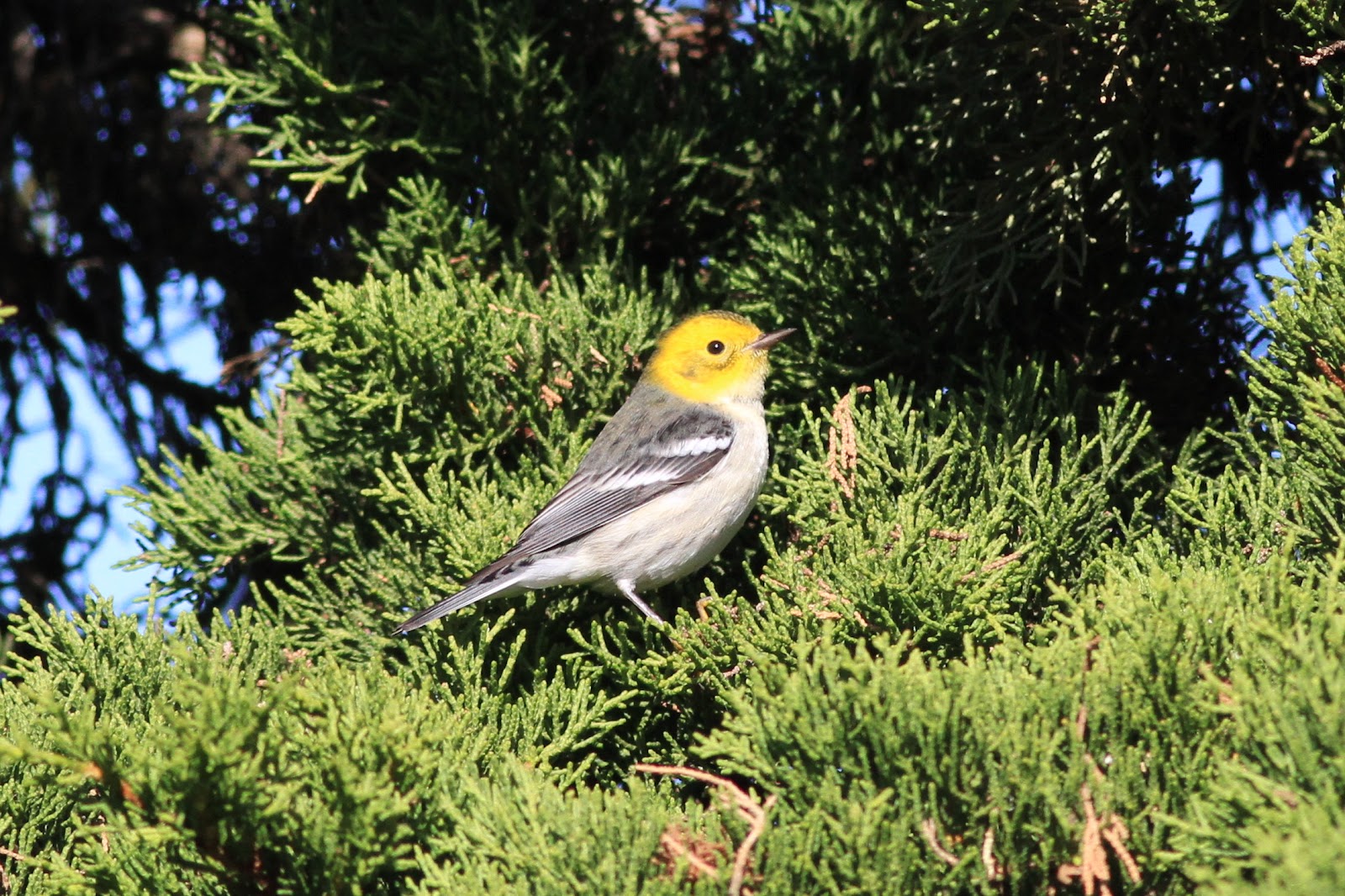
This one was probably much easier for westerners, and since I didn't say where the photo was taken, a lot of options were left open. Off the bat, we have a mostly gray bird with clean white undertail coverts and flanks, streaking on the back, olive wash over the nape, black mottling (or is it shadow?) yellow peaking out from the posterior end of the face, and two obvious white wing bars. The only birds that have this combination of obvious wing bars and yellow face are Setophaga warblers. The lack of vertical streaking on the flanks also eliminates A LOT of possibilities.
Warblers with yellow extending far back on the face include Townsend's, Hermit, Black-throated Green, Golden-cheeked, and Cape May Warblers. The streaking on the back in many Setophaga warblers (including all five birds above) is often quite dark in adult male birds. This streaking is relatively light, so I'd lean towards a first winter male bird or a adult female bird. All of these species other than Hermit have evident streaking on the flanks in most plumages. These four also all have backs ranging from olive to bright green to solid black (Golden-cheeked). The light gray-olive back and olive crown really suggests Hermit Warbler. And that's what it is.
Here is the same bird, from a more identifiable angle. This bird has no black at all on the throat which concerns me about calling it an adult female. It's clearly not a typical adult male. The upper wing-bar (caused by white-tipped/mostly white median coverts) lacks distinct black centers as far as I can tell (may be washed out or covered by the other median coverts), which suggests this is not a first-winter bird. The brightness of the face is also evidence of an adult bird. Still, the face seems to be more typical of an adult male than female. The crown is olive with only a little black mottling, so adult male seems unlikely, but the very large black centers to the uppertail coverts suggest male! I would lean adult female on this, but I can honestly say I really don't know. I have only seen one other Hermit Warbler than this, and it had black on the throat, so I can't say for sure if this is really that atypical, but it is certainly an interesting comparison to any field guide. Any other ideas on age/sex? Townsend's x Hermit Warbler is a rather common hybrid, but I see nothing intermediate here that suggests that.
Winners:
Francesca Massarotto
Ryan DiGaudio (Top Bird Biologist)
Jared Feura
Richard Ackley
Tim Schreckengost
~Luke Musher
Warblers with yellow extending far back on the face include Townsend's, Hermit, Black-throated Green, Golden-cheeked, and Cape May Warblers. The streaking on the back in many Setophaga warblers (including all five birds above) is often quite dark in adult male birds. This streaking is relatively light, so I'd lean towards a first winter male bird or a adult female bird. All of these species other than Hermit have evident streaking on the flanks in most plumages. These four also all have backs ranging from olive to bright green to solid black (Golden-cheeked). The light gray-olive back and olive crown really suggests Hermit Warbler. And that's what it is.
Here is the same bird, from a more identifiable angle. This bird has no black at all on the throat which concerns me about calling it an adult female. It's clearly not a typical adult male. The upper wing-bar (caused by white-tipped/mostly white median coverts) lacks distinct black centers as far as I can tell (may be washed out or covered by the other median coverts), which suggests this is not a first-winter bird. The brightness of the face is also evidence of an adult bird. Still, the face seems to be more typical of an adult male than female. The crown is olive with only a little black mottling, so adult male seems unlikely, but the very large black centers to the uppertail coverts suggest male! I would lean adult female on this, but I can honestly say I really don't know. I have only seen one other Hermit Warbler than this, and it had black on the throat, so I can't say for sure if this is really that atypical, but it is certainly an interesting comparison to any field guide. Any other ideas on age/sex? Townsend's x Hermit Warbler is a rather common hybrid, but I see nothing intermediate here that suggests that.
Winners:
Francesca Massarotto
Ryan DiGaudio (Top Bird Biologist)
Jared Feura
Richard Ackley
Tim Schreckengost
~Luke Musher
Monday, February 13, 2012
Photo Quiz
Identify this bird by Wednesday at 3pm EST (12PM Pacific Time). Email us at boomchachalaca@gmail.com with your answers. The solution and winners names will be posted shortly thereafter.
~The BoomCha Team
Sunday, February 12, 2012
What's your Thayer's-type?
What a headache. After spending a total of around ten hours this week looking at gulls at Fort Baker near Sausalito, CA this week, I have just about nothing to show for it. We missed the Iceland Gull seen well early this week by many, and missed Slaty-backed Gull, of which there were as many as three! Sure we had two different Glaucous Gulls on two different days (one first cycle, one second cycle), but I can't help but feel bitter, like I wasted my time. Then again, I saw more Thayer's Gull's this week than I ever had in my entire life (roughly x100). Though these were mostly first cycle birds, there were a lot of adults and in-betweeners as well.
| Adult Thayer's Gull. [Photo by Lukas Musher] |
| Adult Thayer's Gull. [Photo by Lukas Musher] |
| Adult Thayer's Gull. [Photo by Lukas Musher] |
| A somewhat dark first cycle Thayer's. Pale crescents at tips of primaries beginning to wear off. [Photo by Lukas Musher] |
| First cycle Thayer's Gull. Note: Dark secondaries with pale tips, dark outer primaries, pale inner primaries. Rather checkered-looking median coverts. [Photo by Lukas Musher] |
| First cycle Thayer's Gull. [Photo by Lukas Musher] |
| Kumlien's Gull again. [Photo by Lukas Musher] |
Useful Link: Steve Hampton's Gull ID Website
By Luke Musher
Thursday, February 9, 2012
My Mystery Gull
Originally I suspected a Glaucous X something hybrid based on bill structure and color, and head structure. I suspected a first cycle bird based on plumage and dark iris. After reviewing the photos more, and corresponding with experts, the bird appears to be more likely a second cycle bird. Gray feathers are coming in on the mantle, and the primaries look rounder-tipped rather than pointy as first cycle birds have. The overall uniformity in plumage color suggests GWGU X something as well (if not pure GWGU!), though mixed birds can be rather uniform in their second cycle. Nelson's Gulls generally have more patterning on the greater coverts and primaries.
Now that we know this bird is most likely a second-cycle it allows us to eliminate certain options. Nelson's becomes exceedingly less likely because they should show a pale iris in their second cycle. Glaucous-winged Gull (GWGU) X something then becomes exceedingly more likely since GWGU has a dark iris in its second cycle.
Bill shape and size is large in GWGU, and is bicolored in second cycle, but rarely is the coloration this extreme. On closer inspection, though, the bill is not really all that pink as would be expected in a Glaucous hybrid. Similarly when looking at the photo above, bill structure seems less suitable for a Glaucous hybrid (that doesn't necessarily mean it isn't). Originally the bill looked large and heavy, but when taking a closer look, the bill doesn't look all that different from a typical Herring Gull bill.
It seems like the best arguments I've heard are for Herring (really Smithsonian, but let's not go there now) Gull X GWGU. Still, I've received more votes for Nelson's than anything else.
Any more ideas about this gull are welcomed. Email us or comment on this post if you have anything to add. As a side note, check out the single dark feather on this bird's scapulars - very strange.
By Luke Musher
Wednesday, February 8, 2012
Photo Quiz solution and Aberrant Plumages in Birds
Admittedly, this was a difficult bird to identify to race given it's clearly aberrant plumage. The patches of white on the back, nape, rump, above the eye and elsewhere (including a single greater covert) would make any bird challenging to identify. The distinctly round head, thick legs, overall bulkiness, and long nails (hard to see, but they're there) make Fox Sparrow the obvious choice, and most people got this. Race is more difficult. The bird's washed out breast and belly (either from bad lighting, leucism, or both), and the "albinistic" (we'll get into this later) patches of feathers greatly reduce the value of using plumage to identify race. This bird is very long-tailed and has a rather thick bill. The gray head may suggest Slate-colored, but doesn't rule out Thick-billed. The brown spotty streaking on the breast and flanks also suggests Slate-colored (vs. the black spots on Thick-billed), but this is possibly/probably due to the aberrancy in plumage. The flight feathers appear slightly reddish, but not as reddish as typical Slate-coloreds. Wing bars are completely absent. The extreme length of this bird's tail and thickness of the bill rules out Sooty and Red Fox Sparrows which are short-tailed. Slate-colored would be a lot more likely in Marin county, but the bill on this bird is simply too heavy for that race. This bird probably represents Passerella iliaca brevicauda, which is smaller billed than the massive-billed P. s. megarhyncha.
Another part of the quiz, though, was determining what was causing this bird to look so odd. So far I've used the terms albinistic and leucistic. Albinism is the absence of melanin anywhere in a bird, so an all white bird (although sometimes with some color from pigment other than melanin) and red/pink eyes is always called albinistic. For the purposes of this quiz, I accepted the terms leucistic, partially leucistic, and partially albino since these terms are often used to mean the same things. However, it is important to point out the differences in these terms, and why certain terms are less accurate. Since partial albinism means partial complete absence of pigment, it makes little sense, and is generally not used as frequently anymore. However it used to be used quite frequently to describe the pied appearance as is seen in this bird.
Leucism generally describes two phenomena, a pied/piebald patterning (patches of feathers/skin with no pigment (i.e. they are white patches) as in this bird, or an overall reduction of pigment evenly over the entire bird giving the bird a faded appearance. One of the players on this quiz pointed out that he does not like the term leucistic since it describes multiple problems. Still, both phenomena termed leucistic stem from the same problem - a pathology that causes melanin and other pigments to be deposited aberrantly. This is opposed to albinism, which means the bird presumably cannot make melanin at all. This bird has pigment, but also appears to be faded in some parts, and yet completely white in others. I would call this bird leucistic, but if anyone still believes otherwise, I encourage you to comment on this post.
Winners:
Conor Higgins
Rich Stallcup
Nate Fronk
Thanks for playing!
~Luke Musher
Another part of the quiz, though, was determining what was causing this bird to look so odd. So far I've used the terms albinistic and leucistic. Albinism is the absence of melanin anywhere in a bird, so an all white bird (although sometimes with some color from pigment other than melanin) and red/pink eyes is always called albinistic. For the purposes of this quiz, I accepted the terms leucistic, partially leucistic, and partially albino since these terms are often used to mean the same things. However, it is important to point out the differences in these terms, and why certain terms are less accurate. Since partial albinism means partial complete absence of pigment, it makes little sense, and is generally not used as frequently anymore. However it used to be used quite frequently to describe the pied appearance as is seen in this bird.
Leucism generally describes two phenomena, a pied/piebald patterning (patches of feathers/skin with no pigment (i.e. they are white patches) as in this bird, or an overall reduction of pigment evenly over the entire bird giving the bird a faded appearance. One of the players on this quiz pointed out that he does not like the term leucistic since it describes multiple problems. Still, both phenomena termed leucistic stem from the same problem - a pathology that causes melanin and other pigments to be deposited aberrantly. This is opposed to albinism, which means the bird presumably cannot make melanin at all. This bird has pigment, but also appears to be faded in some parts, and yet completely white in others. I would call this bird leucistic, but if anyone still believes otherwise, I encourage you to comment on this post.
Winners:
Conor Higgins
Rich Stallcup
Nate Fronk
Thanks for playing!
~Luke Musher
Monday, February 6, 2012
The Herring are Running: Glaucous and Mystery Gull
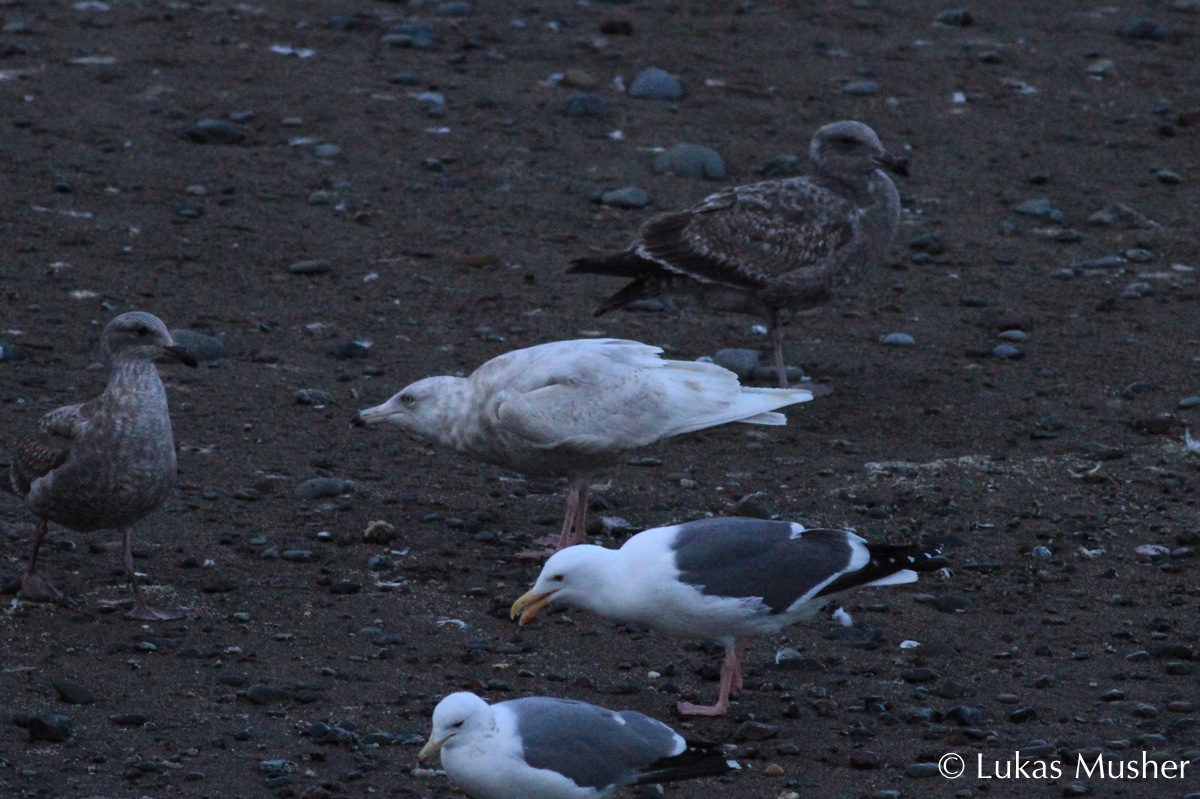
Right now, the herring are running in the bay area, and the gulls are going nuts feeding on eggs and perhaps even the fish themselves. Cory, Dan, Frenchie and I went to see what we could find yesterday afternoon at Fort Baker in Sausalito. Large numbers of Mew, California, Western, Herring, and Glaucous-winged, hundreds of Thayer's and at least one Glaucous Gull. We also found a bird that looked odd. First cycle "Nelson's" Gull came right to mind, although I've only seen one of these ever, and cannot be certain. Structurally the bird looks like a Glaucous, and the pink and black bicolored bill supports Glaucous in its ancestry. Glaucous-winged X Glaucous isn't too rare, and mixed ancestry between these two species is certainly a possibility as well. We encourage readers to comment with their thoughts on this bird as well (photos below). An Iceland Gull had been seen the past two days, but we unfortunately could not locate it amongst the thousands of gulls. Here are some photos. We were there late in the afternoon, and we didn't find the Glaucous Gull until late, so the photos are dark.
| Mystery Gull. Possibly a "Nelson's" (Herring X Glaucous), which was my first thought, but personally I'm not sure. We welcome your insight, and will update when we know more. [Photo by Lukas Musher] |
| The mystery gull again with Glaucous-winged (left), California (background), and Herring (foreground). |
| First cycle Thayer's Gull |
| First cycle Thayer's Gull |
| This banded Western Gull had a fishing hook and line tangled around its left leg, which didn't look to healthy. Otherwise the bird seemed to be in fairly good health. |
| Second cycle Glaucous Gull with Western, Herring, Thayer's and California Gulls |
| Second Cycle Glaucous Gull |
| Second cycle Glaucous Gull in long call posture |
| Second cycle Glaucous Gull (center) |
| Compare this presumed "Nelson's" Gull with the mystery bird above. Pelagic out of Lewes, DE. February 2011. |
Photo Quiz
Saturday, January 28, 2012
Photo Quiz from 1/26/12 Answer
Well this was somewhat of a hard one, and only a few people got it. The photo is dark, and this dull bird is definitely a confusing one. Let's take a look again.
What do we see? First of all we see a mostly olive-backed bird with a gray hood/head and grayish-olive tertials. This bird is definitely a relatively slender, small-headed passerine with a medium-sized tail. We know the bird is in California, but that doesn't rule out a vagrant. Blue-headed Vireo may come to mind, but they have wing bars (not to mention quite rare in CA in January). They would also show white edging on the tertials, and their heads are usually darker and thus contrast more with the body. Nashville Warbler may also come to mind and is a frequent vagrant to CA, but depending on age/sex they show some to a lot of bright yellow on the underparts. They should be much greener above rather than drab-olive like this individual. They also would be much shorter-tailed. Female Mourning and MacGillivray's Warblers are also gray-headed but would show extensive bright yellow to the underparts.
This really only leaves a few options. To me, from the beginning the bird was either a Tennessee or an Orange-crowned Warbler (but then again, I took the photo). It is relatively slender and small-headed. The tail isn't all that long, but isn't short either. Oreothlypus (formerly Vermivora) warblers like Tennessee and Orange-crowned come right to mind because of the lack of wing-bars, gray head, and the overall drabness. Look closely and see that this bird has some yellow poking out from under the tail (i.e. yellow undertail coverts). Tennessee Warbler never shows this. Even if this yellow tinge is an artifact of the lighting, exposure, etc., Tennessee Warbler's tail is fairly short. This bird is an Orange-crowned Warbler of either the Taiga or Interior West race. If you still don't believe me, look below.
Winners:
Timothy Schreckengost - PA
Francesca Massarotto - CA
Drew Weber - PA
Mark Dettling - CA
Andrew Longtin - MN
Thanks for playing!
~Luke Musher
Labels:
Bird,
Bird Watching,
Birding,
Boom Chachalaca,
boomcha,
California,
ID,
identification,
Photo quiz
Thursday, January 26, 2012
Photo Quiz
Tuesday, December 20, 2011
Gull Watching: Little Gull
So I'm taking a break from the large white-headed gulls to show you Little Gull. This is one of my favorite gulls. These photos were taken on an overcast, snowy day this past February, so please excuse the slightly off focus and mediocre lighting on some of them.
| First cycle Little Gull. Note wing pattern (as above), short tail, short, relatively straight bill, and rounded wings. Feb. 2011, Dunkirk, NY [Photo by Lukas Musher |
| First cycle Little Gull. Note shape, structure, and pattern of upperparts same as above. Feb. 2011, Dunkirk, NY [Photo by Lukas Musher] |
| Adult Little Gull. Note structure same as above. gray upperparts with pale wingtips. Feb 2011, Dunkirk, NY [Photo by Lukas Musher] |
Friday, December 16, 2011
Gull Watching: Glaucous Gull
So I don't have any photos of adult Glaucous Gulls, but I have some photos of a first cycle bird that I think could be cool to share on the blog. I wish I had some adults to share, but we'll have to do without. Adults will have the same structural features and will be very pale gray on the upperparts with white wing tips and yellow bill. Let's look at the first cycle bird though.
By Luke Musher
| Glaucous Gull with Herring Gull. Note whitish plumage and wings. February 2011. Pelagic out of Lewes, DE. [Photo by Lukas Musher] |
By Luke Musher
Labels:
Bird Watching,
Birding,
birds,
boom,
Boom Chachalaca,
boomcha,
chachalaca,
delaware,
Glaucous Gull,
Gull,
Gulls,
ID,
identification,
North America,
pelagic,
photographs,
photos,
pictures,
Point Reyes,
PRBO
Subscribe to:
Posts (Atom)