Showing posts with label photograph. Show all posts

Wednesday, February 15, 2012

Photo Quiz Solution

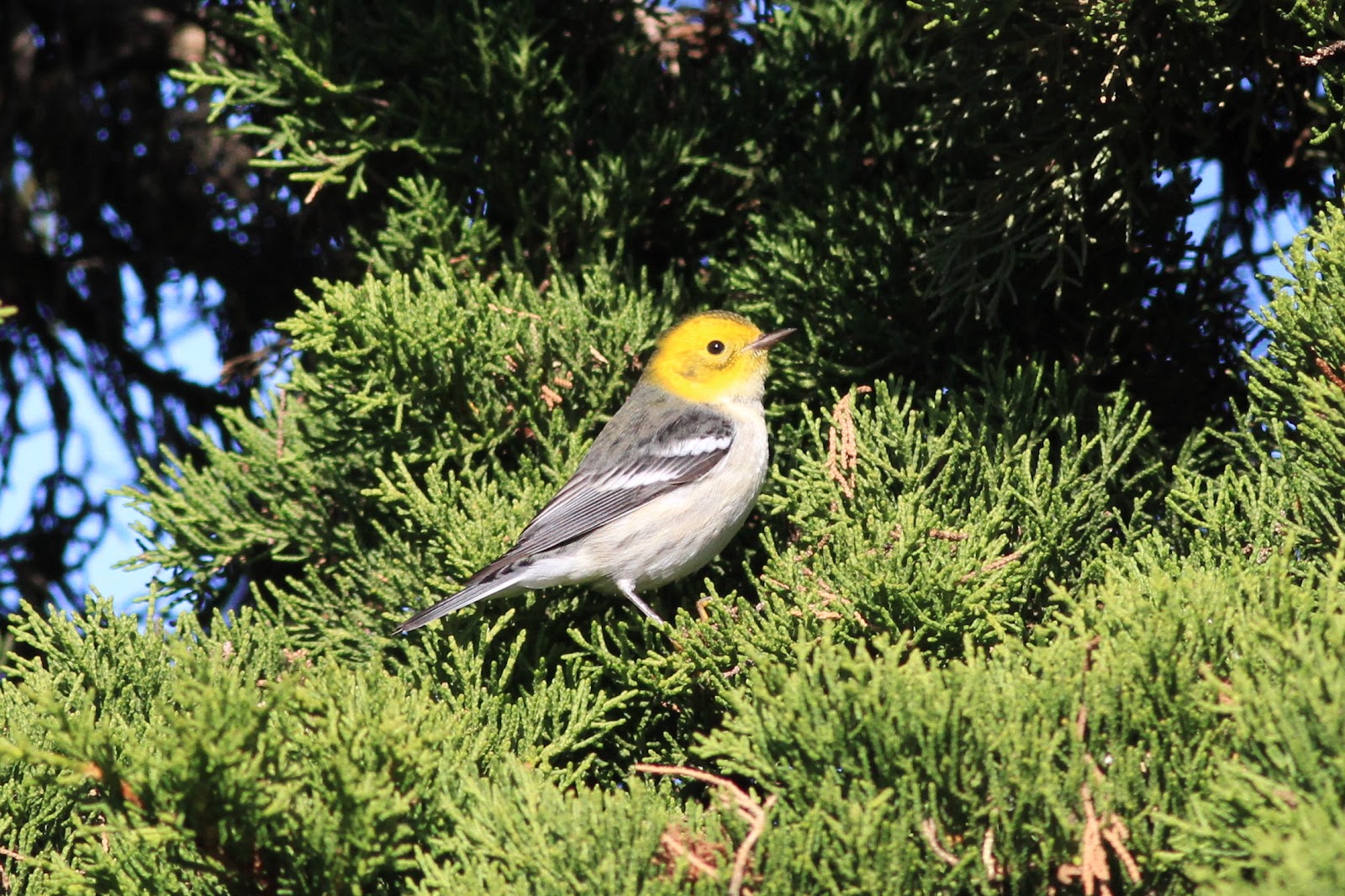
This one was probably much easier for westerners, and since I didn't say where the photo was taken, a lot of options were left open.  Off the bat, we have a mostly gray bird with clean white undertail coverts and flanks, streaking on the back, olive wash over the nape, black mottling (or is it shadow?) yellow peaking out from the posterior end of the face, and two obvious white wing bars. The only birds that have this combination of obvious wing bars and yellow face are Setophaga warblers.  The lack of vertical streaking on the flanks also eliminates A LOT of possibilities.

Warblers with yellow extending far back on the face include Townsend's, Hermit, Black-throated Green, Golden-cheeked, and Cape May Warblers.  The streaking on the back in many Setophaga warblers (including all five birds above) is often quite dark in adult male birds.  This streaking is relatively light, so I'd lean towards a first winter male bird or a adult female bird.  All of these species other than Hermit have evident streaking on the flanks in most plumages.  These four also all have backs ranging from olive to bright green to solid black (Golden-cheeked).  The light gray-olive back and olive crown really suggests Hermit Warbler.  And that's what it is.


Here is the same bird, from a more identifiable angle.  This bird has no black at all on the throat which concerns me about calling it an adult female.  It's clearly not a typical adult male.  The upper wing-bar (caused by white-tipped/mostly white median coverts) lacks distinct black centers as far as I can tell (may be washed out or covered by the other median coverts), which suggests this is not a first-winter bird.  The brightness of the face is also evidence of an adult bird.  Still, the face seems to be more typical of an adult male than female.  The crown is olive with only a little black mottling, so adult male seems unlikely, but the very large black centers to the uppertail coverts suggest male!  I would lean adult female on this, but I can honestly say I really don't know.  I have only seen one other Hermit Warbler than this, and it had black on the throat, so I can't say for sure if this is really that atypical, but it is certainly an interesting comparison to any field guide.  Any other ideas on age/sex?  Townsend's x Hermit Warbler is a rather common hybrid, but I see nothing intermediate here that suggests that.

Winners:
Francesca Massarotto
Ryan DiGaudio (Top Bird Biologist)
Jared Feura
Richard Ackley
Tim Schreckengost


~Luke Musher

Sunday, February 12, 2012

What's your Thayer's-type?

What a headache.  After spending a total of around ten hours this week looking at gulls at Fort Baker near Sausalito, CA this week, I have just about nothing to show for it.  We missed the Iceland Gull seen well early this week by many, and missed Slaty-backed Gull, of which there were as many as three!  Sure we had two different Glaucous Gulls on two different days (one first cycle, one second cycle), but I can't help but feel bitter, like I wasted my time.  Then again, I saw more Thayer's Gull's this week than I ever had in my entire life (roughly x100).  Though these were mostly first cycle birds, there were a lot of adults and in-betweeners as well.
Typical (?) First-cycle Thayer's Gull. Note: Short, relatively thin, straight, solid black bill, gently curved culmen, dome-shaped, dove-like head, though slightly sloped forehead, dark pink legs, dark iris, primaries darker than body and tertials with pale crescents at tips, tertial centers darker than coverts, checkered/barred wing coverts, scapulars mostly pale with dark centers giving a checkered appearance, tail with broad terminal dark band. [Photo by Lukas Musher]
Adult Thayer's Gull. Note: Bill and head structure as above, pale gray mantle, mostly gray primaries.  Very large subterminal mirror (white spot) on P10 (outermost primary) and relatively large mirror on P9 (second most distal primary), black restricted to outer web of primaries.  Streaked head (winter). [Photo by Lukas Musher]
Adult Thayer's Gull.  Head and bill structure as above.  Fairly dark iris, bright pink legs, apical spots (terminal white marks on primaries) relatively even generally becoming larger as you move anteriorly (tail to head) along the folded wing. [Photo by Lukas Musher]
Adult Thayer's Gull.  [Photo by Lukas Musher]
A somewhat dark first cycle Thayer's.  Pale crescents at tips of primaries beginning to wear off.  [Photo by Lukas Musher]
First cycle Thayer's Gull.  Note: Dark secondaries with pale tips, dark outer primaries, pale inner primaries.  Rather checkered-looking median coverts. [Photo by Lukas Musher]
Adult Thayer's Gull.  Note: Bill/head structure as above, small gonydeal bulge (variable, but generally smaller than  herring and other larger-billed gulls), deep pinkish-purple orbital ring, dark yellow-honey iris. [Photo by Lukas Musher]
First cycle Thayer's Gull.  [Photo by Lukas Musher]
First cycle "Kumlin's" Iceland Gull for comparison.  Kumlien's Gull has been treated variously as a hybrid Iceland x Thayer's, and a subspecies of Thayer's or Iceland.  Currently it is categorized as a subspecies of Iceland Gull: Larus glaucoides kumlieni.  [Photo by Lukas Musher]
Kumlien's Gull again. [Photo by Lukas Musher]

By Luke Musher

Tuesday, December 20, 2011

Gull Watching: Little Gull

So I'm taking a break from the large white-headed gulls to show you Little Gull.  This is one of my favorite gulls.  These photos were taken on an overcast, snowy day this past February, so please excuse the slightly off focus and mediocre lighting on some of them.
First cycle Little Gull.  Note black ulnar bars creating M on upperparts, light gray mantle and scapulars, slate-colored cap, and dark black carpal patch.  Size, although not obvious here, is smaller than Boneparte's and Black-headed Gulls. Feb. 2011, Dunkirk, NY [Photo by Lukas Musher]
First cycle Little Gull. Note wing pattern (as above), short tail, short, relatively straight bill, and rounded wings. Feb. 2011, Dunkirk, NY [Photo by Lukas Musher
First cycle Little Gull.  Note shape, structure, and pattern of upperparts same as above.  Feb. 2011, Dunkirk, NY [Photo by Lukas Musher]
Adult Little Gull.  Note structure same as above. gray upperparts with pale wingtips. Feb 2011, Dunkirk, NY [Photo by Lukas Musher]
Adult Little Gull.  Note, underwing pattern distinctive, all black.  No other North American gull shows this combination of pale upperparts and dark underwing.  Wings rounded, bill short and straight. Feb. 2011, Dunkirk, NY [Photo by Lukas Musher]
By Luke Musher

Socializing with Socaible Weavers


Adult sociable weaver.  Sex can't be identified in the field and we have to use genetics to identify the sex of the weavers.[Photo by Gavin Leighton]
Avian biology and behavior have contributed much to our understanding of social behaviors.  The natural world is rife with prosocial behaviors, despite the tendency for natural selection to promote selfish individuals. An especially intriguing case of cooperative behavior is displayed by Sociable Weavers (Philetairus socius).  These small birds (~30g) live in semi-arid savannah in southwestern Africa; but what sets these small passerines apart is that they live in colonies that build and maintain perennial, communal nests (See below). Interestingly, several other species of birds such as Pygmy Falcons, Rosy-faced Lovebirds, and Scaly-feathered Finches have been known to roost in the empty chambers of Sociable Weaver nests. 
Sociable weaver colony.  At the colony we trapped 108 birds. [Photo by Gavin Leighton]
The communal nest also presents an opportunity to understand the evolution of cooperative behaviors that maintain communal goods.  Theoretically, Sociable Weavers that exploit the nest-building behavior of other weavers should be selectively favored, therefore increasing selfishness.  In contrast, such selfishness is avoided, and I am interested in delimiting the evolutionary mechanisms that maintain cooperative nest construction in Sociable Weavers.
These are two rosy-faced lovebirds, one of the species of parrots in Namibia.  Common in the Khomas region, they are known to hang around sociable weaver nests and in some cases even roost in the chambers of a sociable weaver nest. [Photo by Gavin Leighton]
One possible mechanism that may maintain cooperative nest construction is kin selection.  Kin selection supports cooperative behaviors by allowing cooperative individuals to spread their genes by helping relatives reproduce, who share genes with the actor due to common ancestry.  To delineate the relatedness of Sociable Weaver colonies, I recently visited Namibia to collect blood samples from Sociable Weavers.  The weavers are trapped en masse in the morning and it often requires multiple individuals to quickly remove all the birds.  I removed blood from the trapped individuals and will be performing genetic analyses to see if the nests are composed of extended family groups. 

To complete the work, I was helped by multiple individuals from the local city.  Most of the individuals that helped with the projects were Namibian ornithologists in the region, and most of these individuals are birders by passion and have a career in a field other than avian biology.  This is probably the most salient difference between birders in the US and Namibia.  In the US, most bird banding is conducted at designated banding stations, whereas in Namibia banding is performed by a dedicated group of individuals who band on the weekends and in back yards.
Ostrich.  The red on the lower shins is indicative that this individual is in breeding condition. [Photo by Gavin Leighton]
Such banding is critical to the success of Namibian ornithology, as there are no dedicated banding stations or dedicated ornithologists at the universities.  Due to the lack of research in the country, much of the bird life in the region is still shrouded in mystery.  As an example, Ludwig’s bustard is endemic to the region, but only one individual has ever been banded, and its behavior and breeding tendencies are almost completely unknown.  The landscape is entirely wide open, and the density of birds reflects the pristine habitat; in one day we found a nest of Secretary Birds 200 meters away from a nest of Lappet-faced Vultures.  Namibia also offers diverse habitats for birds and birders; from coastal regions to two deserts, birds of all types inhabit the land of Namibia.   
Yellow Canary. [Photo by Gavin Leighton]
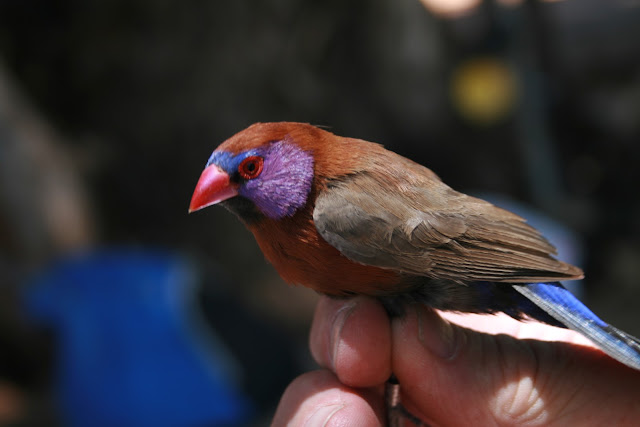
Purple-cheeked waxbill.  Common in the region. [Photo by Gavin Leighton]
Scaly-feathered finch.  Like Rosy-faced lovebirds, Scale-feathered finches are known to join sociable weaver feeding flocks and are also reported to roost in the chambers of sociable weaver nests. [Photo by Gavin Leighton] 

By Gavin Leighton