Long-tailed Jaeger
Showing posts with label Evolution. Show all posts

Thursday, July 18, 2013

Flocks of Furnariid Friends

I just returned to Heredia after 10 rather windy days in Talamancan cloud forest 2500m above sea level.    I think my favorite bird that we captured since I've spoken with you last is this incredible (/incredibly bad-ass) Streak-breasted Treehunter, a member of the family, Furnariidae, which includes ovenbirds (subfamily: furnariinae), miners and leaf-tossers (Sclerurinae), and woodcreepers (Dendrocolaptinae).
A closer (above) and even closer (below) look at this remarkable species.  Too much? Sorry but it's awesome.
I know that I keep saying what families I like and don't like, but I have to say that this morphologically and behaviorally diverse family, Furnariidae, is another one of my favorites.  With 293 currently recognized species, it is an amazing group to study from the perspectives of evolution, biodiversity, and ecology.  It is not uncommon to be watching 5 or more (in some cases many more) species of these often audacious birds in one mixed feeding flock moving through tropical rainforest.  Granted in the Costa Rican highlands 5 species at once is somewhat uncommon, but I did commonly see a few including Spot-crowned Woodcreeper, Ruddy Treerunner, Red-faced Spinetail, and Buffy Tuftedcheek.  Such diversity of species can be noted simply by pointing out that the family is well-represented in just about every habitat type in the Neotropics from the hot, dry Atacama desert to Polylepis forest in the high Andes, to cloud forest and Amazon rainforest.

Interestingly enough, 97% of the species-level and 100% of the genus-level diversity (currently recognized of course) is found in South America.  That means that the vast majority of this giant 33 million-year-old radiation of Sub-oscine Passeriformes birds took place in South America, only spreading north into Central America after the closing of the isthmus of panama 2.5-4 mya (or one newer study indicates as early as 15mya!)

Maybe it's my lack of very much old-world exposure, but the new world is, well, mejor, as they say down here in the CR.  Point not arguable.  Don't try.  Or do, I won't care.

¡Tuanis mae!

References:

Brumfield, Robb T. Inferring the Origins of Lowland Neotropical Birds (2012) The Auk, 129(3): 367-376

Derryberry, Elizabeth P. et al. Lineage Diversification and Morphological Evolution in a Large-scale Continental Radiation: The Neotropical Ovenbirds and Woodcreepers (Aves: Furnariidae) (2011) Evolution 65:2973-2986


Monday, January 7, 2013

What’s Next for Academic Ornithology?

Want to know how studying microorganisms relates to studying adaptive radiation, and evolution in selected traits like color and morphology in birds like this White-winged Crossbill?  Sexual selection is well studied in a host of bird species, but the genetics of sexual selection have yet to be worked out.  Gavin Leighton has brought us yet another great piece on where ornithology may be headed in the near future.  Read on and keep an open mind (White-winged Crossbill, Provincetown, MA, December 2012).
By Gavin M. Leighton

There’s no hiding it anymore: the major academic ornithological societies, e.g. The American Ornithological Union, The Wilson Ornithological Society, The Cooper Ornithological Society, and smaller raptor groups, are facing declining membership numbers and reduced revenues.  These groups are currently in the midst of talks about forming a singular society so as to pool resources and reduce inefficiencies due to overlapping functions.  Importantly, the decline in the groups also reflects a similar, though less drastic, proportion of research biologists performing research on natural populations.  While species such as the Darwin’s Finches continue to receive much press, the fields of evolutionary biology and behavioral ecology have diversified into new groups. 

This diversification is welcome; we can test overarching biological principles in more species and some of the new work is done on species that are amenable to controlled studies in labs.  Therefore, the appropriate response of academic ornithologists is not to resent the burgeoning work on species such as Dictyostelium discoideum; rather, academic ornithologists should turn their attention to the genetic and mutational techniques that have been developed in the microbial and agricultural worlds.  The DNA sequencing technology now available to researchers is staggering; we can sequence billions of base pairs of DNA in less than a few days.  Other groups of researchers have used this data to characterize soil meta-communities, identify mutations in agricultural crops, and delimit the mutations associated with coat color in some mouse species. 
ABI Prism 3100 Genetic Analyzer – we have the technology... (Photo from Wikipedia)
Not only are these techniques providing truck-loads of data, they are also being refined by the researchers performing the techniques.  The researchers have worked out most of the kinks associated with common next-generation sequencing technology thus delivering to ornithological researchers a massive opportunity that should not, and can not, be wasted.  The reasons that first attracted researchers to studying birds are the same reasons that should be used to create a mini-rebirth in academic ornithology. 

For instance, the biological community has gravitated towards studying sexual selection in birds because of the wealth of color traits and behavioral traits that are supposedly due to sexual selection.  As referenced before, Darwin’s finches are a classic example of species radiation (as an aside, Darwin didn’t even realize the finches were all finches until he had an ornithologist friend examine the specimens), and a considerable number of bird species are studied because of their cooperative breeding behaviors. 

Until recently, serious genetic studies could only be conducted on “model” species that were both reared in labs and also had their genome sequenced and published.  Now, a host of enzymatic digestion and sequencing allow researchers to discover large swaths of the genome at a time.  And in some cases, these DNA sequences can be mapped onto the genome of a closely related species; for example, individuals working on Darwin’s finches could map sequences onto the genome of the zebra finch.

What does all this mean? First, we can begin to understand the genetic architecture that underlies the variety of bird colors we see.  We would be able to compare tanagers and Northern Cardinals to see if selection produced red feather color along similar molecular pathways.  We will be able to delimit the genes that underlie behaviors like cooperative breeding, whereby some individuals give up the opportunity to breed elsewhere and instead help raise their siblings or half-sibs. 
Is red feather pigment selected for along the same or similar molecular pathways in all species?  Is bill morphology in Red Crossbill types selected for along similar pathways as bill morphologies in Darwin's finches?  (Red Crossbill, Provincetown, MA, December 2012)
Once we define these genes that are correlated with certain morphological or behavioral traits, it won’t be long before researchers can insert mutations or new forms of a gene into wild individuals using vectors such as viruses.  Field experimentation/validation is considered the holy grail of field biologists, and in the near future ornithologists will be able to perform the studies that conclusively show that certain genes are responsible for certain traits.  Once we understand which genes control which traits, we can follow those genes over time and track evolution in real time in animal species. 

In total, the depth and breadth of our understanding of the natural world will grow exponentially.  The only necessary step is for ornithologists to catch-up with the technology that is coming online.  Regrettably, many ornithologists are only familiar with the new techniques, but hesitant to dive into the new world of next-generation sequencing.  This is disconcerting as the potential data that could be collected and analyzed on bird species would firmly entrench ornithology as a relevant and exciting field of biology.  Indeed, there is no reason why the bird traits that have drawn both researchers and the public to birds in the past, can’t be studied and understood using the new technology we have now.  Importantly, if academic ornithologists do take advantage of the opportunities presented by new sequencing technology, then we could reverse declining membership in bird societies and potentially engender a new renaissance in birding.

Gavin is a PhD candiate at the University of Miami studying cooperative behavior in Sociable Weavers.  To learn more about Gavin, see our Guest Writers page.

We at BoomCha are excited and hopeful to hear from you.  Please comment on this post with your thoughts, concerns, and opinions on Gavin's piece.

Tuesday, March 27, 2012

Fox Sparrows and the Species Concept: Part 1

Here at BoomCha we've begun, and hope to continue, talking about some big questions in ornithology (see Gavin Leighton's recent interesting posts on the evolution of flight).  Another major question, though not at all limited to avian biology, is how to define the idea of the species.  In my experience species definitions (and similarly definitions of higher taxa - genera, family, etc) often seem arbitrary.  The constant lumping and splitting baffles the birding bystander, yet remains unquestioned.  In many cases the same taxa are lumped and then subsequently split or vise versa!
A Fox Sparrow of the thick-billed race, probably representing the subspecies brevicauda.  I would argue (and am not alone) that the four races of Fox Sparrow represent evolutionarily independent units and should be considered distinct species.
Bird watchers and birders in general may not care - though certainly many do - all that much about why species are classified the way they are or who is making those decisions.  For the purposes of birding and bird watching alone, the American Ornithologists Union (AOU) is fairly helpful in keeping a standardized checklist of birds that everyone uses in North America.  Still, every once in a while (i.e. every time a supplement to the AOU Checklist comes out), you have to ask, why ornithologists at the AOU make the decisions they make.  Why split one taxon with multiple independent populations but not others?  Indeed the duty of sorting through the current literature, and choosing what species definitions to use is a difficult one, but it is often done in a way that seems almost arbitrary.

A short hike in February with Steve Howell (author of Gulls of the Americas, A Field Guide to the Birds of  Mexico and Northern Central America, and most recently Petrels, Albatrosses & Storm-Petrels of North America among many others) on Pine Mountain in Marin county, CA to look at three of the four Fox Sparrow races (sooty, thick-billed, and slate-colored) got me thinking about the species concept.  This trip was followed by some interesting discussions with Steve on how to define species, and some major problems with the AOU.  In part one of this series I will discuss very basically about the idea of the species, and some of the ways species (at least for birds) come about.  In later posts I will discuss some of the ways that biologists delimit species, and how these ideas pertain to Fox Sparrow races (the four probably represent separate species but have not been split).  Further, I will attempt to discuss possible ways to deal with the problem of delimiting species.  I will not, however, write an in depth criticism of how the AOU Committee on Classification and Nomenclature (CCN) should do their job (I would not be authoritative on this matter, but if you are interested Steve Howell wrote a very informative commentary on the forty-first supplement to the AOU checklist that covers some examples of inconsistent decisions made by the CCN in the past and the need to standardize a system for taxonomy).

Though there is much debate in biology on how to best delimit species, most biologists agree that a species is the smallest evolutionarily independent unit.  Speciation is the evolutionary process leading to the rise of new species - a consequence of gene flow (essentially gene flow is just interbreeding between two populations; gene flow between populations means speciation won't occur), mutation, natural selection, and genetic drift (changes in gene frequencies due to random chance alone) acting on separated populations.  The most common form, known as allopatric speciation, involves geographic isolation between two populations that then diverge as the aforementioned processes act differently on each population.  Geography, ecology, and genetics all play a major role in this process.  Despite such wide agreement on how species arise and what they are in the most basic sense, there are a lot, in fact more than 25, of species concepts out there, each with a different way of classifying species.
Speciation is the evolutionary process that results in new species.  It has happened millions if not billions of times in earth's history resulting in species of all kinds such as this Mosque Swallow in west Africa (above) and this leopard, Pantera pardus, from South Africa (below).  [Photos by Lukas Musher]
The problem lies simply in the fact that delimiting species is intrinsically complex.  That is to say, since species arise from other species and microevolution is often occurring in natural populations, the point at which speciation happens is often ambiguous.  Species concepts attempt to draw the line that defines the species, and the good ones do it consistently, systematically, and in a way that is broadly applicable, corresponding to discrete entities that exist in nature.  However, no single concept is agreed upon by all biologists, and each has it's own set of problems.

Still, to most, if not all, people the basic idea of the species is not difficult to grasp.  I would argue that for the most part what a species is, is intuitive.  We know that Northern Cardinal is not the same as a Greater Roadrunner.  They look nothing alike, they make different vocalizations, they have different habits, live in different habitats, and so on.  A little more subtly, most people could tell that a Yellow Warbler is different than a Wilson's Warbler if compared next to each other.  However, more difficult, but arguably as intuitive is deciding when cryptic species are different.  We know that Willow and Alder flycatchers are not the same.  They may look the same (almost) and have awfully similar habits, but they make different vocalizations, have different DNA, and so on.
One use of bird song is to help distinguish between other species. Prothonotary Warbler, Magee Marsh, OH [Photo by Lukas Musher]
So it isn't just an evolutionary and molecular understanding that is required to identify species, it is generally something that is easy to do.  Perhaps classification is a major part of being human.  Pre-Darwinian natural historians as well as non-western native cultures have recognized most valid species that we recognize today (most, if not all, exceptions include cryptic species).  Even species can tell species apart.  Song Sparrows, among others, have been shown to be capable of distinguishing between their own and other species.  Needless to say all birds do it on a daily basis during the breeding season (sometimes unsuccessfully in the case of hybridization) with song.

In the words of the great ecologist, Ernst Mayr, species are "natural kinds."  Ultimately, though, a species in it's most basic definition is just an entity that evolved independently of other such entities.  In order to be independent, and thus for speciation to occur, they must not breed with other such entities during the course of their evolution.  In the next part of this series I will discuss some of the major ways of delimiting species in biology.

By Luke Musher

Saturday, March 17, 2012

The Why of Fly - The Origin and Evolution of Flight in Birds: Part 2


To read The Why of Fly - The Origin and Evolution of Flight in Birds: Part 1 by Gavin Leighton, Click here.
How flight evolved is one of the oldest and yet most uncertain questions in avian evolutionary morphology.  Below, Gavin explains some of the prominent hypotheses that may explain the evolution of flight in the context of ecology.  White Hawk, Chan Chich, Belize [Photo by Lukas Musher]
In the first post I explored some of the requisite physiological/morphological changes necessary for flight in birds.  Importantly, these physiological changes did not arise in a vacuum, and there remain the interesting questions of what selective forces could change the body plan of birds so that flight was possible.  Since flight evolved in birds millions of years ago, one can not definitively define the specific selective pressures that contributed to bird evolution.  Despite this difficulty, we still have a set of several competing hypotheses for the selective factors promoting flight.  These factors are described below in conjunction with the evidence for each hypothesis. 

The first explanation is the oldest explanation, having been proposed in 1879 by Samuel Williston.  This first explanation for flight is the cursorial hypothesis (Figure 1).  The cursorial hypothesis posits that the bipedal ancestors of modern birds would run to catch their prey.  To facilitate catching prey that was flying away (think insects), the ancestors would leap into the air to obtain the prey.  While the cursorial hypothesis seems technically possible, the theory is not parsimonious.  First, to gain sufficient ground speed for considerable ascent the ancestors of birds would have to have been faster runners than the birds today.  Second, after liftoff, the increased drag would after liftoff would have limited the ascent.  Finally, and perhaps convincingly, we don’t see this behavior in any extant birds today, suggesting that either this explanation is erroneous, or that feathers evolved according to the cursorial hypothesis and then the behavior was subsequently lost by any and all ancestral birds. 
Figure 1: The cursorial hypothesis.  Therapod dinosaurs that could achieve short bursts of lift may have been better able to catch flighted prey (i.e. insects; dinosaurs like Archeopteryx were not much larger than an American Robin), thus giving them an advantage in survival and reproduction.  Unfortunately this hypothesis is not well-supported.
One of the major hypotheses for why flight evolved capitalizes upon observations of contemporary birds.  Since many birds spend significant time in the trees, the arboreal hypothesis of flight argues that wings evolved to help birds navigate from tree to tree.  The progression of evolution begins with individuals living primarily arboreal lifestyles (i.e. foraging in trees and spending most of the time in tree canopies).  Such a lifestyle would put selection pressure on individuals to move from tree to tree without having to return to the ground first.  These observations led to the arboreal theory.

The arboreal theory is the most strongly supported theory and also provides a plausible progression of feathers.  Specifically, the first arboreal individuals would have utilized the feathers to glide from branch to branch, instead of flapping their wings.  Indeed, research indicates that many of the early feathers would not have been able to withstand the force of a downstroke during flight (Nudds and Dyke, 2010).  Since individuals could not flap their wings to take off, one would expect that the first flight, or proto-flight, took place when birds would jump from branches to reach another branch. 

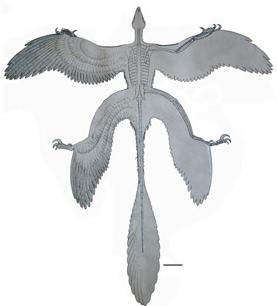
The strength of the arboreal hypothesis derives from multiple sources.  The first is that the requisite physiology necessary for flight was not present in many feathered theropod dinosaurs, and thus, self-powered flight was not possible.  Therefore, climbing a tree to achieve flight would explain how flight could be achieved without all of the pieces being in place.  Second, contemporary birds are arboreal, and inhabitat almost every vertical niche one can think of.  Third, there are many other arboreal inhabitants that have evolved the ability to glide due to their arboreal lifestyle.  For example, flying squirrels and lizards with skin flaps jump from trees and use various adaptations to glide to another branch.  And finally, the arboreal hypothesis provides an argument for the extensive feathering we see on the bodies of Microraptor and Archaeopteryx (Figure 2). 
Figure 2: Many therapod dinosuars in the avian lineage, such as this Microraptor, are known to have been covered with  feathers,  including long feathers extending from both forelimbs and hindlimbs, as well as from the tail, suggesting that early birds were gliders rather than capable of powered flight.
An explanation on the periphery is that wings were primarily helpful for young birds that would climb trees to return to nests they had fallen from.  This idea, known as assisted-incline running is argued most forcefully by Ken Dial (Dial, 2003).  Dr. Dial has studied chukars (Alectoris chukar) in the lab and notice that they will pump their wings to scale inclines in the lab (Figure 3).  The fact that there is a modern bird that uses wing-inclined running makes it more attractive than the cursorial theory that is not supported among modern birds.  In contrast, the theory suffers from fossils that are incongruent with wing-assisted incline running.  Specifically, fossils such as microraptor have feathers on both the hindlimbs and tail; and the feathers in these areas would be unnecessary if used for wing-assisted incline running.   
Figure 3: One potential explanation for how flight evolved involves using wings to help scale inclines.  Although plausable and supported empirically, it probably isn't as good of an explanation as the tree-down, or arboreal hypothesis. 
Most recently, a group from Montana State University has proposed that the evolution of feathers in theropod dinosaurs was used primarily to help stabilize the predator while it was pinning it’s prey with feet (Fowler et al., 2011).  The argument is that theropod dinosaurs, like birds of prey today, would pin their prey down using both feet.  Pinning the prey was enhanced by strong legs and large talons that are used to hold prey that are large enough that they may escape.  Importantly, once the prey has been pinned, the prey may still struggle, thus causing the theropod to lose balance – since it’s legs are being used to grasp the prey.  To help stabilize the predator, the authors argue that feathers would have evolved and wing beats could be used to stabilize the predator while it consumed the prey.  Similar to the other hypotheses, this idea is plausible; however, it still does not explain the extent of the feathers on the entire bodies of many of the earliest bird ancestors. 

Similar to the diversity of birds we see today, there is a diversity of hypotheses that have been offered to explain the evolution of flight in birds.  The four hypotheses: the cursorial, arboreal, wing-assisted inclined running, and predator stabilization, all provide potential explanations for flight.  Some of these hypotheses are even reinforcing.  For example, an arboreal lifestyle would have likely favored making nests in trees, which would have then favored individuals that fell out of nests to re-ascend into the tree.  Therefore, the non-mutually exclusive arboreal and wing-assisted incline running hypotheses could complement each other.  In total, however, the main hypothesis that is still considered the most likely is the arboreal hypothesis.  The arboreal hypothesis can explain many of the phenomena we see in extant birds, and much of the physiology in ancestral birds.  Therefore, birds arguably evolved flight to glide first, and over time gained the adaptations necessary to perform powered flight.  Thus resulting in the avifauna we see today. 
Barrow's Goldeneye, Rodeo Lagoon, Marin Headlands, CA [Photo by Lukas Musher]
By Gavin Leighton


Gavin is a PhD candidate at the University of Miami studying cooperative behavior in Sociable Weavers.  To learn more about Gavin, see our Guest Writers page.

Citations:

Dial, K. (2003). Wing-Assisted Running and the Evolution of Flight.  Science. 17: 402-404

Fowler et al. (2011) The Predatory Ecology of Deinonychus and the Origin of Flapping in Birds. PLoS ONE 6(12).

Nudds, RL., Dyke, GJ. (2010). Narrow Primary Feather Rachises in Confuciusornis and Archaeopteryx Suggest Poor Flight Ability.  Science. 14: 887-889. 


Sunday, January 8, 2012

The Why of Fly - The Origin and Evolution of Flight in Birds: Part 1

By Gavin Leighton

The most salient trait of birds is their ability to fly. Flight allows peregrine falcons to dive at just over 200 miles/hour, flight allows for migration, and flight allows birds like albatrosses to make vast expanses of ocean their home. Indeed, the evolution of flight was a critical event (and maybe the critical event) in the evolution of birds. Given the importance of flight for the class Aves, evolutionary biologists have long studied the origins of flight, and researchers are beginning to delineate how and why birds evolved flight.
Peregrine Falcon, Point Reyes, CA.  Dec. 2011 [Photo by Lukas Musher]
How birds evolved wings with flight feathers is an interesting story, especially since flight has evolved independently at least four times (insects, bats, pterosaurs, and birds). To begin I will very briefly outline the major physiological steps that produced wings that could produce self-powered flight. In the second part of the series, I will try to describe the selective mechanisms that favored the following physiological changes.

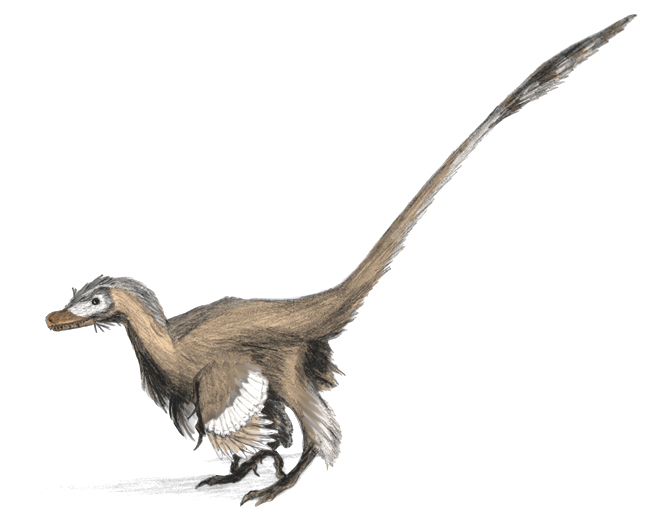
Birds’ closest ancestors were theropod dinosaurs (1). We all know what theropods dinosaurs are thanks to Jurassic Park (and as far as I’m concerned, only one Jurassic Park movie was ever made and it came out in 1993). As depicted in Jurassic park dinosaurs such as Velociraptor (see below), which is actually much smaller than depicted in the movie , and Tyrannosaurus, which may have been more of a scavenger than a predator, are both examples of theropod dinosaurs. In general, theropods were bipedal dinosaurs with strong hindlimbs and a long tail that was likely used for balance. From theropods we get birds, here is a woefully brief description of how.
An artist's rendition of velociraptor [Wikipedia]
To get from velociraptor to a contemporary bird, the first thing we need is feathers. Feathers were traditionally thought to only occur in birds, but a cascade of recent evidence demonstrates that many theropod dinosaurs had feathers as well (2) – I know what you are thinking, and no, Tyrannosaurus Rex could not fly. The theropod feathers were not used for flight, so other explanations must be invoked. The two common explanations are that the dinosaur “protofeathers” were used for signaling during sexual selection (due to the types of melanin researchers have found in fossils we know the dinosaur feathers were black, white, or red-brown type colors [3]); or, for facilitated thermoregulation. These two ideas are not mutually exclusive and hopefully future work will indicate the selective pressures that favored the evolution of the first feathers.
An artist's rendition of anchiornis [National Geographic]

At this point we have feathers on a roughly bi-pedal animal, but we still aren’t close to powered flight. To get powered flight we must move from the proto-feathers (see below) here is a very simple model of how feathers evolved) that resemble the downy feathers of chicks, to asymmetrical flight feathers. To get to contemporary flight feathers, feathers passed through intermediate stages, and an excellent review of this process was “Which came first, the feather or the bird?” by Prum and Brush (2003 – see citation 2). One of the main intermediate stages is the symmetrical flight feather (3). The symmetrical flight feather, compared to the asymmetrical flight feather, is actually worse for flying due to physics that will not be described here. Despite problems with a symmetric feather, components of the symmetrical flight feather were useful. For example, there are tiny hooks called barbules that help smooth the feather to maintain a feather’s airfoil shape. The evolution of barbules almost certainly occurred with or after the evolution of the symmetrical flight feather, thus making the symmetrical flight feather a useful stage to focus on. So, let’s skip ahead a bit and assume we have some sort of flight feathers on the arms, what comes next is the development of adequate wings.
Proto-feather evolution in chronological order. [Wikipedia]
The change from forelimbs with separated digits to the common bird wing involved numerous skeletal changes that I won’t describe.
Wings, such as the long wings allowing Black-footed Albatross to wander countless miles over vast expanses of ocean
evolved from the forelimbs of therapod dinosaurs. Pelagic out of Fort Bragg, CA. Aug. 2011. [Photo by Lukas Musher]

What I will mention as an aside is the downstream evolutionary consequences after wings evolved. After proto-birds lost any sort of forelimb dexterity, the duty of manipulating objects was transferred to the beak. This transfer likely explains the extraordinary diversity of bill forms, compared to other groups. So lets assume that the wing morphology is coming into place, even with wings, other physiological structures and adaptations were necessary to yield contemporary birds. Among the adaptations are hollow bone structures that largely reduce the weight of a bird (1), and save the bird significant amounts of energy during flight. And to actually get into flight, birds rely on their oversized breast muscles, which became so powerful that they need to be anchored to a keeled sternum.
Archeopteryx lithographica, Wyoming Dinosaur Center.  Taxonomically the first bird.  One of 8 specimens worldwide.
Note the details of feathers and other traits that link dinosaurs to birds including the furcula. [Photo by Lukas Musher]
All of these physiological adaptations compose the part of the story that describes “how” bird physiology changed over time to allow for powered flight. In addition to how birds anatomy changed, a complementary question is “why” birds are the way they are, and not otherwise. To answer why birds can fly, several ideas have been posited with varying degrees of support. In part 2 of this series, I will limn the most well established ideas for why birds evolved flight and some of the newer ideas as well. 

Gavin Leighton is a PhD candidate at the University of Miami, studying cooperative behavior in Socialble Weavers.  See more on Gavin at Guest Writers.

Citations:
1 Kaiser, G. The inner bird: anatomy and evolution. 386 (2007).
2 Prum, R. & Brush, A. Which came first, the feather or the bird? Sci Am 288, 84-93 (2003).
3 Vinther, J., Briggs, D. E. G., Clarke, J., Mayr, G. & Prum, R. O. Structural coloration in a fossil feather. Biol Letters 6, 128-131, doi:10.1098/rsbl.2009.0524 (2010).

To read the Why of Fly - the Origin and Evolution of Flight in Birds: Part 2, click here.

Tuesday, December 20, 2011

Socializing with Socaible Weavers


Adult sociable weaver.  Sex can't be identified in the field and we have to use genetics to identify the sex of the weavers.[Photo by Gavin Leighton]
Avian biology and behavior have contributed much to our understanding of social behaviors.  The natural world is rife with prosocial behaviors, despite the tendency for natural selection to promote selfish individuals. An especially intriguing case of cooperative behavior is displayed by Sociable Weavers (Philetairus socius).  These small birds (~30g) live in semi-arid savannah in southwestern Africa; but what sets these small passerines apart is that they live in colonies that build and maintain perennial, communal nests (See below). Interestingly, several other species of birds such as Pygmy Falcons, Rosy-faced Lovebirds, and Scaly-feathered Finches have been known to roost in the empty chambers of Sociable Weaver nests. 
Sociable weaver colony.  At the colony we trapped 108 birds. [Photo by Gavin Leighton]
The communal nest also presents an opportunity to understand the evolution of cooperative behaviors that maintain communal goods.  Theoretically, Sociable Weavers that exploit the nest-building behavior of other weavers should be selectively favored, therefore increasing selfishness.  In contrast, such selfishness is avoided, and I am interested in delimiting the evolutionary mechanisms that maintain cooperative nest construction in Sociable Weavers.
These are two rosy-faced lovebirds, one of the species of parrots in Namibia.  Common in the Khomas region, they are known to hang around sociable weaver nests and in some cases even roost in the chambers of a sociable weaver nest. [Photo by Gavin Leighton]
One possible mechanism that may maintain cooperative nest construction is kin selection.  Kin selection supports cooperative behaviors by allowing cooperative individuals to spread their genes by helping relatives reproduce, who share genes with the actor due to common ancestry.  To delineate the relatedness of Sociable Weaver colonies, I recently visited Namibia to collect blood samples from Sociable Weavers.  The weavers are trapped en masse in the morning and it often requires multiple individuals to quickly remove all the birds.  I removed blood from the trapped individuals and will be performing genetic analyses to see if the nests are composed of extended family groups. 

To complete the work, I was helped by multiple individuals from the local city.  Most of the individuals that helped with the projects were Namibian ornithologists in the region, and most of these individuals are birders by passion and have a career in a field other than avian biology.  This is probably the most salient difference between birders in the US and Namibia.  In the US, most bird banding is conducted at designated banding stations, whereas in Namibia banding is performed by a dedicated group of individuals who band on the weekends and in back yards.
Ostrich.  The red on the lower shins is indicative that this individual is in breeding condition. [Photo by Gavin Leighton]
Such banding is critical to the success of Namibian ornithology, as there are no dedicated banding stations or dedicated ornithologists at the universities.  Due to the lack of research in the country, much of the bird life in the region is still shrouded in mystery.  As an example, Ludwig’s bustard is endemic to the region, but only one individual has ever been banded, and its behavior and breeding tendencies are almost completely unknown.  The landscape is entirely wide open, and the density of birds reflects the pristine habitat; in one day we found a nest of Secretary Birds 200 meters away from a nest of Lappet-faced Vultures.  Namibia also offers diverse habitats for birds and birders; from coastal regions to two deserts, birds of all types inhabit the land of Namibia.   
Yellow Canary. [Photo by Gavin Leighton]
Purple-cheeked waxbill.  Common in the region. [Photo by Gavin Leighton]
Scaly-feathered finch.  Like Rosy-faced lovebirds, Scale-feathered finches are known to join sociable weaver feeding flocks and are also reported to roost in the chambers of sociable weaver nests. [Photo by Gavin Leighton] 

By Gavin Leighton