To read The Why of Fly - The Origin and Evolution of Flight in Birds: Part 1 by Gavin Leighton, Click here.
 |
| How flight evolved is one of the oldest and yet most uncertain questions in avian evolutionary morphology. Below, Gavin explains some of the prominent hypotheses that may explain the evolution of flight in the context of ecology. White Hawk, Chan Chich, Belize [Photo by Lukas Musher] |
In the first post I explored some of the requisite
physiological/morphological changes necessary for flight in birds. Importantly, these physiological
changes did not arise in a vacuum, and there remain the interesting questions
of what selective forces could change the body plan of birds so that flight was
possible. Since flight evolved in
birds millions of years ago, one can not definitively define the specific
selective pressures that contributed to bird evolution. Despite this difficulty, we still have
a set of several competing hypotheses for the selective factors promoting
flight. These factors are
described below in conjunction with the evidence for each hypothesis.
The first explanation is the oldest explanation, having been
proposed in 1879 by Samuel Williston.
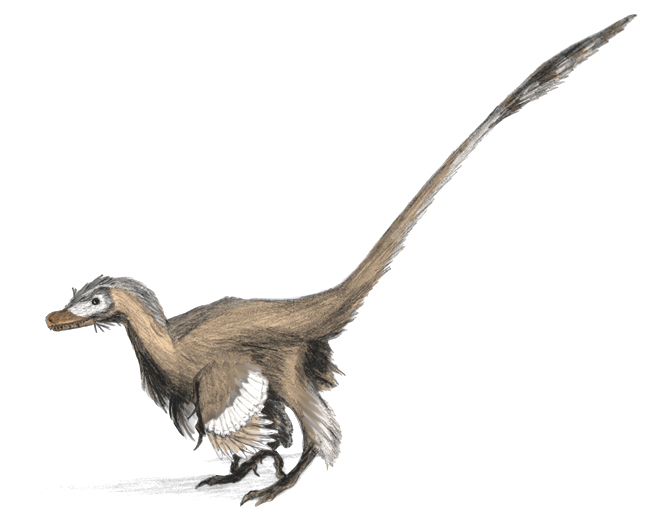
This first explanation for flight is the cursorial hypothesis (Figure 1). The cursorial hypothesis posits that
the bipedal ancestors of modern birds would run to catch their prey. To facilitate catching prey that was
flying away (think insects), the ancestors would leap into the air to obtain
the prey. While the cursorial
hypothesis seems technically possible, the theory is not parsimonious. First, to gain sufficient ground speed
for considerable ascent the ancestors of birds would have to have been faster
runners than the birds today.
Second, after liftoff, the increased drag would after liftoff would have
limited the ascent. Finally, and
perhaps convincingly, we don’t see this behavior in any extant birds today,
suggesting that either this explanation is erroneous, or that feathers evolved
according to the cursorial hypothesis and then the behavior was subsequently
lost by any and all ancestral birds.
 |
| Figure 1: The cursorial hypothesis. Therapod dinosaurs that could achieve short bursts of lift may have been better able to catch flighted prey (i.e. insects; dinosaurs like Archeopteryx were not much larger than an American Robin), thus giving them an advantage in survival and reproduction. Unfortunately this hypothesis is not well-supported. |
One of the major hypotheses for why flight evolved
capitalizes upon observations of contemporary birds. Since many birds spend significant time in the trees, the
arboreal hypothesis of flight argues that wings evolved to help birds navigate
from tree to tree. The progression
of evolution begins with individuals living primarily arboreal lifestyles (i.e.
foraging in trees and spending most of the time in tree canopies). Such a lifestyle would put selection
pressure on individuals to move from tree to tree without having to return to
the ground first. These
observations led to the arboreal theory.
The arboreal theory is the most strongly supported theory
and also provides a plausible progression of feathers. Specifically, the first arboreal
individuals would have utilized the feathers to glide from branch to branch,
instead of flapping their wings.
Indeed, research indicates that many of the early feathers would not
have been able to withstand the force of a downstroke during flight (Nudds and
Dyke, 2010). Since individuals
could not flap their wings to take off, one would expect that the first flight,
or proto-flight, took place when birds would jump from branches to reach
another branch.
The strength of the arboreal hypothesis derives from multiple
sources. The first is that the
requisite physiology necessary for flight was not present in many feathered theropod
dinosaurs, and thus, self-powered flight was not possible. Therefore, climbing a tree to achieve
flight would explain how flight could be achieved without all of the pieces
being in place. Second,
contemporary birds are arboreal, and inhabitat almost every vertical niche one
can think of. Third, there are
many other arboreal inhabitants that have evolved the ability to glide due to
their arboreal lifestyle. For
example, flying squirrels and lizards with skin flaps jump from trees and use
various adaptations to glide to another branch. And finally, the arboreal hypothesis provides an argument
for the extensive feathering we see on the bodies of Microraptor and Archaeopteryx
(Figure 2).
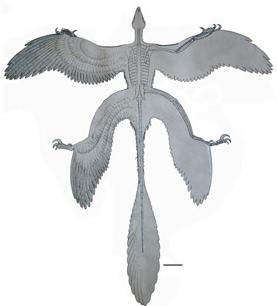 |
| Figure 2: Many therapod dinosuars in the avian lineage, such as this Microraptor, are known to have been covered with feathers, including long feathers extending from both forelimbs and hindlimbs, as well as from the tail, suggesting that early birds were gliders rather than capable of powered flight. |
An explanation on the periphery is that wings were primarily
helpful for young birds that would climb trees to return to nests they had
fallen from. This idea, known as
assisted-incline running is argued most forcefully by Ken Dial (Dial, 2003). Dr. Dial has studied chukars (Alectoris chukar) in the lab and notice
that they will pump their wings to scale inclines in the lab (Figure 3). The fact that there is a modern bird
that uses wing-inclined running makes it more attractive than the cursorial
theory that is not supported among modern birds. In contrast, the theory suffers from fossils that are
incongruent with wing-assisted incline running. Specifically, fossils such as microraptor have feathers on
both the hindlimbs and tail; and the feathers in these areas would be
unnecessary if used for wing-assisted incline running.
 |
| Figure 3: One potential explanation for how flight evolved involves using wings to help scale inclines. Although plausable and supported empirically, it probably isn't as good of an explanation as the tree-down, or arboreal hypothesis. |
Most recently, a group from Montana State University has
proposed that the evolution of feathers in theropod dinosaurs was used
primarily to help stabilize the predator while it was pinning it’s prey with
feet (Fowler et al., 2011). The
argument is that theropod dinosaurs, like birds of prey today, would pin their
prey down using both feet. Pinning
the prey was enhanced by strong legs and large talons that are used to hold
prey that are large enough that they may escape. Importantly, once the prey has been pinned, the prey may
still struggle, thus causing the theropod to lose balance – since it’s legs are
being used to grasp the prey. To
help stabilize the predator, the authors argue that feathers would have evolved
and wing beats could be used to stabilize the predator while it consumed the
prey. Similar to the other
hypotheses, this idea is plausible; however, it still does not explain the
extent of the feathers on the entire bodies of many of the earliest bird
ancestors.
Similar to the diversity of birds we see today, there is a
diversity of hypotheses that have been offered to explain the evolution of
flight in birds. The four
hypotheses: the cursorial, arboreal, wing-assisted inclined running, and predator
stabilization, all provide potential explanations for flight. Some of these hypotheses are even
reinforcing. For example, an
arboreal lifestyle would have likely favored making nests in trees, which would
have then favored individuals that fell out of nests to re-ascend into the
tree. Therefore, the non-mutually
exclusive arboreal and wing-assisted incline running hypotheses could
complement each other. In total,
however, the main hypothesis that is still considered the most likely is the
arboreal hypothesis. The arboreal
hypothesis can explain many of the phenomena we see in extant birds, and much
of the physiology in ancestral birds.
Therefore, birds arguably evolved flight to glide first, and over time
gained the adaptations necessary to perform powered flight. Thus resulting in the avifauna we see
today.
 |
| Barrow's Goldeneye, Rodeo Lagoon, Marin Headlands, CA [Photo by Lukas Musher] |
Citations:
Dial, K. (2003). Wing-Assisted Running and the Evolution of
Flight. Science. 17: 402-404
Fowler et al. (2011) The Predatory Ecology of Deinonychus and the Origin of Flapping in Birds. PLoS ONE 6(12).
Fowler et al. (2011) The Predatory Ecology of Deinonychus and the Origin of Flapping in Birds. PLoS ONE 6(12).
Nudds, RL., Dyke, GJ. (2010). Narrow Primary Feather
Rachises in Confuciusornis and Archaeopteryx Suggest Poor Flight
Ability. Science. 14:
887-889.