Showing posts with label Gulls. Show all posts

Thursday, February 9, 2012

My Mystery Gull

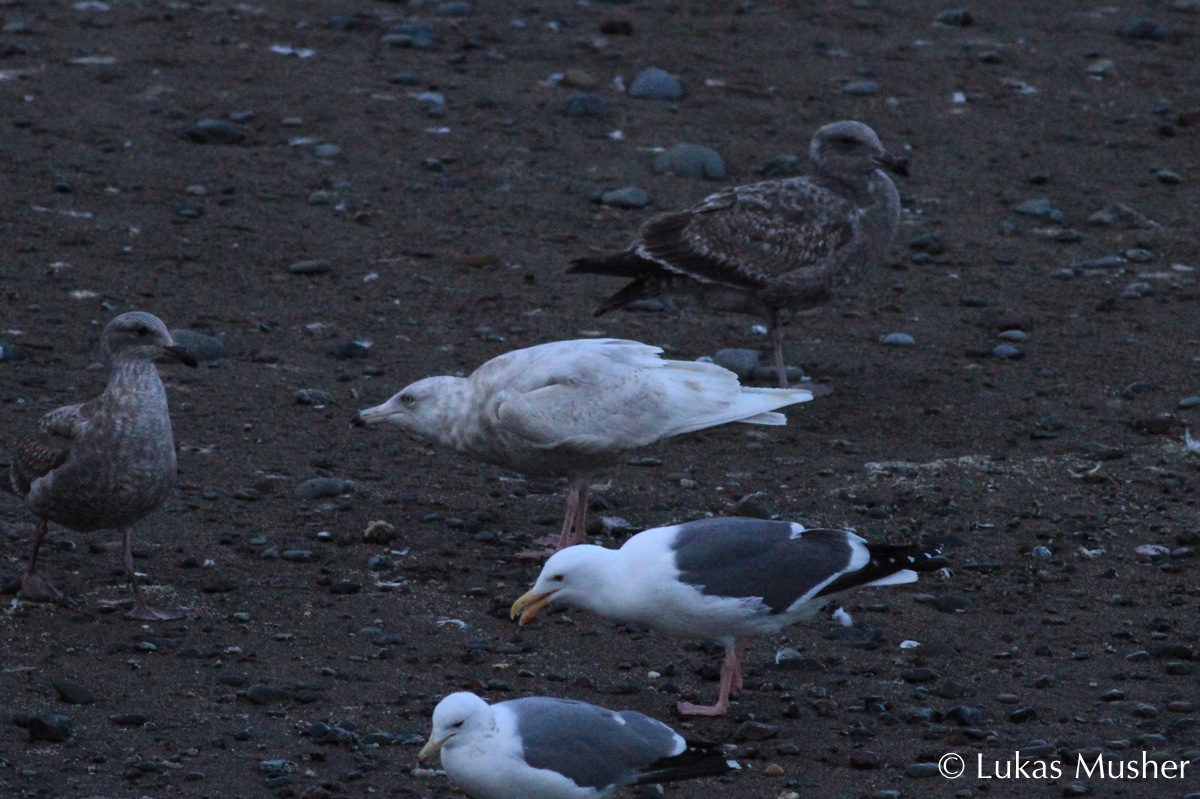
A few days ago, I included two photos of a mysterious gull I found while gulling at Fort Baker, Marin county, CA.  Still no consensus on the bird, and it looks like there probably won't be, but I figured it would be good to post the field marks of this bird, and the direction I and others are leaning on this.
Originally I suspected a Glaucous X something hybrid based on bill structure and color, and head structure.  I suspected a first cycle bird based on plumage and dark iris.  After reviewing the photos more, and corresponding with experts, the bird appears to be more likely a second cycle bird.  Gray feathers are coming in on the mantle, and the primaries look rounder-tipped rather than pointy as first cycle birds have.  The overall uniformity in plumage color suggests GWGU X something as well (if not pure GWGU!), though mixed birds can be rather uniform in their second cycle.  Nelson's Gulls generally have more patterning on the greater coverts and primaries.
Now that we know this bird is most likely a second-cycle it allows us to eliminate certain options.  Nelson's becomes exceedingly less likely because they should show a pale iris in their second cycle.  Glaucous-winged Gull (GWGU) X something then becomes exceedingly more likely since GWGU has a dark iris in its second cycle.
Bill shape and size is large in GWGU, and is bicolored in second cycle, but rarely is the coloration this extreme.  On closer inspection, though, the bill is not really all that pink as would be expected in a Glaucous hybrid.  Similarly when looking at the photo above, bill structure seems less suitable for a Glaucous hybrid (that doesn't necessarily mean it isn't).  Originally the bill looked large and heavy, but when taking a closer look, the bill doesn't look all that different from a typical Herring Gull bill.

It seems like the best arguments I've heard are for Herring (really Smithsonian, but let's not go there now) Gull X GWGU.  Still, I've received more votes for Nelson's than anything else.

Any more ideas about this gull are welcomed.  Email us or comment on this post if you have anything to add.  As a side note, check out the single dark feather on this bird's scapulars - very strange.

By Luke Musher

Monday, February 6, 2012

The Herring are Running: Glaucous and Mystery Gull

Right now, the herring are running in the bay area, and the gulls are going nuts feeding on eggs and perhaps even the fish themselves.  Cory, Dan, Frenchie and I went to see what we could find yesterday afternoon at Fort Baker in Sausalito.  Large numbers of Mew, California, Western, Herring, and Glaucous-winged, hundreds of Thayer's and at least one Glaucous Gull.  We also found a bird that looked odd.  First cycle "Nelson's" Gull came right to mind, although I've only seen one of these ever, and cannot be certain.  Structurally the bird looks like a Glaucous, and the pink and black bicolored bill supports Glaucous in its ancestry.  Glaucous-winged X Glaucous isn't too rare, and mixed ancestry between these two species is certainly a possibility as well.  We encourage readers to comment with their thoughts on this bird as well (photos below).  An Iceland Gull had been seen the past two days, but we unfortunately could not locate it amongst the thousands of gulls.  Here are some photos.  We were there late in the afternoon, and we didn't find the Glaucous Gull until late, so the photos are dark.
Mystery Gull.  Possibly a "Nelson's" (Herring X Glaucous), which was my first thought, but personally I'm not sure.  We welcome your insight, and will update when we know more. [Photo by Lukas Musher]
The mystery gull again with Glaucous-winged (left), California (background), and Herring (foreground).
First cycle Thayer's Gull
This banded Western Gull had a fishing hook and line tangled around its left leg, which didn't look to healthy.  Otherwise the bird seemed to be in fairly good health.
Second cycle Glaucous Gull with Western, Herring, Thayer's and California Gulls
Second Cycle Glaucous Gull
Second cycle Glaucous Gull in long call posture
Second cycle Glaucous Gull (center)
Compare this presumed "Nelson's" Gull with the mystery bird above.  Pelagic out of Lewes, DE. February 2011.  
By Luke Musher

Sunday, January 29, 2012

Drake's Beach Birding Photos

Dan Lipp, Cory, and I visited Drake's Beach yesterday.  Nothing too noteworthy except for two Red-necked Grebe and two Black Scoters.  Otherwise it was a pretty typical day birding Point Reyes waters.  
Marbled Godwit, Drakes Beach, Point Reyes, CA
Ring-billed Gull (adult), Drakes Beach, Point Reyes, CA
Mew Gull (adults), Drakes Beach, Point Reyes, CA
Marbled Godwits, Drakes Beach, Point Reyes, CA
Mew Gull (adult), Drakes Beach, Point Reyes, CA
Mew Gull, Drakes Beach, Point Reyes, CA
Western Gull (second cycle) with Mew Gulls, Drakes Beach, Point Reyes, CA
Western Gull (adult), Drakes Beach, Point Reyes, CA
Elk near Drakes Beach


By Luke Musher

Friday, December 16, 2011

Gull Watching: Glaucous Gull

So I don't have any photos of adult Glaucous Gulls, but I have some photos of a first cycle bird that I think could be cool to share on the blog.  I wish I had some adults to share, but we'll have to do without.  Adults will have the same structural features and will be very pale gray on the upperparts with white wing tips and yellow bill.  Let's look at the first cycle bird though.
First cycle Glaucous Gull. Note long heavy bill, flat crown, large and stocky in size and shape, and mostly white plumage.  Bill brightly bicolored, pink-based and black-tipped.  February 2011.  Pelagic out of Lewes, DE. [Photo by Lukas Musher]
Glaucous Gull with Herring Gull. Note whitish plumage and wings.  February 2011. Pelagic out of Lewes, DE. [Photo by Lukas Musher]
See previous posts for species list in this photo.  First cycle Glaucous Gull (center-right).  Note that this bird is large and heavy-bodied with broad wings and a large pink and black bicolored bill, flat crown with bulging forehead.  White with brown wash, and nearly white flight feathers. February 2011. Pelagic out of Lewes, DE. [Photo by Lukas Musher]
Presumed "Nelson's" Gull, Herring X Glaucous Gull hybrid.   Note structural features similar to pure Glaucous Gull, with darker plumage (though still rather pale), brownish flight feathers, and heavy bicolored bill.  February 2011.  Pelagic out of Lewes, DE. [Photo by Lukas Musher]

Compare these photos with first cycle Iceland Gull (to come).

By Luke Musher

Friday, December 9, 2011

Gull Watching: Intro

As autumn quickly becomes winter, it's time to start watching gulls.  Rare gulls have been turning up across the country including a Black-tailed Gull in Ohio and Slaty-backed Gull in New York.  Recent reports from back in PA, NJ, and NY have me craving gulls here in CA.  I've been going out every so often to try to learn more about gull ID.  I am no expert, and many of the gulls that I see are never completely identified.  I used to be way overconfident about gull ID, but the more I watch gulls, the more I realize that there are so many bird out there that don't match the guides; hybrids are common and variation within species seems almost infinite.  Yet the more I watch, the more watching I want to do.

One of the great parts about living in Bolinas, CA is that the lagoon is only eight or so minutes away, and especially at low tide, all the main pacific gull species can be found.  I've seen California, Ring-billed, Mew, Herring, Western, and Glaucous-winged Gulls here, and many birds that looked good for Thayer's but never had a positive ID.  Nearby, in Petaluma, I've had a few of them, but I still have lots to learn about IDing gulls.  I have decided to write a short post every day for the next week or so showing a few photos of one species per day.  Again, I am no expert when it comes to gulls, but I accept the fact that I cannot ID every gull that comes my way, and am willing to work with that.  For most large, white-headed gulls I prefer to use structure first to ID, and then plumage/coloration, but there are obviously some exceptions here.  I won't even come close to showing every age, plumage or possible species, but I will share a few photos of some expected winter gulls in the lower 48.

For now, enjoy these photos of some gulls I have taken.  Look at the photos, and try to figure out what it is you are looking at.  If there are multiple birds in a photo, are they all the same species or mixed species? What species do you see?  What field marks do you see, even if you can't ID the bird downright?  Flip through your field guides, and see what you can learn and figure out.  Or perhaps you don't need a field guide to identify these birds.  That is fine, too.  I will post about the species in each photo tomorrow.
Feb. 2005, Berkley, CA [Photo by Lukas Musher]
Feb. 2011, Pelagic off of Lewes, DE [Photo by Lukas Musher]
Feb. 2011, Pelagic out of Lewes, DE [Photo by Lukas Musher]
Nov. 2011, Lake Merit, Oakland, CA [Photo by Lukas Musher]

By Luke Musher