Showing posts with label pennsylvania. Show all posts

Wednesday, May 29, 2013

BOOM.....Not a bird!!

By Cory DeStein


Earlier today I decided to hit up the mountains of Fayette County again, rather than spending a day focused on the birding I decided to spend my morning looking for some of the regions reptiles! Unfortunately with my limited time schedule I was only able to come up with three species, but it was a great morning to be out exploring. I started my morning off along the Youghiogheny River, searching for Northern Copperheads. Of Pennsylvania's three species of venomous snakes, the Copperhead is the most widely distributed and abundant. The cryptic coloration of this species allows them to melt into their habitat of dried leaves on the forest floor. Earlier in the week my friend Aaron and I checked an area along the Yough River and nearly missed a snake right infront of us as it blended into leaf litter.
iPhone photo of Northern Copperhead


Heading back to the same area today, I did not find any snakes along the rocky hillside. Instead I checked along the river and along some of the rocky ledges where we had 2 copperheads earlier in the week. Sure enough not far from the original spot, the two snakes were sunning themselves in the early morning. A great start to the day!
2 Northern Copperheads

With the temperature increasing rapidly I decided to head up the ridge for rattlesnakes, before they retreated to the rocks to escape the heat. Timber Rattlesnakes can be found in the spring and fall basking at primarily southern facing outcrops, boulder fields, and forest openings. One of the most feared snake in Pennsylvania, I find they are one of the most timid, docile, and misunderstood. This is my third summer going out with the goal of finding these pit vipers, and the hunt has taken me to some truly beautiful habitat. Timber Rattlesnakes prefer forested habitat above 1800 feet in elevation, and Fayette County is exactly that. The first spot I hit was a secluded boulder field, where I have had up to 13 rattlers in the past as well as 4 different species of snake. This spring I have only observed two gravid(pregnant) females, but today only 3 Northern Ringneck Snakes were found.
Flipped a rock to find these 3 Northern Ringneck Snakes

Striking out on rattlers at the meadow, I headed over to a rocky outcrop that is reliable for the snakes through out the spring. Venturing out onto the rocky ledge, I encounter 2 Five-lined Skinks scurrying across the stones. Near the edge of outcrop I came upon the rock that has been most reliable for snakes, 9 rattlers were out sunning themselves along the boulder's edges. A few retreated under the rock as I approached, but a majority remained still and silent, relying on their perfect camouflage. Quite a few of these snakes were clearly gravid, impregnanted the previous summer and due to give birth to live young this fall. I was excited to find a small yellow phase hidden among 3 black phases, only the second yellow I have seen in the county.
First Yellow Phase I have seen in the county since 2010.

Soon the males and non-gravid females at this location will begin to move off into the forest, the males up to 2 miles from the den. The gravid females will carry out their 14 month gestation typically within 200 yards of the den. They will not typically feed during this time and will give birth to live young in late August to September. These females are not sexually mature until the age of 7 or 8, and males mature around the age of 5 years. Protecting the locations of these maternity sites is crucial in protecting the species from illegal collecting and poaching. In Pennsylvania snake hunters are allowed to collect 1 Timber Rattlesnake a year with a permit, only males over 42 inches in legnth with 21 or more sub-caudal scales. These are beautiful misunderstood creatures that for me represent the Pennsylvania Wilds. They face constant human threats everyday from vehicles, habitat destruction, poaching and just senseless killings.
Closeup! 

Black Phase
Gravid females


Thursday, May 23, 2013

BOOM....Grassland Birds

By Cory DeStein


The Imperial Grasslands in Allegheny County is a large reclaimed strip mind with impressive grasslands, wetlands, and shrub habitat. The area has a long history when it comes to property development,  trespassing and some remarkable bird records for the county. In the past Blue Grosbeak and Short-eared Owls bred in the area. In the winter White-winged Crossbills, Common Redpolls, Northern Shrike, and Rough-legged Hawks can be viewed here. The area known to local birders as Main Pond has held impressive records such as; Snowy Plover, American Avocet, Whimbrel, Western Sandpiper, Buff-breasted Sandpiper and all three phalaropes. For my walk this week I was able to enjoy breeding birds such as Bobolink, Eastern Meadowlarks, Prairie Warbler, Blue-winged Warbler, Henslow's Sparrow, Vesper Sparrow, Savannah Sparrow and Grasshopper Sparrows.
Just 1 of 30 Grasshopper Sparrows
Hitting the area at sunrise I immediately stumbled upon a Black Rat Snake being scolded by Prairie, Yellow, and Blue-winged Warblers. With my accidental interruption the reptile retreated to denser cover and the birds went back to their business. Coming to extensive grasslands I could hear Eastern Meadowlarks, Grasshopper Sparrows, and Vesper Sparrows singing. A Red-winged Blackbird chased a male Bobolink across a small pond where 4 Lesser Yellowlegs were feeding. Scanning the fields I spotted another male Bobolink singing, the bird was exceptionally tame and allowed me to approach within a respectable distance for some photography.
Male Bobolink
While photographing the Bobolink, I began to hear a new song being sung nearby, Henlow's Sparrow! This was a new bird in Allegheny County for me. I ended with at least 6 birds total for the day, including a very cooperative male singing from a nearby shrub.
Allegheny County Henslow's Sparrow!
Baltimore and Orchard Orioles, Yellow Warbler, Hooded Warbler, Wood Thrush, Great-crested Flycatcher as well as a Yellow-breasted Chat were singing from a nearby woodlot as I worked my way back to the car. Sadly this ever shrinking grasslands continues to be threatened with development  The ponds are drained, new roads are paved, and new construction flags seem to appear daily. I am only enjoying a small portion of what the grasslands was when birders began heavily using it in the 90's. Interesting in one of the new industrial parks a small pond was developed which held a pair of Ross's Geese in 2011, Red Phalarope in February of 2012!!? And breeding Sora this past summer. Time will tell what development holds in store for this unique area.
Eastern Meadowlark 

Male Bobolink

Eastern Meadowlark 

Thursday, May 16, 2013

An Introduction to Fayette County

By Cory DeStein


Hi everybody! My name is Cory DeStein, I am a birder from Pittsburgh, Pennsylvania. I have joined Cory and Luke here as the newest contributor to Boom. Unlike these guys, I actually do not work in the bird field, I am a nurse at a pediatric hospital in Pittsburgh. I bird strictly for hobby! My goal is to be able to share with you all my birding adventures in Pennsylvania, birding trips through out the country, photography, and my amusing adventures with attempting to increase my yard list. 

This spring I have dedicated nearly all of my time birding to Fayette County in the southwest region of Pennsylvania. For the month of May I have reached 90 species for an area, State Game Lands 51 near the town of Dunbar. This large game lands contains rhododendron lined thickets along Dunbar Creek with a nearly 800ft elevation gain to the Zebley Flats area, a primarily secondary growth forest with multiple access roads along the Chestnut Ridge. It's a great area for countless hours of exploring. I began birding this particular patch in 2009 when I first got into birding. I went without any maps or knowledge of the area and began exploring, each day I continue to find new and interesting gems in the massive location. Golden-winged Warblers have bred through out Zebley Flats, and I have had 2 sightings of Northern Goshawk over the years. Mammal highlights have included American Black Bear, Gray Fox, and Fisher! Allegheny Woodrat breeds in the area, but I have not found one...yet! I have also had 9 species of reptile and 7 species of amphibians.
Kentucky Warbler along Dunbar Creek. 
I started the morning off along Dunbar Creek, the drive in was loaded with Kentucky Warblers, Louisiana Waterthrush, Worm-eating Warblers and Wood Thrush. From the parking area I picked up plenty of Magnolia Warblers, Song Sparrow, House Wren, as well as a Great-blue Heron fishing in the creek. Working my way up the ridge through the hemlocks I caught sight of a Swainson's Thrush lurking in the underbrush. Climbing up the ridge I continued to enjoy plenty of Worm-eating Warblers as well as Northern Parula singing from the eastern hemlocks. 
Worm-eating Warbler
At the mid-way point up the mountain you come to a clearing with multiple food plots, fruit trees, and dense underbrush. This has worked out to be one of the better migrant traps I have come across here. Kentucky Warblers continued to call in all directions as well as Louisiana Waterthrush. A Wilson's Warbler popped up from the brush along with the White-crowned and White-throated Sparrows. Red-breasted Nuthatches were calling from the larches a bird I have never had breeding here, but appears that this year they are. Accompanying the nuthatches in the trees were at least 5 Rose-breasted Grosbeaks feeding with the males singing up a storm. Carefully checking the fruit trees I was able to add Magnolia, Nashville, Tennessee, Hooded, Black-and-white, and Black-throated Green Warblers to my day list as well as a nearby singing Winter Wren. 
1 of 5 Rose-breasted Grosbeaks in a single tree!
Conquering the final stretch of the climb to the flats I was able to grab Blue-headed, Red-eyed, Yellow-throated and Warbling Vireos as well as Ovenbirds calling non-stop. Upon reaching the top of the ridge I could hear Yellow-billed Cuckoo calling, but it was hot as hell and I wasn't going to go looking for it. Covering just a short distance along the access road the growth along the path was filled with Indigo Buntings, Chestnut sided and Hooded Warblers with plenty of Field and Chipping Sparrows adding to the mix before I ventured back down to my car. I ended today with 62 species during my hike and reached 97 species for SGL 51 this year. 
Chestnut-sided Warbler were EVERYWHERE

The most cooperative Winter Wren

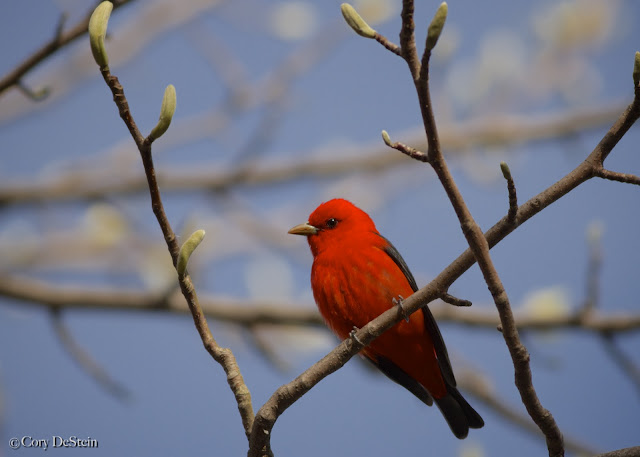
Scarlet Tanager
I hope everyone enjoyed this introduction to me as well as spring birding in Fayette County, I hope to be able to add more from this area (like when I find a Swainson's Warbler!!) and much more! Thanks for reading!