Showing posts with label 2013. Show all posts

Thursday, July 18, 2013

Flocks of Furnariid Friends

I just returned to Heredia after 10 rather windy days in Talamancan cloud forest 2500m above sea level.    I think my favorite bird that we captured since I've spoken with you last is this incredible (/incredibly bad-ass) Streak-breasted Treehunter, a member of the family, Furnariidae, which includes ovenbirds (subfamily: furnariinae), miners and leaf-tossers (Sclerurinae), and woodcreepers (Dendrocolaptinae).
A closer (above) and even closer (below) look at this remarkable species.  Too much? Sorry but it's awesome.
I know that I keep saying what families I like and don't like, but I have to say that this morphologically and behaviorally diverse family, Furnariidae, is another one of my favorites.  With 293 currently recognized species, it is an amazing group to study from the perspectives of evolution, biodiversity, and ecology.  It is not uncommon to be watching 5 or more (in some cases many more) species of these often audacious birds in one mixed feeding flock moving through tropical rainforest.  Granted in the Costa Rican highlands 5 species at once is somewhat uncommon, but I did commonly see a few including Spot-crowned Woodcreeper, Ruddy Treerunner, Red-faced Spinetail, and Buffy Tuftedcheek.  Such diversity of species can be noted simply by pointing out that the family is well-represented in just about every habitat type in the Neotropics from the hot, dry Atacama desert to Polylepis forest in the high Andes, to cloud forest and Amazon rainforest.

Interestingly enough, 97% of the species-level and 100% of the genus-level diversity (currently recognized of course) is found in South America.  That means that the vast majority of this giant 33 million-year-old radiation of Sub-oscine Passeriformes birds took place in South America, only spreading north into Central America after the closing of the isthmus of panama 2.5-4 mya (or one newer study indicates as early as 15mya!)

Maybe it's my lack of very much old-world exposure, but the new world is, well, mejor, as they say down here in the CR.  Point not arguable.  Don't try.  Or do, I won't care.

¡Tuanis mae!

References:

Brumfield, Robb T. Inferring the Origins of Lowland Neotropical Birds (2012) The Auk, 129(3): 367-376

Derryberry, Elizabeth P. et al. Lineage Diversification and Morphological Evolution in a Large-scale Continental Radiation: The Neotropical Ovenbirds and Woodcreepers (Aves: Furnariidae) (2011) Evolution 65:2973-2986


Friday, May 31, 2013

Boom: Blue-crowned Motmot

By Luke Musher
I haven't started banding or working yet, so I decided to go for a short walk this morning to see what kind of birds I should expect and start learning some calls and songs.  As I left my bunk I was treated to Rufous-capped Warbler, Clay-colored Thrush, Great Kiskadee, Red-billed Pigeon, White-tipped Dove, and Rufous-collared Sparrow. I crossed the street to enter InBio Parque's rear entrance and immediately saw a Blue-crowned Motmot fly from within the forest to a wire by the road.  It was in perfect light, so I snapped about 300 photos.
Blue-crowned Motmot, InBio Parque, Santo Domingo, Costa Rica


I had a few other species as well including Rufous-tailed Hummingbird, Blue-gray Tanager, Melodious Blackbird, Great-tailed Grackle, Black and Vaux's Swifts, Blue-and-white Swallow, House Wren, and Grayish Saltater.
Red-billed Pigeon
Grayish Saltater
Grayish Saltater
Clay-colored Thrush
Clay-colored Thrush

Saturday, May 18, 2013

Bird of the Week: Blue-winged Warbler

Earlier this week I spent some time in Sterling Forest State Park in Orange county, NY to try to photograph some Golden-winged Warblers.  Although I was able to get brief glimpses of one and heard another, the photo opportunities were completely lacking.  But among the 16 species of Warblers I detected in the park (also including Worm-eating, Cerulean, Hooded, Prairie, American Redstart, and Louisiana Waterthrush) my only really good photos came from a very cooperative Blue-winged Warbler along the power line cut at the end of Ironwood Drive.  I also found a color-banded individual.  I hope you enjoy the photos.


This one has color bands.

Wednesday, May 15, 2013

Photo Quiz 5/7/13 Solution

I sort of realized a day after I posted this and really looked at the photo, that this was a little unfair.  It's hard.  In fact it's so hard that nobody got the answer correct, and the lighting makes the bird's undertail coverts look yellower than they actually are.  I apologize for the extreme difficulty of this quiz, and will try to do better with picking quizes in the future.  But let's take a gander.

The first thing we notice is how bright yellow this bird is, and we can go straight to looking at the wood-warblers.  Remember that this photo was taken in spring so we are looking at a male bird in alternate plumage.  We can rule out a large number of them, and just think about the species with brightly colored breasts and bellies, dark streaking, and tail spots: Magnolia, Cape May, Eastern Palm, Pine, Kirtland's, and Prairie.  Pine Warbler and eastern Palm Warbler do not have black streaking that matches this individual so we can fairly quickly rule those out, leaving only these other four species.

If you clicked on the photo to enlarge you could see somewhat more clearly that the belly itself is pale, and so is much of the undertail coverts, but there is still some yellow-buff coloration posterior to the legs.  Magnolia Warbler has bright white undertail coverts and broad black tips to the rectrices, therefore it is out.  The dark streaking on Kirtland's Warbler really only extends down the sides of the breast and flanks, but this bird has streaking creeping down into the middle of the breast.  Also, the dark tips to the rectrices extend completely around the tip of each rectrix isolating each individual spot unlike Kirtland's which has white extending all the way to the tips.  So Kirtland's is out.

That leaves Prairie and Cape May Warblers.  The dark tips and the streaking can also be used against Prairie Warbler.  Additionally the pale gap in the yellow would be atypical for any Praire Warbler I've ever seen which tend to be fairly bright yellow all the way through the belly. Even the undertail coverts tend to be mostly yellowish.  So I'm going with Cape May, which it is, but I knew the answer ahead of time.  The lighting on the undertail really may not have been sufficient to be certain of an ID.  Thanks for playing.
A much more identifiable image of the Cape May Warbler.  Presque Isle State Park, Erie, PA 5/2/13
CORRECTION: CORY RITTER OF BOOM CHACHALACA GOT THE ANSWER RIGHT.  HE IS A BOSS AND A HELLUVA GOOD BIRDER.

Thursday, February 14, 2013

Birding the Mangrove and Coast of Northern Brazil

Coastal Maranhao has extensive mangrove swamp, some of the most expansive in the world.  It isn't as  species rich as the rainforest, but a surprising number of species can be found there. From the ubiquitous Orange-winged Parrots (Amazona amazona), Yellow-headed Caracaras, and Scarlet Ibis to Crested Orupendulas, Rufous Crab Hawk, and many others, the mangroves were fun to bird in.  
Scarlet Ibis were gorgeous and perhaps one of the commonest species seen.  Late in the evening it was not uncommon to see hundreds flying to roost for the night.
They roost in trees in very large numbers.
Captivating to the point of distraction.  How can you find or even glance at other species when hundreds of these are flying over your head?
That color is hard to photograph though.  Most of my photos look fake!
Yellow-headed Caracaras were common as well.  Scarecely a moment passed where one wasn't seen or heard.  
In this part of Brazil they look different from the rest of the population.  There head is more white than yellow.  Apparently boating is a hobby.
The slightly less common Southern Caracara was also a pleasure to watch.  Sorry for the crap photo.
Needless to say, Great Kiskadees were just about everywhere, as common here as anywhere else in the Neotropics from South America to south Texas.
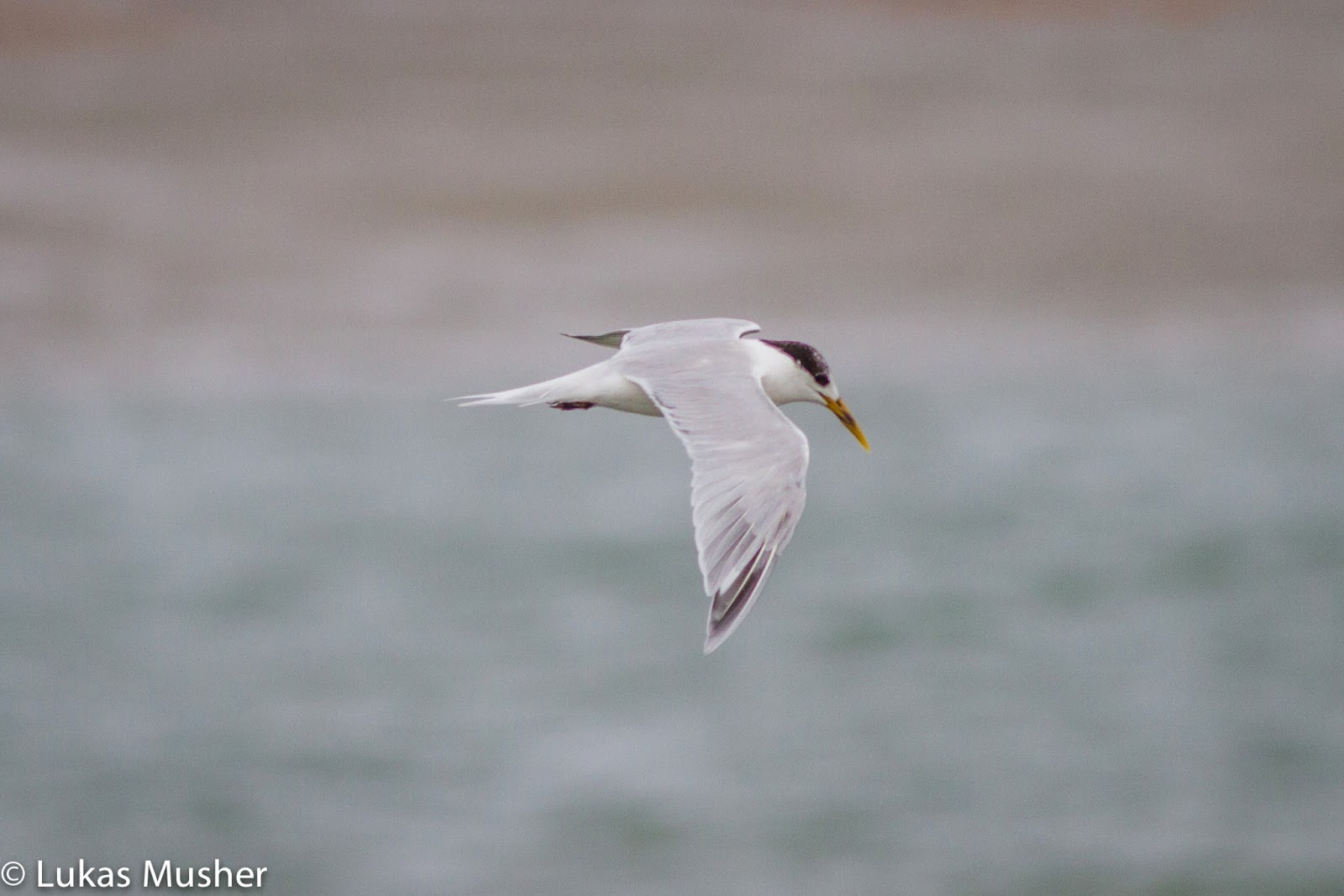
Cayenne Tern, formerly classified as a population of Sandwich Tern, was uncommon but seen regularly.
Large-billed Tern.  Another common bird.  Another crappy photo.
Beware of the evil goats on the windblown dunes of Lencois.  Frightening.
Orange-winged Parrots.  The only Amazona that we saw in the mangroves, and the only parrot we identified there.  I think we had parakeets at one point whose identity was never confirmed.
Good night.
Other cool species we saw included Crimson-crested Woodpecker, Ringed and Amazon Kingfisher, Greater Ani, Little Blue, Tricolored, Striated, Rufescent Tiger-, and Cocoi Herons, Great Black Hawk, Tropical Mockingbird, Yellow-billed Tern, Gray-hooded Gull, and of course the countless shorebirds.

~Luke