Showing posts with label warblers. Show all posts

Thursday, May 16, 2013

An Introduction to Fayette County

By Cory DeStein


Hi everybody! My name is Cory DeStein, I am a birder from Pittsburgh, Pennsylvania. I have joined Cory and Luke here as the newest contributor to Boom. Unlike these guys, I actually do not work in the bird field, I am a nurse at a pediatric hospital in Pittsburgh. I bird strictly for hobby! My goal is to be able to share with you all my birding adventures in Pennsylvania, birding trips through out the country, photography, and my amusing adventures with attempting to increase my yard list. 

This spring I have dedicated nearly all of my time birding to Fayette County in the southwest region of Pennsylvania. For the month of May I have reached 90 species for an area, State Game Lands 51 near the town of Dunbar. This large game lands contains rhododendron lined thickets along Dunbar Creek with a nearly 800ft elevation gain to the Zebley Flats area, a primarily secondary growth forest with multiple access roads along the Chestnut Ridge. It's a great area for countless hours of exploring. I began birding this particular patch in 2009 when I first got into birding. I went without any maps or knowledge of the area and began exploring, each day I continue to find new and interesting gems in the massive location. Golden-winged Warblers have bred through out Zebley Flats, and I have had 2 sightings of Northern Goshawk over the years. Mammal highlights have included American Black Bear, Gray Fox, and Fisher! Allegheny Woodrat breeds in the area, but I have not found one...yet! I have also had 9 species of reptile and 7 species of amphibians.
Kentucky Warbler along Dunbar Creek. 
I started the morning off along Dunbar Creek, the drive in was loaded with Kentucky Warblers, Louisiana Waterthrush, Worm-eating Warblers and Wood Thrush. From the parking area I picked up plenty of Magnolia Warblers, Song Sparrow, House Wren, as well as a Great-blue Heron fishing in the creek. Working my way up the ridge through the hemlocks I caught sight of a Swainson's Thrush lurking in the underbrush. Climbing up the ridge I continued to enjoy plenty of Worm-eating Warblers as well as Northern Parula singing from the eastern hemlocks. 
Worm-eating Warbler
At the mid-way point up the mountain you come to a clearing with multiple food plots, fruit trees, and dense underbrush. This has worked out to be one of the better migrant traps I have come across here. Kentucky Warblers continued to call in all directions as well as Louisiana Waterthrush. A Wilson's Warbler popped up from the brush along with the White-crowned and White-throated Sparrows. Red-breasted Nuthatches were calling from the larches a bird I have never had breeding here, but appears that this year they are. Accompanying the nuthatches in the trees were at least 5 Rose-breasted Grosbeaks feeding with the males singing up a storm. Carefully checking the fruit trees I was able to add Magnolia, Nashville, Tennessee, Hooded, Black-and-white, and Black-throated Green Warblers to my day list as well as a nearby singing Winter Wren. 
1 of 5 Rose-breasted Grosbeaks in a single tree!
Conquering the final stretch of the climb to the flats I was able to grab Blue-headed, Red-eyed, Yellow-throated and Warbling Vireos as well as Ovenbirds calling non-stop. Upon reaching the top of the ridge I could hear Yellow-billed Cuckoo calling, but it was hot as hell and I wasn't going to go looking for it. Covering just a short distance along the access road the growth along the path was filled with Indigo Buntings, Chestnut sided and Hooded Warblers with plenty of Field and Chipping Sparrows adding to the mix before I ventured back down to my car. I ended today with 62 species during my hike and reached 97 species for SGL 51 this year. 
Chestnut-sided Warbler were EVERYWHERE

The most cooperative Winter Wren

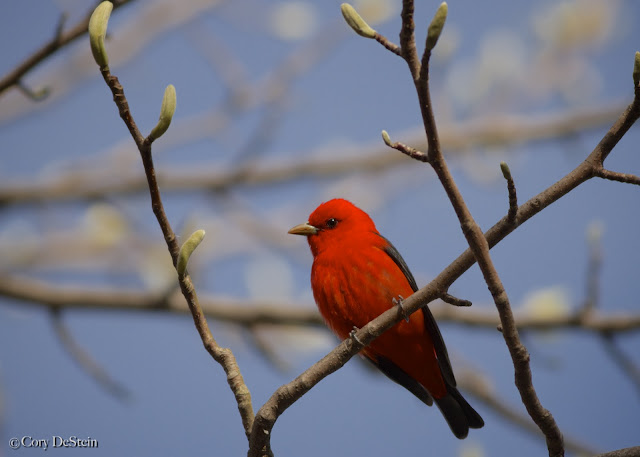
Scarlet Tanager
I hope everyone enjoyed this introduction to me as well as spring birding in Fayette County, I hope to be able to add more from this area (like when I find a Swainson's Warbler!!) and much more! Thanks for reading! 

Wednesday, May 15, 2013

Photo Quiz 5/7/13 Solution

I sort of realized a day after I posted this and really looked at the photo, that this was a little unfair.  It's hard.  In fact it's so hard that nobody got the answer correct, and the lighting makes the bird's undertail coverts look yellower than they actually are.  I apologize for the extreme difficulty of this quiz, and will try to do better with picking quizes in the future.  But let's take a gander.

The first thing we notice is how bright yellow this bird is, and we can go straight to looking at the wood-warblers.  Remember that this photo was taken in spring so we are looking at a male bird in alternate plumage.  We can rule out a large number of them, and just think about the species with brightly colored breasts and bellies, dark streaking, and tail spots: Magnolia, Cape May, Eastern Palm, Pine, Kirtland's, and Prairie.  Pine Warbler and eastern Palm Warbler do not have black streaking that matches this individual so we can fairly quickly rule those out, leaving only these other four species.

If you clicked on the photo to enlarge you could see somewhat more clearly that the belly itself is pale, and so is much of the undertail coverts, but there is still some yellow-buff coloration posterior to the legs.  Magnolia Warbler has bright white undertail coverts and broad black tips to the rectrices, therefore it is out.  The dark streaking on Kirtland's Warbler really only extends down the sides of the breast and flanks, but this bird has streaking creeping down into the middle of the breast.  Also, the dark tips to the rectrices extend completely around the tip of each rectrix isolating each individual spot unlike Kirtland's which has white extending all the way to the tips.  So Kirtland's is out.

That leaves Prairie and Cape May Warblers.  The dark tips and the streaking can also be used against Prairie Warbler.  Additionally the pale gap in the yellow would be atypical for any Praire Warbler I've ever seen which tend to be fairly bright yellow all the way through the belly. Even the undertail coverts tend to be mostly yellowish.  So I'm going with Cape May, which it is, but I knew the answer ahead of time.  The lighting on the undertail really may not have been sufficient to be certain of an ID.  Thanks for playing.
A much more identifiable image of the Cape May Warbler.  Presque Isle State Park, Erie, PA 5/2/13
CORRECTION: CORY RITTER OF BOOM CHACHALACA GOT THE ANSWER RIGHT.  HE IS A BOSS AND A HELLUVA GOOD BIRDER.

Wednesday, September 19, 2012

Recent Farallon Finds

Magnolia Warbler, Southeast Farallon Island, CA
It's been busy as ever lately, with lots of new birds coming to the island.  Today is our first slow day in over a week, so allow me to fill you in on some of the goodies that have been turning up.

The migrant passerines continue to move through with Yellow, Chestnut-sided, Hermit, Magnolia, Blackpoll, Bay-breasted, Townsend's, Black-throated Gray, Yellow-throated, Black-and-white, Tennessee, Orange-crowned, MacGillivray's, and Wilson's Warblers, American Redstart (including one stunning adult male), Common Yellowthroat, Bobolink, Vesper Sparrow, Indigo Bunting, Dickcissel, Red Crossbill (there are very few records of this for the island, but this fall has been especially good since it is an irruption year for at least one type on the west coast), Blue-gray Gnatcatcher (less than 40 records for the island), Swainson's and Hermit Thrushes, Warbling Vireo, Baltimore Oriole, Western tanager, Lincoln's Sparrow, Pacific Wren, and Hammond's Flycatcher as some of the migrants we've seen since my last post.

We are banding dozens of Red-breasted Nuthatches as well, with more coming in each day.  When they come in off the ocean they land on the lighthouse, and begin to glean microscopic invertebrates off of the lichen that grows on it.  They allow very close approach, and one even let me feed it dead kelp flies (slapped from my arms), off of the tip of a pencil.

On the 17th Dan Maxwell and I were up on the lighthouse when we heard over the radio, "ducks flying by the terrace!"  We immediately got on the flock of six birds, and began calling things out.  I immediately said Blue-winged Teal, and over the radio Jim Tietz said, "I think we've got a mixed flock of teal."  Although at the time I thought they were all uniform in size, shape, and plumage, Jim was right, and thanks to some photos by Dan Maxwell (below), we confirmed that we had three Cinnamon Teal, and three Blue-winged Teal. Can you pick out which ones are which?  Here's a hint, look at bill size and shape, and face pattern.  I think you'll find that the wing pattern on these two species is nearly identical.  The Cinnamon Teal were the first for the island in more than 12 years, and the Blue-winged Teal represent the 11th (or 12th?) record for the island ever.
Mixed Teal Flock, Southeast Farallon Island, CA [Photo by Daniel Maxwell]
The Northern Gannet is still around.
One of the few Bobolinks we've had this year.

Thursday, September 13, 2012

Some Vagrants: My First Farallon Wave

Blackburnian Warbler at the Lighthouse.
Tuesday night the conditions were good for a small wave to hit the Farallons yesterday.  The light south winds and low overcast sky made made my fourth day on the island a good one.  As I was eating breakfast this morning, the first landbirds started dropping in to the lighthouse, with reports of Bay-breasted and Blackburnian Warblers, American Redstart, Olive-sided Flycatcher, and Rose-breasted Grosbeak over the radio.  After my morning sea watch, where I picked up my year Pink-footed Shearwater, I began searching the island for birds, turning up several new arrivals including two Clay-colored Sparrows, several Townsend's Warblers, and the Blackburnian Warbler.  However, it wasn't until I made it up to the lighthouse for my shark-watching shift that I got to see almost all of the vagrants reported on the island for the day.  The only one I missed was Ovenbird.

Tuesday afternoon was good as well, with a couple vagrants arriving in the afternoon including Baltimore Oriole and Tennessee Warbler.

This Tennessee Warbler was present since Tuesday, along with one new arrival on Wednesday.
Bay-breasted Warbler on Lighthouse Hill.
 Magnolia Warbler at the lighthouse
Townsend's Warbler at the Lighthouse
American Redstart at the Lighthouse

Rose-breasted Grosbeak on Lighthouse Hill
Magnolia Warbler
Chestnut-sided Warbler at the lighthouse