Not really sure how late I am to the scene here but my friend Jim Tietz just informed me that our Little Bunting sight record from last fall on Southeast Farallon Island, a bird we got no photos of, but was definitely a Little Bunting passed the California Bird Records Committee in the first round! This was very unexpected because many if not most bird records committees are wary to accept a record of a review species without some sort of photo of audio documentation. Here are some excerpts from Jim's "Update to Rare Birds of California" of the birds we had that were reviewed (by the way I saw all of them!)
Showing posts with label Farallons. Show all posts
Thursday, June 27, 2013
Monday, November 5, 2012
Farallonia's Common and Scarce
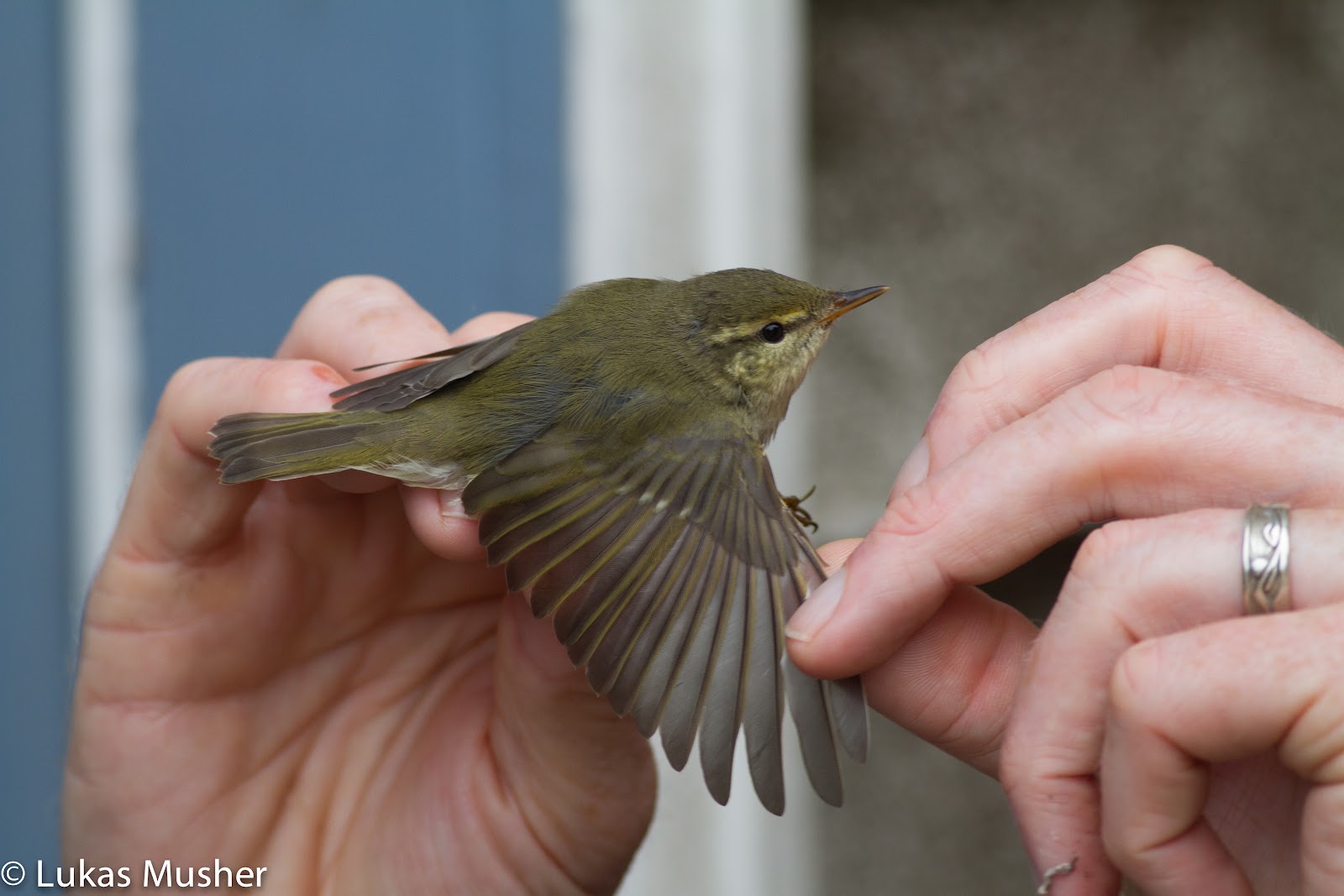
By Luke Musher
One of my favorite recent birds was a Horned Puffin yesterday (pow! that's a lifer) that was spotted while we were operating the crane to bring the boat on shore. Ryan DiGaudio, Nora Livingston, Maggie Spilatro and I all basically spotted the bird at exactly the same time and realized it wasn't a Tufted Puffin, which breed on the island and would be far more likely, but a Horned. Jim Tietz got this as an island bird while still waiting on the boat he was arriving on. Note the white underparts, pinched base of the bill, and obvious paleness in the face–much different than any Tufted Puffin. What a BAMF.
![]() |
| HY Anna's Hummingbird, a common bird on the Farallons. |
Since I first arrived, I have found it incredibly interesting how some species that are fairly abundant just 30 miles east on the mainland can be incredibly rare, and are thus highly coveted by us Faralisters here in Farallonia. Then there are birds that are much more likely to turn up here than on the mainland. For example we get far more Least Flycatchers, an eastern vagrant, than Dusky or Hammond's Flycatchers, which are relatively common species in the west. We recently had two Farallon megas, Common Goldeneye and Cooper's Hawk that are doubtfully any birder's idea of chase birds. However, birders who spend time on the Farallons take their island lists very seriously, so when I called out the goldeneye over the radio, the others came sprinting to me as if it were an Arctic Warbler (not surprisingly also induced a rapid and shamefully twitchy response).
![]() |
| NOT the Loch Ness Monster, but the 20th Island record and 6th Fall record of Common Goldeneye for Southeast Farallon Island. Nearly all records are in winter. |
| Cooper's Hawk, one of roughly 30 records for the island [Photo by Ryan DiGaudio] |
Despite the fact that the birding has been slow due to various amounts of wind and/or fog, we've had a a trickle of arrivals over the past few weeks, including new Grasshopper Sparrow, Lapland Longspur, Short-eared Owls (almost daily), Rough-legged Hawk, Blackburnian Warbler (a good vagrant anytime, but especially this late in the season), and Surf Scoters to name a few.
![]() |
| Lapland Longspur, the most likely species of longspur here, but still a relatively uncommon bird. |
![]() |
| Short-eared Owl, a common species but an outstanding bird every time. |
![]() |
| We have butterflies too, like this west coast lady.... |
![]() |
| ...and this painted lady. |
![]() |
| We haven't seen many Pigeon Guillemots lately, but this individual, Hermen, has been here since the breeding season, and is finally molting in a much-needed new set of remiges. |
Sunday, October 14, 2012
Wave Days are the Best
![]() |
| "Western" Palm Warbler, Southeast Farallon Island, CA |
![]() |
| Rock Wren, Southeast Farallon Island, CA |
![]() |
| Aleutian Cackling Goose, one of seven total seen, Southeast Farallon Island, CA |
![]() |
| HY Peregrine Falcon |
![]() |
| White-throated Sparrow, Southeast Farallon Island, CA |
![]() |
| "Bicolored" Red-winged Blackbird, Southeast Farallon Island, CA |
![]() |
| One of the few dozen Pine Siskins during the wave |
![]() |
| This rather late Olive-sided Flycatcher was one of the first birds I saw on wave day (October 11th). |
![]() |
| Common Raven on wave day, Southeast Farallon Island, CA |
![]() |
| Townsend's Solitaire, Southeast Farallon Island, CA |
![]() |
| Townsend's Solitaire, Southeast Farallon Island, CA |
![]() |
| Adult male Evening Grosbeak, Southeast Farallon Island, CA |
![]() |
| Adult male Evening Grosbeak, Southeast Farallon Island, CA |
The best bird of the day was a probable Yellow-bellied Sapsucker (would be 3rd record for the island)/possible Red-naped Sapsucker (would be 6th record for island). I saw the bird flying around the lighthouse (but to me only identifyable as a woodpecker), but Jim Tietz was at the lighthouse and was able to photograph (photos here) the bird during it's brief stay at the lighthouse before it flew off never to be seen again. Of course there is always the possibility of hybridization, and the experts don't seem to agree on the identity of this individual, some going so far as to say they won't put a name on it from the photos. Several people think it is Yellow-bellied, though. The back pattern, to me looks great for Yellow-bellied, but I haven't seen enough Red-naped, and don't know enough about hybridization in these taxa to make a call myself. Comment with your opinion.
![]() |
| Ash-throated Flycatcher, Southeast Farallon Island, CA |
![]() |
| Swamp Sparrow [Photo by Dan Maxwell] |
![]() |
| Brown Booby [Photo by Dan Maxweel] |
Luke
Labels:
2012,
Birding,
Boom Chachalaca,
boomcha,
Cackling Goose,
Evening Grosbeak,
fall,
Farallons,
Migration,
Peregrine Falcon,
PRBO,
SEFI,
Southeast Farallon Island,
Townsend's Solitaire,
wave
Saturday, September 29, 2012
Mega: Arctic Warbler
Wednesday, September 26, 2012
Birds in the Fog
![]() |
| White-crowned Sparrow |
Today, though, will not be one of those days. Birding in the haze not only clouds our vision such that seeing birds at a distance becomes more challenging, but also makes birding slow for us. We expect few birds on days like these, and generally find few as well. Despite the poor weather, we have been able to turn up a few new arrivals here and there.
![]() |
| Monday we found this damp American Redstart in the company of a Warbling Vireo we banded over a week ago. |
![]() |
| Burrowing Owls have finally arrived on the island, and we captured and banded one individual so far. |
![]() |
| Ruby-crowned Kinglet at the Lighthouse |
![]() |
| Lincoln's Sparrow |
![]() |
| It has been an amazing year for Red-breasted Nuthatches here. |
![]() |
| One of our first Golden-crowned Sparrows of the fall. |
![]() |
| Another first of fall bird and arrival in the fog, I found this Varied Thrush late in the day. |
![]() |
| Even through the dense fog, this Common Raven is unmistakable. |
Sunday, September 23, 2012
Prairie Warbler and other Notes (Shark Notes)
I've been two weeks on the island now, and if you haven't noticed it's been pretty incredible. No megas (yet), but always plenty of good birding to be had. We sea watch twice per day on the island, and although numbers of birds (specifically Sooty Shearwaters) are down from the first week, I've had Pomarine Jaegers migrating close to the island on my last two afternoon watches. Today I had an adult and an immature within a few minutes of each other.
The interesting landbirds continue to move through including a Prairie Warbler that showed up yesterday afternoon at the lighthouse.
As you may know, one of the specialties of the Farallon Islands is white sharks. Each intern spends two hours per day on the lighthouse watching for shark attacks. We look for gulls swarming, pools of blood in the water,
and, of course, sharks thrashing and feeding on a carcass in the water.
These photos were taken on Thursday of a white shark feeding on an immature elephant seal less than a quarter of a kilometer from the island. This was one of five attacks we've gotten to see in the past week.
The interesting landbirds continue to move through including a Prairie Warbler that showed up yesterday afternoon at the lighthouse.
As you may know, one of the specialties of the Farallon Islands is white sharks. Each intern spends two hours per day on the lighthouse watching for shark attacks. We look for gulls swarming, pools of blood in the water,
and, of course, sharks thrashing and feeding on a carcass in the water.
These photos were taken on Thursday of a white shark feeding on an immature elephant seal less than a quarter of a kilometer from the island. This was one of five attacks we've gotten to see in the past week.
Wednesday, September 19, 2012
Recent Farallon Finds
![]() |
| Magnolia Warbler, Southeast Farallon Island, CA |
The migrant passerines continue to move through with Yellow, Chestnut-sided, Hermit, Magnolia, Blackpoll, Bay-breasted, Townsend's, Black-throated Gray, Yellow-throated, Black-and-white, Tennessee, Orange-crowned, MacGillivray's, and Wilson's Warblers, American Redstart (including one stunning adult male), Common Yellowthroat, Bobolink, Vesper Sparrow, Indigo Bunting, Dickcissel, Red Crossbill (there are very few records of this for the island, but this fall has been especially good since it is an irruption year for at least one type on the west coast), Blue-gray Gnatcatcher (less than 40 records for the island), Swainson's and Hermit Thrushes, Warbling Vireo, Baltimore Oriole, Western tanager, Lincoln's Sparrow, Pacific Wren, and Hammond's Flycatcher as some of the migrants we've seen since my last post.
We are banding dozens of Red-breasted Nuthatches as well, with more coming in each day. When they come in off the ocean they land on the lighthouse, and begin to glean microscopic invertebrates off of the lichen that grows on it. They allow very close approach, and one even let me feed it dead kelp flies (slapped from my arms), off of the tip of a pencil.
On the 17th Dan Maxwell and I were up on the lighthouse when we heard over the radio, "ducks flying by the terrace!" We immediately got on the flock of six birds, and began calling things out. I immediately said Blue-winged Teal, and over the radio Jim Tietz said, "I think we've got a mixed flock of teal." Although at the time I thought they were all uniform in size, shape, and plumage, Jim was right, and thanks to some photos by Dan Maxwell (below), we confirmed that we had three Cinnamon Teal, and three Blue-winged Teal. Can you pick out which ones are which? Here's a hint, look at bill size and shape, and face pattern. I think you'll find that the wing pattern on these two species is nearly identical. The Cinnamon Teal were the first for the island in more than 12 years, and the Blue-winged Teal represent the 11th (or 12th?) record for the island ever.
| Mixed Teal Flock, Southeast Farallon Island, CA [Photo by Daniel Maxwell] |
![]() |
| The Northern Gannet is still around. |
![]() |
| One of the few Bobolinks we've had this year. |
Subscribe to:
Posts (Atom)