Showing posts with label Evening Grosbeak. Show all posts

Saturday, May 25, 2013

Photo Study: Birds of Northern Minnesota

By Cory DeStein


In late February I joined a birding tour group lead by Ethan Kistler and Frank Nicoletti through the bogs of northern Minnesota. The main destination of the trip was Sax-Zim Bog, a well known wintering location for Great Gray and Northern Hawk Owl as well as over 240 breeding and migrant birds in the spring! The trip was highlighted by 5 species of owl; Great Gray, Northern Hawk, Snowy, Northern Saw-whet, and BOREAL Owl!!!
Freaking Boreal Owl!!!!!!
While owls were certaintly a highlight of the trip, the boreal species of the northern woods were unbeatable. The feeding stations at the Bog were filled with Pine Grosbeaks, Gray Jays, Common and Hoary Redpolls, as well as Evening Grosbeaks. A Short-tailed Weasel even made his home at one of these stations!

Female Pine Grosbeak
Short-tailed Weasel
Heading up to the Superior National Forest we got very lucky with 9 Spruce Grouse in the middle of the road, many of them displaying. The birds were exceptionally tame, allowing everyone in the group to get fantastic looks, and some great pictures as well. Grays Jays and Pine Grosbeaks were through out the forest, and we were also treated to a pair of Red Crossbills feeding along the road.
Male Spruce Grouse

Male Red Crossbill
Back at the feeding stations in the bog, peanut butter did the trick to attract a Boreal Chickadee at eye level for the whole group. Hoary Redpolls were numerous throughout, and offered great practice for the group in identification. Frank had a recent sighting of a Northern Hawk Owl nearby and lead the group for great closeups of the gorgeous owl. On the way out Frank was able to spot a Northern Goshawk perched in the distance.
Boreal Chickadees

Female Hoary Redpoll

Northern Hawk Owl
In all it was a great trip for me, resulting in 5 lifers. Visitors to Northern Minnesota can hope for all the birds mentioned above as well as other birds in the area; Sharp-tailed Grouse, Black-backed Woodpecker, Northern Shrike, Rough-legged Hawk, and Bohemian Waxwings. I highly suggest a winter (or spring!) trip in your future!
Bohemian Waxwings
Black-backed Woodpecker 
Gray Jay
Great Gray Owl 
Pine and Evening Grosbeaks, Common Redpolls, and American Goldfinch.

Male Pine Grosbeaks

Common Redpoll

Red-breasted Nuthatch

Snowy Owl

Male Spruce Grouse

Northern Saw-whet Owl

Tuesday, November 27, 2012

Goodbye Farallones

As you may have gathered, I have departed from the Farallones.  Although it is weird being back in civilization, it's good to be home.  Overall I had a great first season on the Farallones, with 193 species on my Farallist.  I was hoping to break 200, but I missed a few good birds early in the season, that I just couldn't make up for during my 10-week tenure on the island.  My list includes 12 species of waterfowl, 8 tubenoses, 2 Sulids, 5 Hawks, 17 shorebirds, 9 gulls, 7 alcids, 5 owls, 9 flycatchers, 6 thrushes, 24 warblers, 19 Emberizid sparrows, 6 Cardinalids, 8 Icterids, and 7 finches!  I got 38 year birds on the Farallones (marked with stars), putting my total at 430 for 2012 (now 432 with 2 species I've gotten since leaving the Farallones, Barnacle Goose and White-winged Crossbill, both in Long Island, NY).  Here is my complete 2012 Farallist of species, including some photo highlights.

Greater White-fronted Goose (3 October)
Brant (2 November)
Cackling Goose (9 October)
BLUE-WINGED TEAL (17 September)
CINNAMON TEAL(17 September)
Northern Shoveler (29 September)
Northern Pintail (8 September)
Green-winged Teal (7 November)
Surf Scoter (30 October)
COMMON GOLDENEYE (30 October)
Red-breasted Merganser (7 November)
RUDDY DUCK (27 September)
Pacific Loon (15 September)
Common Loon (4 October)
Horned Grebe (7 November)
Eared Grebe (15 September)
Western Grebe (27 September)
*Northern Fulmar (21 October)
*Pink-footed Shearwater (11 September)
*Flesh-footed Shearwater (16 October)
*Buller's Shearwater (21 October)
*Sooty Shearwater (8 September)
*Short-tailed Shearwater (7 November)
*Black-vented Shearwater (16 October)
*Ashy Storm-Petrel (13 September)
*Brown Booby (13 October)
NORTHERN GANNET (8 September)
Brandt's Cormorant (8 September)
Double-crested Cormorant (8 September)
Pelagic Cormorant (8 September)
Brown Pelican (8 September)
Great Blue Heron (5 October)
Great Egret (12 September)
White-tailed Kite (13 October)
Northern Harrier (18 September)
Sharp-shinned Hawk (12 October)
COOPER'S HAWK (25 October)
*Rough-legged Hawk (25 October)
Black-bellied Plover (8 September)
Semipalmated Plover (8 September)
Killdeer (12 September)
Black Oystercatcher (8 September)
Spotted Sandpiper (15 September)
Wandering Tattler (8 September)
Willet (8 September)
Whimbrel (8 September)
Black Turnstone (8 September)
Sanderling (15 September)
SEMIPALMATED SANDPIPER (8 October)
Pectoral Sandpiper (8 October)
Short-billed Dowitcher (9 October)
Long-billed Dowitcher (28 September)
Wilson's Snipe (18 October)
Red-necked Phalarope (8 September)
*Red Phalarope (10 September)
Black-legged Kittiwake (2 November)
Bonaparte's Gull (7 November)
Heermann's Gull (9 September)
Mew Gull (7 October)
Western Gull (8 September)
California Gull (8 September)
Herring Gull (27 September)
Thayer's Gull (30 October)
Glaucous-winged Gull (22 October)
*Elegant Tern (27 September)
*Pomarine Jaeger (15 September)
Parasitic Jaeger (11 September)
Common Murre (8 September)
*Pigeon Guillemot (8 September)
Ancient Murrelet (23 October)
*Cassin's Auklet (8 September)
Rhinoceros Auklet (8 September)
*HORNED PUFFIN(3 November)
*Tufted Puffin (11 September)
Eurasian Collared-Dove (8 September)
Mourning Dove (12 September)
Barn Owl (8 September)
Burrowing Owl (23 September)
*Long-eared Owl (8 November)
Short-eared Owl (12 October)
*Northern Saw-whet Owl (8 November)
*Vaux's Swift (28 September)
Anna's Hummingbird (8 September)
Rufous Hummingbird (8 September)
Belted Kingfisher (19 October)
Northern Flicker (7 October)
American Kestrel (12 September)
Merlin (8 September)
Peregrine Falcon (8 September)
*Olive-sided Flycatcher (12 September)
Western Wood-Pewee (8 September)
Willow Flycatcher (14 September)
*Least Flycatcher (8 September)
*HAMMOND'S FLYCATCHER (18 September)
Pacific-slope Flycatcher (18 September)
Black Phoebe (15 September)
Say's Phoebe (23 September)
Ash-throated Flycatcher (12 October)
Hutton's Vireo (3 November)
Warbling Vireo (12 September)
Common Raven (18 September)
Horned Lark (18 October)
Northern Rough-winged Swallow (12 September)
Violet-green Swallow (11 Ocotober)
Cliff Swallow (10 September)
Red-breasted Nuthatch (9 September)
Brown Creeper (7 October)
*Rock Wren (8 September)
House Wren (3 October)
Pacific Wren (14 September)
Blue-gray Gnatcatcher (17 September)
Golden-crowned Kinglet (9 October)
Ruby-crowned Kinglet (25 September)
*ARCTIC WARBLER (28 September)
*TOWNSEND'S SOLITAIRE (11 October)
*GRAY-CHEEKED THRUSH (4 October)
*Swainson's Thrush (18 September)
Hermit Thrush (18 September)
American Robin (4 November)
Varied Thrush (25 September)
Northern Mockingbird (8 September)
European Starling (2 October)
American Pipit (12 September)
Cedar Waxwing (12 September)
*Lapland Longspur (19 October)
Ovenbird (25 September)
Black-and-white Warbler (16 September)
*Tennessee Warbler (11 September)
Orange-crowned Warbler (8 September)
Nashville Warbler (25 September)
*MacGillivray's Warbler (17 September)
Common Yellowthroat (13 September)
American Redstart (12 September)
*Cape May Warbler (8 September)
Magnolia Warbler (12 September)
*Bay-breasted Warbler (12 September)
Blackburnian Warbler (12 September)
Yellow Warbler (8 September)
Chestnut-sided Warbler (12 September)
Blackpoll Warbler (10 September)
Black-throated Blue Warbler (29 September)
Palm Warbler (26 September)
Yellow-rumped Warbler (15 September)
YELLOW-THROATED WARBLER (14 September)
Prairie Warbler (21 September)
Black-throated Gray Warbler (16 September)
Townsend's Warbler (12 September)
Hermit Warbler (13 September)
Black-throated Green Warbler (4 October)
Wilson's Warbler (12 September)
Spotted Towhee (1 October)
Chipping Sparrow (8 September)
Clay-colored Sparrow (8 September)
Brewer's Sparrow (8 September)
*Vesper Sparrow (17 September)
Lark Sparrow (8 September)
*Lark Bunting (8 September)
Savannah Sparrow (8 September)
Grasshopper Sparrow (18 October)
Fox Sparrow (21 September)
Song Sparrow (11 November)
Lincoln's Sparrow (11 September)
Swamp Sparrow (12 October)
White-throated Sparrow (3 October)
*Harris's Sparrow (18 October)
White-crowned Sparrow (22 September)
Golden-crowned Sparrow (25 September)
Dark-eyed Junco (24 September)
*LITTLE BUNTING (14 November; Pending acceptance by CBRC)
Summer Tanager (14 November)
*Western Tanager (16 September)
Rose-breasted Grosbeak (12 September)
Black-headed Grosbeak (10 September)
Lazuli Bunting (9 September)
Indigo Bunting (17 September)
*PAINTED BUNTING (18 September)
DICKCISSEL (17 September)
Bobolink (8 September)
Red-winged Blackbird (7 October)
Western Meadowlark (23 September)
Yellow-headed Blackbird (9 September)
*RUSTY BLACKBIRD (14 November)
Brewer's Blackbird (7 October)
Brown-headed Cowbird (11 September)
Baltimore Oriole (11 September)
Purple Finch (11 October)
House Finch (18 October)
RED CROSSBILL (13 September)
Pine Siskin (28 September)
Lesser Goldfinch (8 September)
American Goldfinch (7 October)
*EVENING GROSBEAK (11 October)

Sunday, October 14, 2012

Wave Days are the Best

Today is my first real break since a four day wave starting on October 10 with only a few arriving birds and peaking on the 11th and 12th with hundreds of arriving landbirds, including likely over 100 Ruby-crowned Kinglets and perhaps more than 150 (>200?) Zonotrichia sparrows (mostly Golden-crowned with one third as many White-crowned and a few White-throated), many first of fall birds, and a few rarities.
"Western" Palm Warbler, Southeast Farallon Island, CA
Rock Wren, Southeast Farallon Island, CA
Aleutian Cackling Goose, one of seven total seen, Southeast Farallon Island, CA
HY Peregrine Falcon
White-throated Sparrow, Southeast Farallon Island, CA
"Bicolored" Red-winged Blackbird, Southeast Farallon Island, CA
One of the few dozen Pine Siskins during the wave
We continue to band Burrowing Owls every night, and continue to find unbanded owls each day.  This is apparently the best year ever for Burrowing Owls on the island in terms of numbers.  Our daily high count is 17, shattering the previous record of 11.
This rather late Olive-sided Flycatcher was one of the first birds I saw on wave day (October 11th).
As I said, the wave pretty much started on the 10th with a few new birds such as Cackling Goose, Golden-crowned Kinglet, and several other new arriving songbirds.  However, the 11th was the big day.  I rolled out of bed expecting nothing new, or at least very little in terms of arriving birds, since the the winds were very strong.  However, the cloud ceiling was low enough that the mainland wasn't visible, and when I walked out the door to start my AM area search, there were dozens of sparrows and kinglets flitting about and calling in the tree and shrubbery by the house.  As I continued my search, I turned up more and more new arrivals such as Olive-sided Flycatcher and Townsend's Solitaire (less than 50 records on the island; anything under 100 records is a pretty good bird), among the hundreds of other birds.

Common Raven on wave day, Southeast Farallon Island, CA
Townsend's Solitaire, Southeast Farallon Island, CA
My favorite bird of the day, though, was found at the lighthouse just 30 minutes or so after I got down from doing my shark watch from there.  Sophie Webb radioed down that she was looking at a "lovely male Evening Grosbeak sitting on the lighthouse."  We spent some time attempting to scope it from below, but could never find it, and the bird eventually flew somewhere that Sophie could not tell.  I spent the next hour or so hiking around the island looking for the bird.  It began raining, so the rocks on all the hills were slippery, and I had to keep my camera under my shirt to keep it from getting too wet.  Just when I was ready to give up, I heard it call from the lighthouse, and I saw it flying in my direction.  The bird landed about 20ft from me, and I was able to get some okay photographs given the rain and lack of light.  There are only 5 previous records for Evening Grosbeak on Southeast Farallon Island.  Of course after all that effort, the bird flew into one of our nets, and I got to band it.
Adult male Evening Grosbeak, Southeast Farallon Island, CA
It was hard to beat the wave on the 11th, but the 12th still brought in a number of new birds, including a few island birds for me.  Ash-throated Flycatcher and Swamp Sparrow were among them.  On the 13th we were treated to a few new birds, and a Brown Booby that loafed around all day with the cormorants on Sugarloaf (small island/large rock just off of the island).

The best bird of the day was a probable Yellow-bellied Sapsucker (would be 3rd record for the island)/possible Red-naped Sapsucker (would be 6th record for island).  I saw the bird flying around the lighthouse (but to me only identifyable as a woodpecker), but Jim Tietz was at the lighthouse and was able to photograph (photos here) the bird during it's brief stay at the lighthouse before it flew off never to be seen again.  Of course there is always the possibility of hybridization, and the experts don't seem to agree on the identity of this individual, some going so far as to say they won't put a name on it from the photos.  Several people think it is Yellow-bellied, though.  The back pattern, to me looks great for Yellow-bellied, but I haven't seen enough Red-naped, and don't know enough about hybridization in these taxa to make a call myself.  Comment with your opinion.
Ash-throated Flycatcher, Southeast Farallon Island, CA
Swamp Sparrow [Photo by Dan Maxwell]
Brown Booby [Photo by Dan Maxweel]
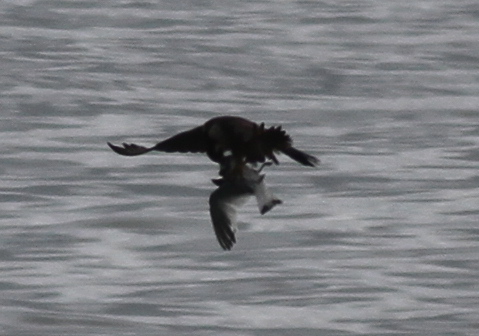
One of the most interesting occurrences on the 12th was seen only by Dan Maxwell, as this adult Peregrine Falcon snatched a Sabine's Gull (I need that bird for the year!) off the water.  This cropped, distant shot is still identifiable. [Photo by Dan Maxwell]
Until next time –

Luke