Showing posts with label SSHA. Show all posts

Thursday, September 19, 2013

2013 Hawk Weekend at Hawk Ridge Bird Observatory

By Cory Ritter

HRBO's annual Hawk Weekend Festival runs during the third full weekend in September, so it starts tomorrow (Friday, September 20th) and runs through Sunday. Since September started on a Sunday this year, the September 20th start date is the latest since 2002. I've been worried that the festival may be a little too late to catch the Broad-wing migration, so I looked into the hawkcount.org data for the past ten years to see what we can expect for this weekend.

Over the last ten years (1993-2012), seven of the biggest days came on September 14th (4) and September 15th (3). Another came on September 16th, making the middle of the month the most likely to see the big day. The final two big days were outliers, one on September 20, 2006 and one on September 9, 2012.

During this time, there have been 53 days with over one thousand Broad-winged Hawks counted from the Ridge—averaging 5.3 days with over one thousand Broad-wings per season. Of those 53 days, 16 (30.2%) were on or after September 20th.

With that being said, September 20th is a bit late in the season for the Broad-winged Hawk peak, but they have peaked this late in the past. Also, we have only had two 1,000+ Broad-wing days this season—against an average of 5.3. Furthermore, we have had a week of unfavorable winds from the south or east and a couple days of fog and rain. This weather is supposed to clear out for the weekend, and leave us with favorable west or northwest winds—just in time for Hawk Weekend.

With the good weather headed our way and a history of some big Broad-wing days around this time of the season, this weekend looks like it is shaping up to be a good one! Here are some birds that are coming through right now, and you can expect to see them at the Ridge this weekend.
Broad-winged Hawk Ridge Bird Observatory
Broad-winged Hawk, 16 September 2013
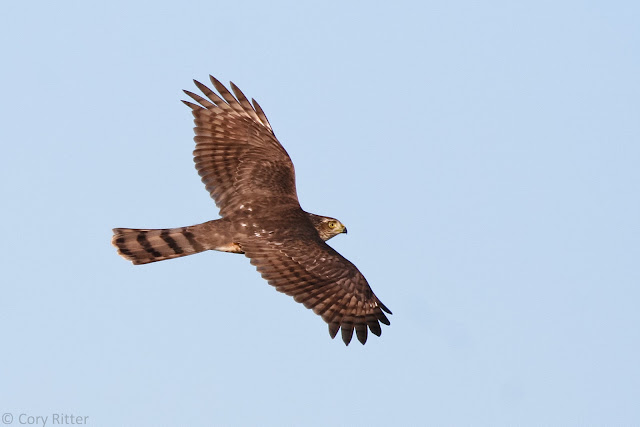
Sharp-shinned Hawk Duluth Minnesota
Sharp-shinned Hawk, 11 September 2013
Palm Warbler Hawk Ridge
Palm Warbler, 12 September 2013
Merlin Duluth Minnesota
Merlin, 16 September 2013
American Kestrel Hawk Ridge
American Kestrel, 13 September 2013
Canada Goose Duluth Minnesota
Canada Goose, 11 September 2013
American Kestrel Duluth Minnesota
American Kestrel, 13 September 2013
Broad-winged Hawk Ridge
Broad-winged Hawk, 13 September 2013
Merlin Duluth Minnesota
Merlin, 11 September 2013
American Kestrel Hawk Ridge Minnesota
American Kestrel, 17 September 2013
American White Pelicans Duluth Hawk Ridge
American White Pelicans, 16 September 2013
American Kestrel Minnesota Hawk Ridge
American Kestrel, 17 September  2013
All photos were taken at Hawk Ridge Bird Observatory, St. Louis County, Minnesota.

Monday, September 9, 2013

Sharpies and Kestrels - Hawk Ridge Update

By Cory Ritter

While Bald Eagles and Ospreys have been coming though in reliably good numbers as of late, Sharp-shinned Hawks and American Kestrels just kicked into gear on Friday, September 7th. As it turns out, it was our best day of the season for total raptors (554), and our biggest day for Bald Eagles (98), Sharp-shinned Hawks (375), American Kestrels (31), Merlins (6), and Peregrine Falcons (3).

The raptors are picking up, and diversity is high (12 raptor species on the 7th). It won't be long before the broadwings make their big push!
Immature Sharp-shinned Hawk
Sharp-shinned Hawk; Hawk Ridge Bird Observatory; St. Louis County, MN; 6 September 2013
Osprey
Osprey; Hawk Ridge Bird Observatory; St. Louis County, MN; 3 September 2013
Immature Broad-winged Hawk
Broad-winged Hawk; Hawk Ridge Bird Observatory; St. Louis County, MN; 4 September 2013
Broad-winged Hawk Upperside
Broad-winged Hawk; Hawk Ridge Bird Observatory; St. Louis County, MN; 4 September 2013
Broad-winged Hawk Underside
Broad-winged Hawk; Hawk Ridge Bird Observatory; St. Louis County, MN; 4 September 2013
Northern Harrier with Cedar Waxwings
Northern Harrier and Cedar Waxwings; Hawk Ridge Bird Observatory; St. Louis County, MN; 5 September 2013
Turkey Vulture in Flight
Turkey Vulture; Hawk Ridge Bird Observatory; St. Louis County, MN; 6 September 2013
American White Pelican Flock
American White Pelicans; Hawk Ridge Bird Observatory; St. Louis County, MN; 3 September 2013
American Crow with White Wing Patches
American Crow with white wing patches; Hawk Ridge Bird Observatory; St. Louis County, MN; 5 September 2013
Cedar Waxwing Perched on Branch
Cedar Waxwing; Hawk Ridge Bird Observatory; St. Louis County, MN; 5 September 2013
Non-breeding Bobolink
Bobolink; Hawk Ridge Bird Observatory; St. Louis County, MN; 7 September 2013

Saturday, September 7, 2013

Raptors of Hawk Ridge: Early Birds

By Cory Ritter

The fall count season at Hawk Ridge officially began on August 15th, but, as the assistant hawk counter, I didn't start until the 31st. While the days are still quite hot and slow, we are most grateful for two things: rare raptors, and Bald Eagles.

Early in the count-season is the best time to see both Mississippi Kites and Swainson's Hawks here at Hawk Ridge, and both are a welcomed reward for standing out in the heat all day—not to mention a lister's nightmare to time correctly. We've already racked up a few rewards this season, as we have two Mississippi Kites (August 27th and September 4th) and one Swainson's Hawk (September 2nd) on the official count—all of which were out of range for photographs, as luck would have it.

Bald Eagles, on the other hand, are far from rare. Instead, they are one of the most consistent migrants from the first to the last day of the count at Hawk Ridge, and we average more than 4,400 per season over the past five years. We are very thankful for Bald Eagles because they help keep the sanity on the count platform when there would otherwise be no raptors flying. Yesterday, for example, we counted 67 raptors among four species, of which 42 were Bald Eagles.

Now, a collection of photos from my first day on the job last Saturday. Sorry, there are no photos of Mississippi Kites, Swainson's Hawks, or even Bald Eagles—yes, even after all of that blathering.

Sharp-shinned Hawk Ridge Bird Observatory
Sharp-shinned Hawk; Hawk Ridge Bird Observatory; St. Louis County, MN; 31 August 2013
Sharpie in Duluth Minnesota
Sharp-shinned Hawk; Hawk Ridge Bird Observatory; St. Louis County, MN; 31 August 2013
Sharpie Gliding Away
Sharp-shinned Hawk; Hawk Ridge Bird Observatory; St. Louis County, MN; 31 August 2013
'Marsh Hawk' at Hawk Ridge
Northern Harrier; Hawk Ridge Bird Observatory; St. Louis County, MN; 31 August 2013
Juvenile Northern Harrier
Northern Harrier; Hawk Ridge Bird Observatory; St. Louis County, MN; 31 August 2013
Adult Male Northern Harrier at Hawk Ridge
Northern Harrier; Hawk Ridge Bird Observatory; St. Louis County, MN; 31 August 2013
Merlin in Duluth Minnesota
Merlin; Hawk Ridge Bird Observatory; St. Louis County, MN; 31 August 2013
Upperwing and Tail of Merlin
Merlin; Hawk Ridge Bird Observatory; St. Louis County, MN; 31 August 2013
American Kestrel in Flight
American Kestrel; Hawk Ridge Bird Observatory; St. Louis County, MN; 31 August 2013
Immature Red-tailed Hawk Underwing
Red-tailed Hawk; Hawk Ridge Bird Observatory; St. Louis County, MN; 31 August 2013
'Buzzard' at Hawk Ridge
Turkey Vulture; Hawk Ridge Bird Observatory; St. Louis County, MN; 31 August 2013
American Crow Screaming
American Crow; Hawk Ridge Bird Observatory; St. Louis County, MN; 31 August 2013
American Crow Wing Out
American Crow; Hawk Ridge Bird Observatory; St. Louis County, MN; 31 August 2013

Wednesday, January 4, 2012

Compare-A-Sharpie

In addition to exciting birding, the new year has also ushered in a time for possible confusion. That is because birds are aged on a calendar system, so a hatch year bird on December 31st is now a second year bird on January 1st. We are comparing three different ages of Sharp-shinned Hawks (SSHA) in this post, but all three birds just passed their "birthday" and became a different age along with the new year. To reduce confusion I will try to break down how these birds are aged and how that relates to plumage differences before I get into the rest of the post.

From hatching until December 31st of that calendar year, these SSHA are considered hatch year (HY). The subsequent year they are considered second year (SY), and so on. Simple enough. But, these birds don't molt on December 31st and January 1st, so the different plumage types don't correlate exactly with their calendar age.  These birds generally molt in the fall; therefore, a SY SSHA early in the year (before molt) looks different than a SY SSHA late in the year (after molt). Also, SSHA that are past their 3rd calendar year don't show enough unique characteristics to age any farther than third year (TY) in December or after third year (ATY) in January. So, even if a SSHA is in its 5th calendar year, it would still be called an ATY.

So, to avoid confusion I will call our three Sharp-shinned Hawks juvenile, sub-adult, and adult. The juvenile hatched in 2011 and was a HY in December but a SY now, the sub-adult hatched in 2010 and just became an third year (TY) bird, and the adult hatched in 2009 or earlier and is now considered an after third year (ATY).
 
Now we will compare our two new SSHA to the one from last month in the post Birds in Hand: A Couple of Recent Favorites.
This is how we weigh birds. There is no harm done by putting the bird in a can or cup. [Photo by Luke Musher]
Here is a juvenile male Sharp-shinned Hawk. Note the yellow iris and thick, brown streaking (running the length of
 the body) as these are characteristic of juvenile SSHA. [Photo by Luke Musher]
Another look at the juvenile male Sharp-shinned Hawk. [Photo by Luke Musher]
This is the sub-adult male Sharp-shinned Hawk that we posted about last month. Note the orange iris characteristic of
 sub-adult male SSHA and the rufous barring (running across the body vs. along the length of the body) characteristic 
of older (sub-adult and adult) Sharp-shinned Hawks. [Photo by Cory Ritter]
A closer look at the sub-adult SSHA (SY last week, ASY today). Again, note the orange iris and rufous barring. [Photo
 by Cory Ritter]
This is a third male Sharp-shinned Hawk that was caught last Saturday. This SSHA is an adult based on the deep red 
iris. Therefore, this bird hatched in 2009 or earlier. So, these three Sharpies hatched in three different years. The top 
bird hatched in 2011, the middle in 2010, and this one in 2009 or earlier. Note how the rufous barring is pretty much
 the same as the middle bird, but the iris is a deeper red. [Photo by Cory Ritter]
We have caught some other pretty sweet birds lately. Below are some photos of some recent captures:
AHY Male Anna's Hummingbird. We feed hummingbirds sugar water, the same that goes into hummingbird feeders, to 
ensure they don't run low on energy during processing. This is a photo of Frenchie feeding this Anna's Hummingbird
 some sugar water. [Photo by Dan Lipp]
Here is another look at the AHY male Anna's Hummingbird. [Photo by Dan Lipp]
Cory measuring the wing-chord of a Bewick's Wren. [Photo by Dan Lipp]
Bewick's Wren posing for the camera. [Photo by Dan Lipp]
Posing, once more. [Photo by Dan Lipp]
This is Red-breasted Sapsucker was caught on New Year's Eve, and was a SY bird (now, in 2012, a third year [TY]
 bird). This photo shows the primary coverts that are uniform in wear and abraded--a trait of SY/ASY Red-breasted
 Sapsuckers. [Photo by Cory Ritter]
This photo shows more evidence of this being a SY/TY bird. There is a block of retained feathers, which are duller
 black and more worn, in the secondaries. Secondaries 1-4 are retained and 5-9 are replaced--this was the same on
 both wings.  HY/SY birds will show all secondaries of the same generation (no contrast) and ASY/ATY birds will show
a mixture of retained and replaced feathers that are neither in a block nor symmetrical on both wings. [Photo by Cory
 Ritter]
SY/TY Red-breasted Sapsucker [Photo by Cory Ritter]
So, we hope we haven't confused you by this post. There are lots of ages being thrown around in this post, and if anything doesn't make sense, please ask us and we can explain it further. Thanks!

By Cory Ritter and Luke Musher