Long-tailed Jaeger

Sunday, April 22, 2012

Birding Southeast Arizona

By Luke Musher

As I mentioned yesterday, I spend a day birding in the Madeira Canyon and Patagonia last week.  Though short, it was a successful trip, and I got lots of good year birds and even a few lifers.  My friend Will and I camped the night before at the Bog Springs Campground in Madeira Canyon, but I didn't spend very much time owling, so the only owl I got was Whiskered Screech-Owl, a lifer for me.  The next morning I started hiking before 6am freezing my butt off, but getting great bird.  Black-throated Gray Warblers, Scott's Oriole, Bridled Titmouse, Hutton's Vireo, and Bewick's Wren among others were all singing and I eventually got great looks at all of these (except HUVI).  I walked to the Santa Rita Lodge and watched the feeders for a while seeing 5 species of hummingbirds including Broad-billed, Broad-tailed, Anna's, Black-chinned, and after much waiting a gorgeous male Magnificent Hummingbird (appeared very briefly so no photos).  Also at the feeders were several dozen Chipping Sparrows, 8 or so Lazuli Bunting, several Black-headed Grosbeaks, Mexican Jays, a beautiful male Scott's Oriole.  

I then walked up to the amphitheater, picking up Hepatic Tanager and Blue-gray Gnatcatcher along the way.  Finally I began hiking down the mountain stopping again briefly at the lodge, and the Madeira Picnic area, and then worked my way down the trail to the Proctor Road Parking Area.
Blue-gray Gnatchatcher, Madeira Canyon, AZ
Lot's of great birds along this stretch of trail.  Highlights for me included Arizona Woodpecker, Rufous Hummingbird, Dusky-capped, Ash-throated and Western (Cordilleran/Pacific-slope) Flycatchers, Cassin's Kingbird, Cassin's Vireo, Verdin, Lucy's, Wilson's, Black-throated Gray, and Townsend's Warblers, and Canyon Towhee.

Black-headed Grosbeak (w/ Lazuli Buntings in background), Santa Rita Lodge, AZ
Lazuli Bunting, Madeira Canyon, AZ
Mexican Jay, Madeira Canyon, AZ
Scott's Oriole, Santa Rita Lodge, Madeira Canyon, AZ
Canyon Towhee, Madeira Canyon, AZ
From there, Will met me with the car and we drove to Patagonia.  We stopped very briefly at the Florida Wash and had boatloads of Bell's Vireos singing. In Patagonia we met up with Frenchie (whom we worked with at PRBO) who is now working on a project looking at heavy metal build up in populations of Song Sparrows in the Patagonia area.  French and her boss, Michael Lester, took us around the area looking for various things from hummingbirds to cormorants. We got great birds despite missing others such as Black-capped Gnatcatcher, Rufous-backed Robin, and Neotropic Cormorant.  Our time was limited though so the birds we did get were still great.  Some highlights/new day birds included, Zone-tailed and Gray Hawks, Violet-crowned Hummingbird, Costa's Hummingbird, Ladder-backed Woodpecker, Gila Woodpecker, Bullock's and Hooded Orioles, Lark Bunting, Western Grebe, several species of waterfowl, Gray and Vermillion Flycatchers, Plumbeous Vireo, Painted Redstart, Green-tailed and Abert's Towhees, and Pyrruloxia.
Violet-crowned Hummingbird, Paton's Yard, Patagonia, AZ
Zone-tailed hawk, Patagonia-Sonoita Creek Preserve, Patagonia, AZ

Saturday, April 21, 2012

Southeast Arizona Hummingbirds

By Luke Musher

Sorry for the long break in posting, everybody, but I've been super busy for the past two weeks driving across the country and getting ready for my next job, and Cory is swamped with his own work.  Neither Cory nor I are in Point Reyes anymore, but we'll be posting about our new jobs soon enough.  As you may know, Cory is at Whitefish Point Bird Observatory counting hawks for the spring.  I will be starting a job banding shorebirds on Delaware Bay for New Jersey Audubon starting Monday.  Until then, I have some great hummingbird photos to share with you from the day I spent birding in southeastern Arizona last week.  I only had a day there, so I only birded Madeira Canyon and Patagonia.  I did fairly well, seeing Broad-billed, Costa's, Anna's, Black-chinned, Violet-crowned, Magnificent, Broad-tailed, and Rufous Hummingbird, though only photographed a few species.  More photos of other birds from SE AZ to come.
Broad-billed Hummingbird, Santa Rita Lodge, Madeira Canyon, AZ
Broad-billed Hummingbird (female), Santa Rita Lodge, Madeira Canyon, AZ
Violet-crowned Hummingbird, Paton's Yard, Patagonia, AZ
Broad-billed Hummingbird, Patagonia-Sonoita Creek Preserve, Patagonia, AZ
Black-chinned Hummingbird, Patagonia-Sonoita Creek Preserve, Patagonia, AZ

Sunday, April 8, 2012

Birding Southern California: San Diego to Salton Sea

By Luke Musher

I've spent the last week in Southern California visiting friends and doing some birding.  Big thanks to Melissa Graham (new PhD Candidate at Clark University) for showing me around and putting me up at her place.  Early in the week I birded around San Diego and spent Friday and Saturday birding the Salton Sea.  Highlights included Reddish Egret, Little Blue Heron, Snowy Plover, Stilt Sandpiper, 3 Heerman's Gulls at Salton Sea, a total of 6 tern Species, including Gull-billed and Black Skimmer, lots of Burrowing Owls in the Salton Sea, Thick-billed Kingbird, a couple Cactus Wrens in various places, Nashville and Black-throated Gray Warbler, Black-headed Grosbeak, and Bullock's Oriole among other great stuff.  Here are lots of photos from the week.
Cassin's Kingbird, San Diego, CA [Photo © Lukas Musher]
Whimbrel, San Diego, CA [Photo © Lukas Musher]
California Towhee, San Diego, CA [Photo © Lukas Musher]
Rufous-crowned Sparrow, San Diego, CA [Photo © Lukas Musher]
Western Bluebird, San Diego, CA [Photo © Lukas Musher] 
Thick-billed Kingbird, San Diego, CA [Photo © Lukas Musher]
Western Kingbird, Salton Sea, CA [Photo © Lukas Musher]
Great-tailed Grackle, Salton Sea, CA [Photo © Lukas Musher]
White-crowned Sparrows, Salton Sea, CA [Photo © Lukas Musher]
This Barn Owl was roosting in a palm tree.  Salton Sea, CA [Photo © Lukas Musher] 
Common Ground-Dove, Salton Sea, CA [Photo © Lukas Musher]
Black-throated Sparrow, Mountain Springs Rd, west of Ocotillo, CA, [Photo © Lukas Musher]
Gull-billed Tern, Salton Sea, CA [Photo © Lukas Musher]
Gambel's Quail, Salton Sea, CA [Photo © Lukas Musher]
Burrowing Owl, Imperial Valley, CA [Photo © Lukas Musher]
Cattle Egret, Imperial Valley, CA [Photo © Lukas Musher]
Black-throated Gray Warbler, Imperial Valley, CA [Photo © Lukas Musher]
After the week, my year list is at 258, 256 of which are in California.  Five birds seen this week were lifers.  My complete list from SoCal this week is:

SNGO, ROGO, GADW, AMWI, MALL, BWTE, CITE, NSHO, NOPI, GWTE, REDH, SUSC, RBME, RUDU, GAQU, CAQU, COLO, EAGR, PBGR, WEGR, DCCO, AWPE, BRPE, GBHE, LBHE, REEG, BREG, SNEG, CAEG, GRHE, BCNH, WFIB, TUVU, OSPR, NOHA, COHA, RTHA, AMKE, PEFA, CLRA, SORA, COGA, AMCO, BBPL, SNPL, SEPL, KILL, BNST, AMAV, GRYE, WILL, WHIM, LBCU, MAGO, SAND, WESA, LESA, DUNL, STSA, LBDO, HEEG, RBGU, CAGU, GWGU, WEGU, GBTE, CATE, ROTE, ELTE, FOTE, BLSK, ROPI, EUCD, WWDO, MODO, COGD, GRRO, BANO, BUOW, WTSW, BCHU, ANHU, RUHU, BEKI, GIWO, ACWO, NUWO, BLPH, ATFL, WEKI, CAKI, TBKI, LOSH, WAVI, CORA, HOLA, NRWS, TRES, BARS, CLSW, VERD, CACW, HOWR, MAWR, BGGN, NOMO, EUST, CEDW, OCWA, NAWA, COYE, YRWA, BTYW, TOWA, SPTO, ABTO, CALT, RCSP, CHSP, BRSP, LASP, BTSP, SAVS, SOSP, WCSP, BHGR, RWBL, WEME, YHBL, BRBL, GTGR, BHCO, BUOR, HOFI, LEGO, AMGO, HOSP

Caspian Terns of the Salton Sea: A Photographic Study

500 Caspian Terns nest off of the Rock Hill Trail in the Salton Sea of California.  I stood in one place as bird after bird flew past.  Here are a few photos.


All photos © Lukas Musher


Wednesday, April 4, 2012

Molt and Aging Birds

By Dan Lipp

Here at Palomarin, we like to keep track of how old our birds are.  Since we can’t ask a bird when it hatched, we resort to slightly more direct measures of age.  One of the best ways to determine when a bird hatched is to look to its flight feathers and wing coverts for molt limits.  You may already know that a freshly hatched bird closer resembles an amorphous blob with mold growing on it than the svelte adults we've come to know.  This is due in no small part to the hatchling’s lack of non-downy feathers.
Anna's Hummingbirds, freshly hatched.  If you squint, it looks like the inside of a 70-year-old man's ear.
During the next few weeks, while the hatchling wallows in its own filth, it will undergo its first molt, the pre-juvenal molt, and grow a complete set of feathers, termed the juvenal plumage.  These feathers actually have shafts, allowing the bird to fly.  However, they are of poorer quality than adult feathers, and tend to make the bird look like it just rolled out of bed after a 3-day meth bender.  The juvenal flight feathers tend to be narrower and more tapered than adult feathers; presumably because they need to grow at such a rapid rate to allow the nestlings to fledge in a short period of time.  Because they grow while the bird is in the nest, they  become worn and tattered rather quickly.  Juvenal feathers are often easily distinguished, by shape and wear, from the higher quality feathers that are molted later in the bird's life.
The same Anna's Hummingbirds as above 10 days later, with most of their juvenal plumage.  That'll comb right out.
The second molt that many birds go through is the pre-formative molt, which produces the formative plumage.  It isn’t until several months after the bird has fledged that it begins to molt these higher quality feathers.  However, when it replaces the flight feathers and coverts, it tends not to replace them all.  This leaves it with a somewhat predictable mix of crappy juvenal feathers and sleek adult feathers.  When this mix occurs within one feather tract (e.g. greater coverts or primaries), it is called a molt limit.  At this time of year, we can surmise that birds showing molt limits were born during the last breeding season since all adults would have gone through a complete molt--replacing off of their feathers (this only applies to birds on a complex basic strategy--see bottom for additional information on molt strategies).

Take a look at this Red-breasted Sapsucker caught in November of 2011.  Note how the brown, tattered, and tapered retained juvenal primary coverts contrast with the newer, replaced greater coverts.  Also, there is a molt limit in the secondaries (tertials AKA the three innermost secondaries have been replaced, whereas a block of worn juvenal feathers remain on the outside).  Woodpeckers are actually a little more complex with regards to age, but this example shows what a molt limit looks like.  This individual is actually a second year (pre Jan 1) or a third year (post Jan 1) bird.
He was whining a lot and acting like an immature in general.  Unfortunately, we can't use that to age them.
Another way we might come upon a molt limit is if a bird shows an eccentric replacement pattern.  Normally birds molt their flight feathers starting at P1 (primary #1) moving outwards and S1 (secondary #1) moving inwards.  However, in birds exhibiting an eccentric molt pattern, the bird will begin molting not at P1 but at a middle primary such as P3 or P4 and continue distally until its outermost wing feathers are replaced while the inner feathers are retained.

Occasionally, we see abnormalities in molt limits. We caught a Wrentit in November that essentially displayed this pattern, except that it retained its outermost primary, P10.  The difference in color is evident in the photo below.  Older feathers are a light caramel color, bleached with sun, while newer feathers are more of a darker chocolate.  Mmmm, suddenly I'm hungry.
P4 through P9 and the tertials have been replaced, while all the secondaries, 
primaries 1-3, and primary 10 were retained.
Anyway, because of the eccentric molt, we can deduce that this bird (caught in late 2011) is a hatch-year.  What's interesting is that in nearly every documented case, birds that undergo eccentric molt will complete by molting the outermost flight feather; in the case of Wrentits, that would be primary number 10.  However, if we look at the photo, we can see that P10, the outermost flight feather, is light caramel meaning that it was retained.  We asked friend of Palomarin and all-around molt wizard Steve Howell why this might be, and we were told that, likely, some environmental pressure or genetic impetus forced it to stop before it had completed its molt.  "Well, that's a data point," he said.
So what the hell do we do with this guy?  Oh yeah, I forgot; we don't catch pelicans.
Special thanks to Luke Musher and Cory Ritter for sharing their soapbox.  They run a helluva bird blog.

Additional information on molt strategies:

Since most of the birds we encounter at Palomarin are on the complex basic molt strategy, this post almost exclusively applies to birds on this system; however, keep in mind that a strong understanding of basic strategies is critical to understanding other such strategies.  The basic strategy is divided into two types, simple and complex.  The simple basic strategy means that every molt the bird goes through is the same, and thus always involves molting all feathers.  The complex basic strategy is the same except that the second molt, the pre-formative molt, is almost always partial (only molting some body feathers) to incomplete (some to all body feathers and some flight feathers), yielding different generations of feathers in the same plumage.


Sunday, April 1, 2012

On the Road Again

Story and photos by Cory Ritter

Well...March was hiatus month for me. So, while I wasn't posting, I was doing a good deal of traveling and finding lifers and year-birds. I finished up at Point Reyes on the last day of February, and I began my trip back to the Midwest on March 1st. I decided to take a little detour through Arizona and visit friends in Texas before heading north to Whitefish Point to count hawks for the spring. Now that I'm settled in here at Whitefish Point in Michigan's Upper Peninsula, I'll be recounting some of my travel stories along with the birds that I happened upon.

So, my first day was pretty simple, and consisted of driving across California towards a destination of Lake Havasu City, Arizona. My plan was to head out to Planet Ranch Road in Bill Williams National Wildlife Refuge to look for the Nutting's Flycatcher that has been seen there for most of the winter.

Although birds weren't a number one priority the first day, I did make a few stops along the way. First, I tried for Greater Roadrunner, Lewis's Woodpecker, and Phainopepla along Mine's Road just south of Livermore, California. This was a fruitless venture because I realized I was just about out of gas when I started down Mine's Road. I ended up taking a different route to find a gas station, and didn't feel like backtracking after filling up. I was able to get a decent look at a flock of Yellow-billed Magpies while searching for a gas station.
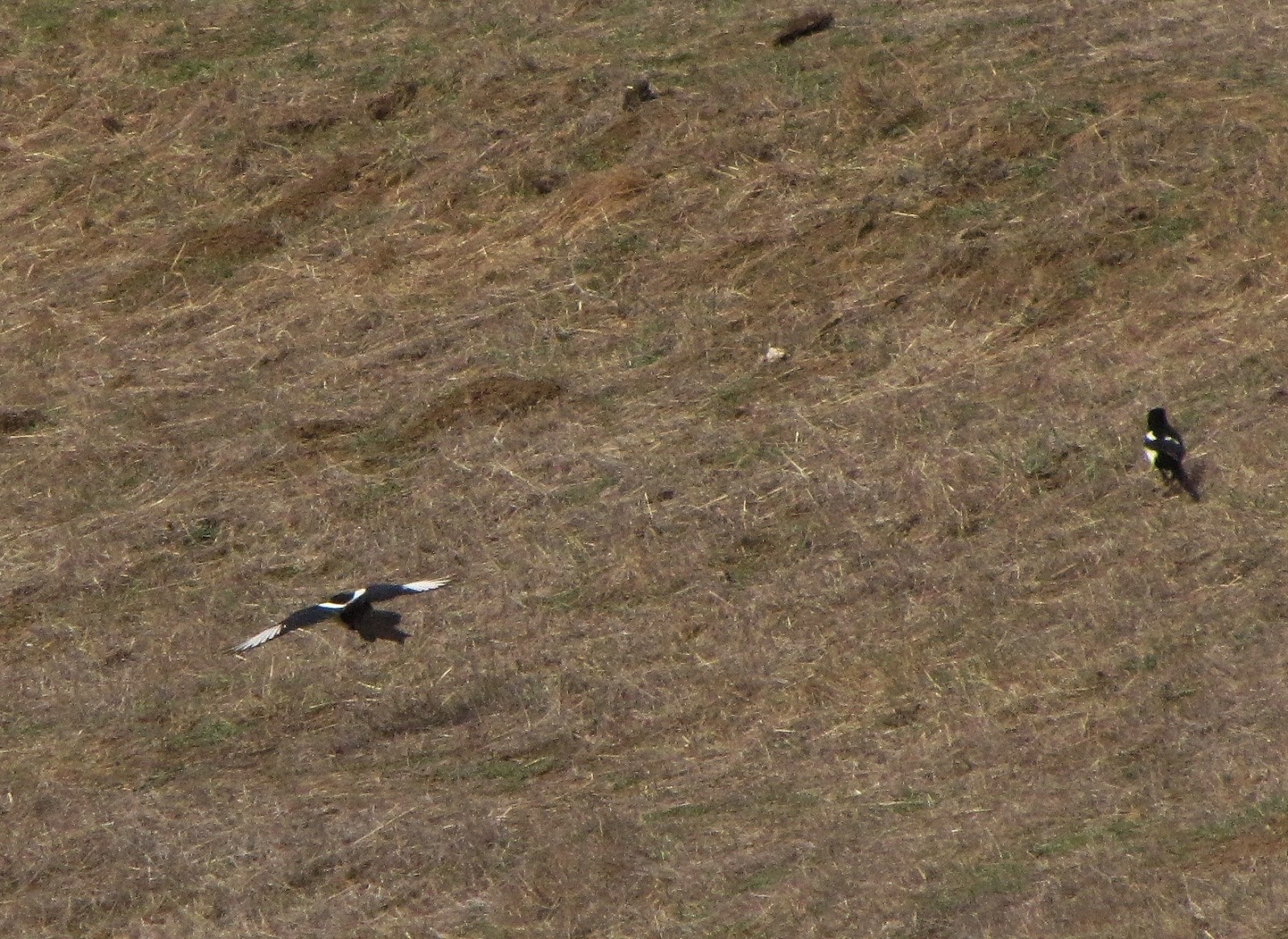
Yellow-billed Magpies, Alameda County, California
After the magpies, I drove a long stretch without stopping, but I ended up stopping in Bakersfield, CA for gas and a quick driving break. I happened to be filling up next to a McDonalds, so I checked the web real quick for any nearby birds. As luck would have it, there was a Spotted Dove reported a couple of days prior at Beale Park, just a few minutes down the road. Naturally, I stopped by to check it out. At first I didn't find much, and the only activity was a bunch of Rose-ringed Parakeets moving from tree to tree. I saw a dove-like bird in a tree across the street, but, when I made my way over there, it was gone. I began birding up and down the street and ran into a bunch of Audubon's Warblers, a few Acorn Woodpeckers, Ruby-crowned Kinglet, Western Scrub-Jay, and most surprisingly a single Black-throated Gray Warbler--a good looking male. However, it didn't stay put for more than a few seconds, and I was unable to get a photo of this bird. This was a great pickup, and a bird I wasn't counting on seeing this year!

Finally, just before I was about to give up I found a pair of Spotted Doves perched in a tree just down the road from my parked car. Although not overly cooperative, I was able to get a decent shot.
Spotted Dove, Beale Park, Kern County, California
Rose-ringed Parakeet, Beale Park, Kern County, California
After I was done getting photos of the Spotted Dove, I went to check one other place just outside of Bakersfield. There were Sage Thrashers and Greater Roadrunners reported a few days earlier from a personal location, but when I arrived I found it to be a little too personal. There were plenty of no trespassing signs--and they looked serious. So, I settled for a few White-crowned Sparrows and a Northern Mockingbird viewed from the car, and I went on my way.

Next stop: Bill Williams NWR...