Thursday, February 14, 2013

Birding the Mangrove and Coast of Northern Brazil

Coastal Maranhao has extensive mangrove swamp, some of the most expansive in the world.  It isn't as  species rich as the rainforest, but a surprising number of species can be found there. From the ubiquitous Orange-winged Parrots (Amazona amazona), Yellow-headed Caracaras, and Scarlet Ibis to Crested Orupendulas, Rufous Crab Hawk, and many others, the mangroves were fun to bird in.  
Scarlet Ibis were gorgeous and perhaps one of the commonest species seen.  Late in the evening it was not uncommon to see hundreds flying to roost for the night.
They roost in trees in very large numbers.
Captivating to the point of distraction.  How can you find or even glance at other species when hundreds of these are flying over your head?
That color is hard to photograph though.  Most of my photos look fake!
Yellow-headed Caracaras were common as well.  Scarecely a moment passed where one wasn't seen or heard.  
In this part of Brazil they look different from the rest of the population.  There head is more white than yellow.  Apparently boating is a hobby.
The slightly less common Southern Caracara was also a pleasure to watch.  Sorry for the crap photo.
Needless to say, Great Kiskadees were just about everywhere, as common here as anywhere else in the Neotropics from South America to south Texas.
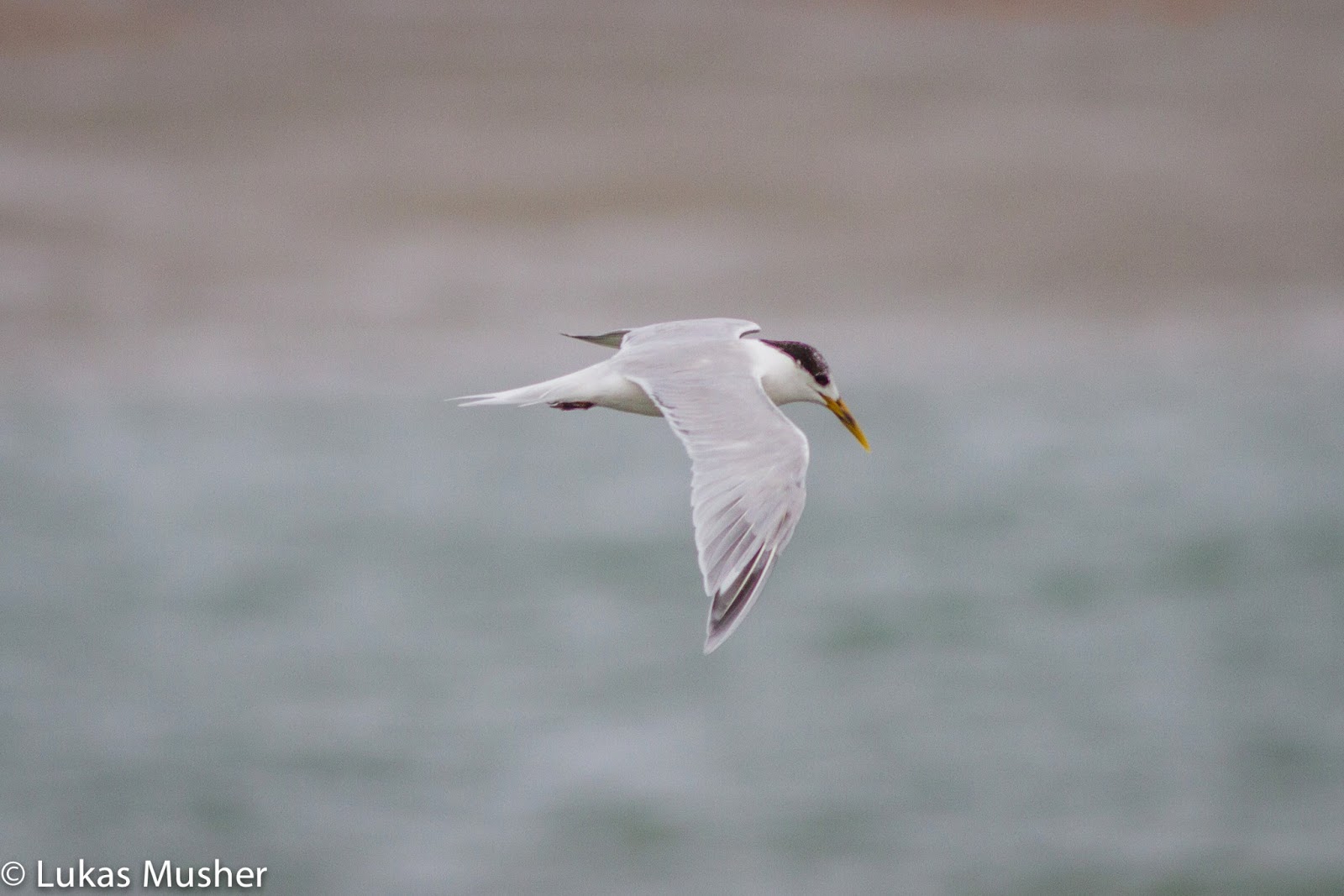
Cayenne Tern, formerly classified as a population of Sandwich Tern, was uncommon but seen regularly.
Large-billed Tern.  Another common bird.  Another crappy photo.
Beware of the evil goats on the windblown dunes of Lencois.  Frightening.
Orange-winged Parrots.  The only Amazona that we saw in the mangroves, and the only parrot we identified there.  I think we had parakeets at one point whose identity was never confirmed.
Good night.
Other cool species we saw included Crimson-crested Woodpecker, Ringed and Amazon Kingfisher, Greater Ani, Little Blue, Tricolored, Striated, Rufescent Tiger-, and Cocoi Herons, Great Black Hawk, Tropical Mockingbird, Yellow-billed Tern, Gray-hooded Gull, and of course the countless shorebirds.

~Luke

Wednesday, February 13, 2013

The Shorebirds of Coroa Dos Ovos

Well I'm back from Brazil, and excited to start posting again.  As I mentioned, the main purpose of my visit to northern Brazil was as part of a project run by David Mizrahi at New Jersey Audubon to band and flag Semipalmated Sandpipers (Calidris pusilla) on their wintering grounds.  We had a very successful trip, banding 1600 birds in just 8 days of netting.
Semipalmated Sandpipers on Coroa Dos Ovos
The island we were on was called Coroa Dos Ovos, which is Portugese for Crown of the Eggs.  It is a very long sandspit that becomes an island at high tide and connects to the mainland during low tide.  There are several species of regularly occurring shorebirds here such as American Oystercatcher, Whimbrel, Willet, Greater Yellowlegs, Sanderling, Red Knot, Semipalmated, Black-bellied, Wilson's, and Collared Plovers, Short-billed Dowitcher, and of course Semipalmated Sandpiper.  Interestingly enough, all of these species (except American Oystercatcher, Wilson's Plover, and Collared Plover) can be seen feeding in the mangroves at low tide, a behavior that is very difficult for us to imagine in North America.

The tides in this area are extreme.  Low tides expose rich substrate in the mangroves, and create extensive mudflats between Coroa Dos Ovos and the mainland on which the shorebirds forage.  At high tides, birds are pushed up into the mangroves and onto the island to roost.  It was not uncommon to see Whimbrel and Willet roosting in mangrove trees (weird to those of us used to seeing them in salt marsh)!  At extreme high tides, many more birds are forced out of the mangroves to roost on Coroa Dos Ovos.
Whimbrel and Semipalmated Sandpipers roosting in the mangroves
We concentrated our efforts right around the full moon, allowing for the highest tides, and we were not disappointed.  Up to 10,000 Semipalmated Sandpipers, and hundreds of Willets, Whimbrels, Sanderling, and Black-bellied Plover, dozens of Short-billed Dowitcher and Red Knot, and several other species of shorebirds and terns were found roosting on the island.  We caught sometimes more than 300 birds in a night.

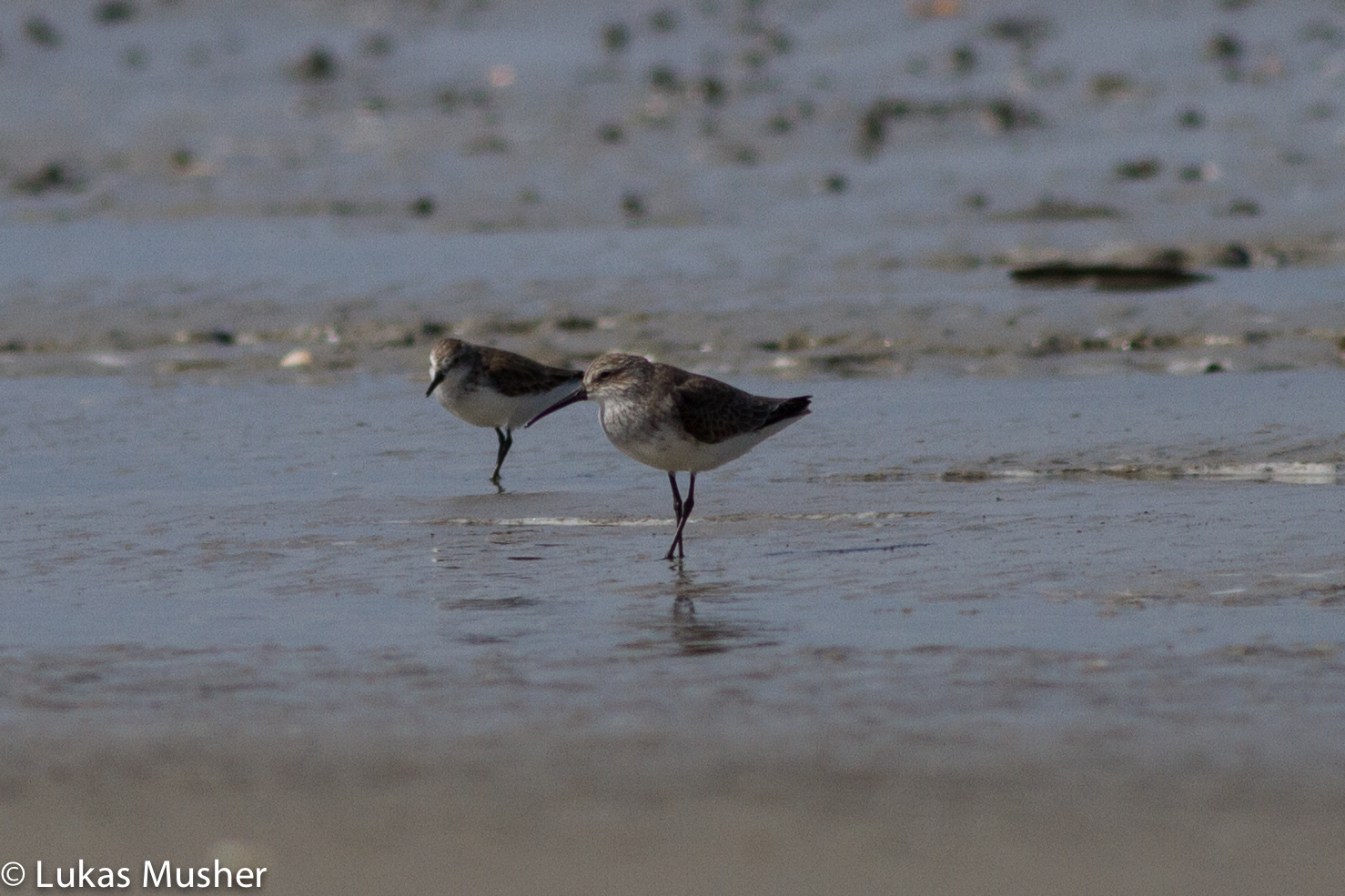
One of the Western Sandpipers we captured – an after second year (adult).  Note the dark centers to the back feathers, dark tertials, and little bit of rufous on one or two scapulars (leftover from breeding plumage).
The most exciting part about this was the number of rare shorebirds that could be found in these flocks. While scanning for flagged Semipalmated Sandpipers, I located a Curlew Sandpiper (Calidris ferruginea), and Tom Magarian spotted the first few Bar-tailed Godwits of which we eventually had a high count of 14!  We captured a total of 4 Western Sandpipers, and I found one long-billed individual mixed in with the semis once as well.
Curlew Sandpiper
Curlew Sandpiper
Curlew Sandpiper
Up until last year there were no records for Western Sandpiper on the Atlantic coast of South America (last year our team minus me caught two).  There are not many records for Bar-tailed Godwit for Brazil (not certain of the exact number), but last year the team had the first record for the state of Maranhão with a count of 12 individuals.  There are no published Curlew Sandpiper records for Brazil, but we just found out about a photograph of an individual from 2010.  That makes our bird the 2nd for Brazil, and the first for the state of Maranhão.
Whimbrels and 13 Bar-tailed Godwits (and a Willet that you can't really see)
And again, can you find all 13?
Here's 1-8
...and here is 5-13
And here is the 14th Bar-tailed Godwit, with Whimbrel and Gull-billed Terns (the tern in the bottom left is a Yellow-billed Tern)

~Luke

Thursday, January 17, 2013

Off to Brazil

I'm off to Brazil for three weeks to band shorebirds.  I'll post photos and stories when I return.

Take care, and happy birding –

Luke

Monday, January 7, 2013

What’s Next for Academic Ornithology?

Want to know how studying microorganisms relates to studying adaptive radiation, and evolution in selected traits like color and morphology in birds like this White-winged Crossbill?  Sexual selection is well studied in a host of bird species, but the genetics of sexual selection have yet to be worked out.  Gavin Leighton has brought us yet another great piece on where ornithology may be headed in the near future.  Read on and keep an open mind (White-winged Crossbill, Provincetown, MA, December 2012).
By Gavin M. Leighton

There’s no hiding it anymore: the major academic ornithological societies, e.g. The American Ornithological Union, The Wilson Ornithological Society, The Cooper Ornithological Society, and smaller raptor groups, are facing declining membership numbers and reduced revenues.  These groups are currently in the midst of talks about forming a singular society so as to pool resources and reduce inefficiencies due to overlapping functions.  Importantly, the decline in the groups also reflects a similar, though less drastic, proportion of research biologists performing research on natural populations.  While species such as the Darwin’s Finches continue to receive much press, the fields of evolutionary biology and behavioral ecology have diversified into new groups. 

This diversification is welcome; we can test overarching biological principles in more species and some of the new work is done on species that are amenable to controlled studies in labs.  Therefore, the appropriate response of academic ornithologists is not to resent the burgeoning work on species such as Dictyostelium discoideum; rather, academic ornithologists should turn their attention to the genetic and mutational techniques that have been developed in the microbial and agricultural worlds.  The DNA sequencing technology now available to researchers is staggering; we can sequence billions of base pairs of DNA in less than a few days.  Other groups of researchers have used this data to characterize soil meta-communities, identify mutations in agricultural crops, and delimit the mutations associated with coat color in some mouse species. 
ABI Prism 3100 Genetic Analyzer – we have the technology... (Photo from Wikipedia)
Not only are these techniques providing truck-loads of data, they are also being refined by the researchers performing the techniques.  The researchers have worked out most of the kinks associated with common next-generation sequencing technology thus delivering to ornithological researchers a massive opportunity that should not, and can not, be wasted.  The reasons that first attracted researchers to studying birds are the same reasons that should be used to create a mini-rebirth in academic ornithology. 

For instance, the biological community has gravitated towards studying sexual selection in birds because of the wealth of color traits and behavioral traits that are supposedly due to sexual selection.  As referenced before, Darwin’s finches are a classic example of species radiation (as an aside, Darwin didn’t even realize the finches were all finches until he had an ornithologist friend examine the specimens), and a considerable number of bird species are studied because of their cooperative breeding behaviors. 

Until recently, serious genetic studies could only be conducted on “model” species that were both reared in labs and also had their genome sequenced and published.  Now, a host of enzymatic digestion and sequencing allow researchers to discover large swaths of the genome at a time.  And in some cases, these DNA sequences can be mapped onto the genome of a closely related species; for example, individuals working on Darwin’s finches could map sequences onto the genome of the zebra finch.

What does all this mean? First, we can begin to understand the genetic architecture that underlies the variety of bird colors we see.  We would be able to compare tanagers and Northern Cardinals to see if selection produced red feather color along similar molecular pathways.  We will be able to delimit the genes that underlie behaviors like cooperative breeding, whereby some individuals give up the opportunity to breed elsewhere and instead help raise their siblings or half-sibs. 
Is red feather pigment selected for along the same or similar molecular pathways in all species?  Is bill morphology in Red Crossbill types selected for along similar pathways as bill morphologies in Darwin's finches?  (Red Crossbill, Provincetown, MA, December 2012)
Once we define these genes that are correlated with certain morphological or behavioral traits, it won’t be long before researchers can insert mutations or new forms of a gene into wild individuals using vectors such as viruses.  Field experimentation/validation is considered the holy grail of field biologists, and in the near future ornithologists will be able to perform the studies that conclusively show that certain genes are responsible for certain traits.  Once we understand which genes control which traits, we can follow those genes over time and track evolution in real time in animal species. 

In total, the depth and breadth of our understanding of the natural world will grow exponentially.  The only necessary step is for ornithologists to catch-up with the technology that is coming online.  Regrettably, many ornithologists are only familiar with the new techniques, but hesitant to dive into the new world of next-generation sequencing.  This is disconcerting as the potential data that could be collected and analyzed on bird species would firmly entrench ornithology as a relevant and exciting field of biology.  Indeed, there is no reason why the bird traits that have drawn both researchers and the public to birds in the past, can’t be studied and understood using the new technology we have now.  Importantly, if academic ornithologists do take advantage of the opportunities presented by new sequencing technology, then we could reverse declining membership in bird societies and potentially engender a new renaissance in birding.

Gavin is a PhD candiate at the University of Miami studying cooperative behavior in Sociable Weavers.  To learn more about Gavin, see our Guest Writers page.

We at BoomCha are excited and hopeful to hear from you.  Please comment on this post with your thoughts, concerns, and opinions on Gavin's piece.

Monday, December 10, 2012

Estero Llano Grande State Park

Rose-throated Becard, Estero Llano Grande State Park, TX
Cory and I really enjoyed Estero Llano Grande State Park.  We made three separate trips to this location and got some of my favorite birds of the trip.  Cory got the rarest bird of the trip here, a female Rose-throated Becard.  Alas, I missed it because I was at Santa Ana looking for Hook-billed Kites at first light.  When Cory called I rushed over, but could not relocate the bird.
Common Pauraque, Estero Llano Grande State Park, TX
Alligator Lake was great for Common Pauraque, Anhinga, Neotropic Cormorant, Green Kingfisher, waterfowl, and Least Grebe.  There was also an Eastern Screech-Owl with its head out of a nest box, and a Long-billed Thrasher here.
Curve-billed Thrasher, Estero Llano Grande State Park, TX
Walking in the "Tropical Area" turned up a lot of great birds early in the morning including Buff-bellied and Ruby-throated Hummingbirds, Wilson's, Yellow-rumped, Pine, and Orange-crowned Warblers, Northern Beardless-Tyrannulet, Inca and White-tipped Dove, Clay-colored Thrush, Ladder-backed and Golden-fronted Woodpeckers, Green Jay, Altimira Oriole, Plain (boom) Chachalaca, and Curve-billed Thrasher.  This is where the becard hangs out when it is seen.
Neotropic Cormorant, Estero Llano Grande State Park, TX
Along the other trails in the park we saw lots of waterfowl and herons, Vermillion Flycatcher, and sparrows among other species.

Sunday, December 9, 2012

Texas Trip: Santa Ana NWR

One of the places I was most excited to visit in south Texas was Santa Ana National Wildlife Refuge.  This beautiful, more than 2,000 acre refuge harbors many of the rare and sought-after birds in south Texas.  We visited the refuge three times during our 6 days in the Lower Rio Grande Valley.  Despite the refuge's great reviews by other birders, we left the park each time a little disappointed.  Perhaps we had bad luck here compared with other places.  We did two long early morning hikes in the park, but found bird activity and diversity to be relatively low.  Still, we enjoyed the long hikes through forests of texas ebony, and got a lot of great birds.  Waterfowl and shorebirds abounded in the park, and we spent a lot of time scanning the impoundments and lakes hoping for a Northern Jacana or a Masked Duck, but with no luck.
Green Jay at the feeder, Santa Ana NWR, TX
White-tipped Dove, Santa Ana NWR, TX
The main birds we saw in the park were Green Jay, White-tipped Dove, Plain (BOOM!) Chachalaca, Harris's Hawk, Great Kiskadee, Olive Sparrow, and Long-billed Thrasher.  We also spent a lot of time pishing to see what we could turn up in the flocks of wintering songbirds.  Despite our efforts, we only had common species such as Orange-crowned Warbler (just about everywhere!), Yellow-rumped Warbler, Blue-gray Gnatcatcher, Ruby-crowned Kinglet, Pine Warbler, and Black-crested Titmouse.  On the lakes we saw Least and Pied-billed Grebes, most of the normal North American waterfowl, Wilson's Snipe, Long-billed Dowitchers, and other shorebirds.
Harris's Hawk, Santa Ana NWR, TX
I put in a little bit of time on the observation tower hoping to spot a Hook-billed Kite, but much to my chagrin, I could not locate one.  Harris's Hawk, Gray Hawk, Turkey and Black Vulture, Northern Harrier, Osprey, Red-tailed and Red-shouldered Hawks were the only raptors I saw from up there.

Even though we were a little disappointed after our visits here, I would recommend this refuge to any birder or naturalist visiting south Texas.  The extensiveness of the trails, habitat diversity, and potential for rare birds is amazing in itself.  I am absolutely looking forward to going back in the future.

Saturday, December 8, 2012

Texas Trip: Aransas NWR to Port Aransas

Brown Pelican, Port Aransas, TX

I'm back from my 9-day trip to Texas with my friend Cory DeStein.  We saw a lot of good birds and each got some good lifers (Cory got more than 40!).  Over the next week and a half I will do a few posts for each of the main locations we birded, and post some photos from them as well.

Aransas National Wildlife Refuge was beautiful, and our main target bird there was Whooping Crane.  We started the morning off birding near the visitor center where we picked through the winter flocks of songbirds, which contained mostly Yellow-rumped Warblers and Ruby-crowned Kinglets along with Orange-crowned Warblers and a few other common species.  We also had American Kestrel, Merlin, and flyover Sandhill Cranes, Snow and Ross's Geese, and a Pine Siskin.

We then drove the auto loop stopping every so often to look at the waterfowl, pelicans, and waders.  Highlights along the loop were hundreds of Redhead, Northern Pintail, and several other waterfowl species, and great looks at Whooping Crane from the observation tower.  We had six in all.  Two right by the tower (they are usually very distant), two close flybys, and two distant birds.  Other birds we had on the loop included Inca Dove, Orange-crowned Warblers, Red-tailed Hawks, and some very large wild pigs that scared the pants off of Cory (I saved him though).
Whooping Crane, Aransas NWR, Texas
From Aransas we drove south to Goose Island State Park where we saw hundreds of Brown and American White Pelicans, Common Goldeneye, Red-breasted Merganser, Redhead, Caspian and Royal Terns, and other waterfowl and shorebirds.

We then drove to Port Aransas to look for terns (I still needed Sandwich for the year).  At the jetty we head Black, Forster's, Caspian, Royal, and Sandwich Terns, and a Reddish Egret but not much else except for an unidentified sea turtle that popped up for a few seconds.  We continued south from there adding Crested Caracara and White-tailed Hawks on the power lines on the barrier islands north of Corpus Christi.
Reddish Egret, Port Aransas, TX
 By Luke Musher