Thursday, January 12, 2012

Binge Birding: Part 2


So...where was I?  Oh yes, the ominously approaching waves.  So I have about ten seconds to get back up onto the wall and not get drenched or worse, swept off the jetty entirely.  I sprinted up to the next section of wall and dove onto it, shielding my camera from spray and trying not to bash it against any rocks.  The waves came in one after another but I was protected on the wall.  I continued this method for the entire length of the jetty - walking along the wall, navigating over the rocks where possible and sprinting up the lower portion where the wall and rocks were too dangerous to endeavor.  After fifteen minutes of this I reached the end of the jetty.  I found a flock of roosting shorebirds including Semipalmated Plover and Western Sandpiper, but no Rock Sandpipers.  

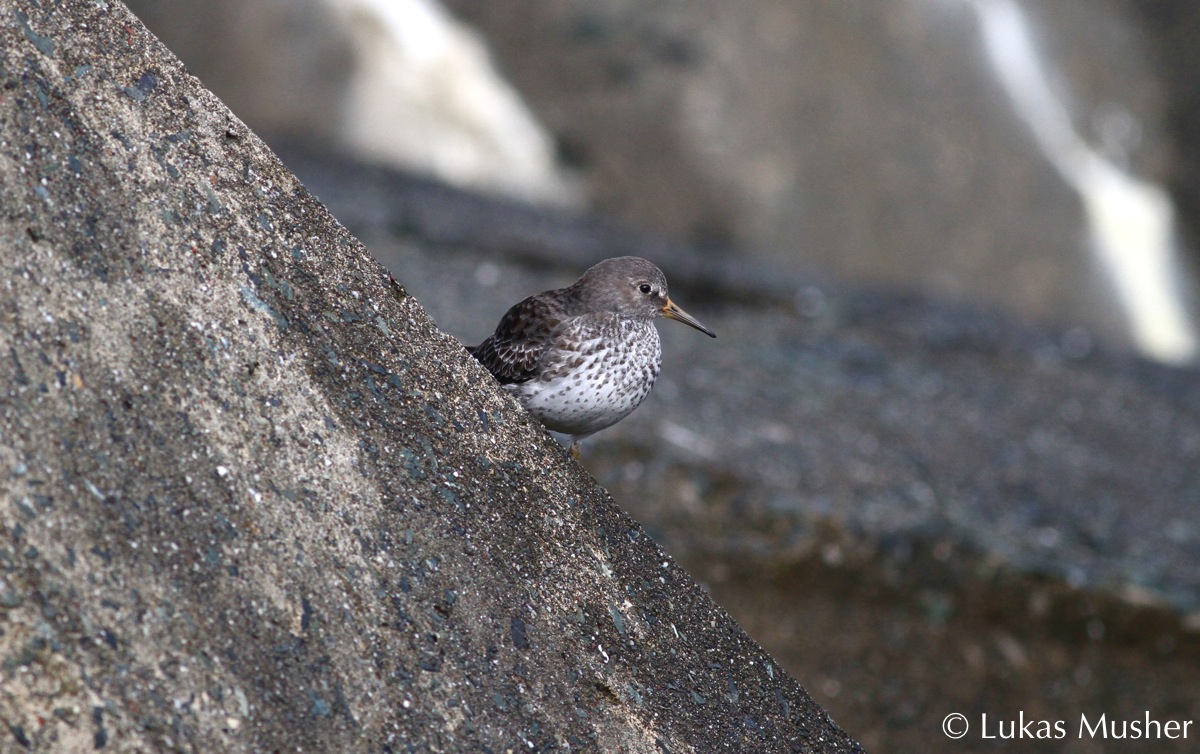
The distant end of the breakwater was elevated and wide, surrounded by a barricade of rubble and cement.  I was safe of the waves, for now, but my scope was all by itself on the beach and I needed to find the birds fast to get back to it.  I walked around looking, but couldn't find my sandpipers.  Three male Harlequin Ducks drifted just twenty meters of so from the jetty, a good year bird, but my focal species wouldn't show.  I was getting anxious and checking every crevice for feeding birds, but none showed themselves.  Then as I was ready to give up, a flock of Surfbirds was roosting in the rocks.  I got closer and started taking photos.  I realized then that there were more than just surfbirds in this flock, but all the birds were sleeping.  I fabricated an alarm call that somewhat resembled that of a Greater Yellowlegs, whistling do-do-do-do-do-do-do-do-do.  The birds all stood up and lifted their heads from behind their wings.  Two Wandering Tattler, were lifers for me, and I was beyond happy to see them, but they weren't Rock Sandpipers.  I scanned the flock again, and there they were.  Four Rock Sandpipers stood in front of me wondering what the ruckus was all about.  Yes!  I continued doing the alarm call because they kept trying to go to sleep (I needed photos after all).  I crept up and braced myself on a rock, laying there and snapping off dozens of photos.  Luckily the fog disappeared for about five minutes so I could lower my ISO and get some quality photos!
Wandering Tattler, Humboldt Bay North Jetty, CA. 01/10/2012/ [Photo by Lukas Musher]
Rock Sandpiper (center) with Surfbirds. [Photo by Lukas Musher]
Surfbird (also notice the two sleeping Rock Sandpipers in the back ). [Photo by Lukas Musher] 
Rock Sandpiper (!) [Photo by Lukas Musher]
Harlequin Duck, through the fog and cropped. [Photo by Lukas Musher]
So now I had to get back.  I managed to get most of the way back without any problems.  But then I looked through my binoculars to check on my scope and saw a man standing around right by it.  CRAP!  I sped up my walk.  As I approached, the surf came up and washed over my legs, but luckily wasn't strong enough to knock me over.  Two large white SUV's pulled up and men in uniforms approached the man at my scope.  What on earth was going on.  I got back and explained that this was my scope, and I had merely left it so that I could safely make it to the end of the jetty to see a bird.  The man who had been with my scope had called the coast guard.  The coast guard proceeded to explain to me that people fall off the jetty ALL THE TIME and that locals call in anything suspicious in case somebody had slipped or been knocked off.  Last year a group of teenagers was washed off the jetty by a large wave.  When I asked if everyone was alright he said, "Yes, except for one kid had a broken arm and femur." Well, good thing I had such a good system for getting across the jetty (?).  Thankfully, I was fine, and even if something had went wrong, it's nice to know that the coast guard would have been there promptly.  A large coast guard vessel in the inlet turned around, and an orange helicopter flew over, back towards the base.  Whoops... Probably not the last time I risk it for a bird, but 'tis the life of a lister!

So after apologizing profusely and thanking them, and hearing, "No big deal, happens all the time," I made my way back up the beach to my car and continued birding.
Savannah Sparrow, Ferndale, CA. 01/10/2012. [Photo by Lukas Musher] 
Clay-colored Sparrow, Ferndale, CA. [Photo by Lukas Musher]
So I went to several spots looking for birds such as Red Crossbill, Northern Shrike, Gray Jay, Golden Eagle, Ferruginous Hawk, Rough-legged Hawk, and Snow Bunting, but struck out on all fronts.  I did manage to add Caspian Tern, Double-crested Cormorant and Bald Eagle, though, and followed up on Rob Fowler's tip out the Clay-colored Sparrow.  A beautiful bird.  I made it back to PRBO by nine and ended with 128 species for the trip.
Clay-colored Sparrow, Ferndale, CA. [Photo by Lukas Musher]
By Luke Musher

Wednesday, January 11, 2012

Binge Birding: Part 1

I had Monday and Tuesday off so I went north to pick up a few species I need for my life list as well as a bunch of year birds.  I birded pretty much non-stop sunrise to sunset both days, finding a lot of good year birds including two lifers, but also striking out on several birds that would have been great to see.
Townsend's Warbler, Bolinas, CA. 01/08/2012. [Photo by Lukas Musher]
I started my trip off right in Point Reyes, Sunday afternoon after banding.  Cory, Dan Lipp and I went looking on Overlook Drive to see if we could relocate the Yellow-bellied Sapsucker that had been seen several times over the past two weeks or so.  No luck there, but we my trip list started racking up birds nonetheless.  Townsend's Warbler, Yellow-rumped Warbler, Eurasian Collared-Dove, Mourning Dove, Merlin, American Kestrel, and lots of other common birds.

I then drove straight up Route 1 to Bodega Bay where my main target birds were Marbled and Ancient Murrelets and Black-legged Kittiwake among other target year birds.  I camped the night at the Westside campground, and froze my butt off because I forgot my sleeping bag - all too typical for me I'm afraid.  I attempted to do some owling but ended up on some road that appeared to be private in the middle of nowhere and kind of spooked myself out so I left within twenty minutes.  Northern Pygmy and Spotted Owls will have to wait for another time (I was actually pretty sure I heard some Northern Pygmy-Owls way off in the distance, but I couldn't rule out that I was just imagining it).

Monday morning I woke up before sunrise and got out to Bodega Head by about 7:45.  I spent an hour scanning for my target species, but visibility was relatively poor, and I didn't have time to sea-watch all day, so I missed the murrelets and kittiwake (not all that likely anyway).  I did manage to get Western, Clark's, Horned, Eared and Red-necked Grebe (got the grebe sweep!), six species of gulls (no positive Thayer's IDs), three loons, Brandt's and Pelagic Cormorants, Brant, poth pelicans, and most of the expected waterfowl in Bodega Harbor.
Western Meadowlark, Bodega Bay, CA. 01/09/2012. [Photo by Lukas Musher]
 At the Diekman's Store in Bodega Bay, I added Yellow Warbler (has been present there for a while now, but a good year and state bird for me) and Orange-crowned Warbler.  Anna's Hummingbirds were by far the most common bird at this site, but Townsend's Warblers seemed to be everywhere as well.
Anna's Hummingbird, Bodega Bay, CA. 01/09/2012. [Photo by Lukas Musher]
Yellow Warbler (terrible documentation photo), Bodega Bay, CA. 01/09/2012. [Photo by Lukas Musher]
From Bodega Bay I drove five hours north on 101 to Humboldt county to look for Tropical Kingbird, Northern Shrike, Rough-legged Hawk, Gray Jay, and Rock Sandpiper to name a few.  My first stop was on a back road along the coast outside a small town called Ferndale.  It was getting late though, and I knew I didn't have much time at this spot.  I was looking for Northern Shrike, but found nothing save a few Townsend's Warblers, a White-tailed Kite, Northern Harrier, some White-crowned and Golden-crowned Sparrows and a lone American Kestrel.  

I then went to the small town of Loleta, CA where a Tropical Kingbird had been staying all winter.  I drove around the area it had been seen but could not locate the bird.  On my way out, I saw a flash of yellow sally out from a wire across the road.  I pulled over and saw that the TRKI was actively catching bumblebees very successfully.  I was able to get a lot of photos.  Here are a few:
Tropical Kingbird, Loleta, CA. 01/09/2012. [Photos by Lukas Musher]
I then continued north to Humboldt Bay.  I stopped at King Salmon to scope the southern part of the Bay.  Sitting on the water were no less than seven adult Black-legged Kittiwake, all possible Loons and Grebes, White-winged and Surf Scoters, Red-breasted Merganser, and six other species of gulls among other birds.  These were my second through eighth kittiwakes ever, my first being a distant view of an immature bird in Delaware waters.

By this point it was fairly late, and I was planning on trying to find Rock Sandpiper before dark, and then trying to get up to Crescent City, another two hours away, to spend the next day.  Well I got to the jetty, and it was foggy and getting dark fast.  I started walking along the jetty, but I quickly realized there was no way I was getting out there in time.  I headed into the city of Eureka and stayed at a motel for the night.  I decided to skip Crescent City in order to spend more time birding the Humboldt bay area.

The next morning I woke up at 7 before the sun rose, and headed out to Arcata marsh.  Here I had a lot of good birds (although nothing too rare), but missed American Bittern, Cinnamon Teal, and some of the other species I had hoped to find.  The marsh was amazing, though, and some of the most fun birding I've ever experienced.  The shorebirding easily rivaled that of Brigantine back east (although obviously less diversity than during migration).  As I approached the mudflats on the bay, I was staring at somewhere between 15,000 and 30,000 shorebirds (I didn't count), Dunlin being the most abundant.  Western Sandpiper, Least Sandpiper, Black-bellied Plover, Sanderling, Marbled Godwits, Long-billed Dowitcher, American Avocet, and Greater Yellowlegs were all present as well.  I also added Black-capped Chickadee to my state and year list (sounds mundane to all you easterners, but out here they barely make it into CA).

I spent some time in the farmland north of the bay searching for some of the rarer birds that show up in winter.  Despite my efforts, no Pacific Golden-Plover, Rough-legged Hawk, or Northern Shrike.  I did have hundreds of Killdeer, a dozen or so Wilson's Snipe, and a Prarie Falcon, though.  I also had a Dunlin in a field filled with Killdeer that I REALLY wanted to turn into a Curlew Sandpiper, but I'm fairly certain it wasn't.  I met a birder from the area who was nice enough to give me a tip about a Clay-colored Sparrow visiting a feeder twenty minutes away, and told me the Rock Sandpipers at the jetty were usually pretty reliable, but that he wouldn't suggest trying for them at high tide.

Well, I got to the jetty, and low and behold, it was high tide!  In front of me was a degenerated quarter-mile long breakwater, covered in muck and algae.  The surf was washing almost constantly over the walkable part, sweeping away everything in its path.  Along the side there was a wall that had collapsed into the ocean in parts.  At the end beyond the fog lay my Rock Sandpipers.  I knew this much.  The only thing holding me back was the dangerous surf and the birder's words echoing in the back of my head, "I wouldn't suggest trying at high tide."  Well I had come this far, and I didn't have time to wait around four six hours for the tide to drop.  I had to band the next day and drive 6 hours back to Point Reyes!  I looked around, nobody was around.  Nobody would know if I fell in, but more importantly nobody would steal my scope if I left on the beach (couldn't carry it and risk losing balance, plummeting into the ocean, breaking bones and so on).  But my camera was a different story.  I didn't know how to protect it from the spraying sea, but it needed to accompany me on my Rock Sandpiper quest.
Black Turnstone were the commonest shorebird on the jetty. Humboldt Bay, North Spit Jetty, CA. 11/10/2012.
[Photo by Lukas Musher]
As wave after wave crashed into the jetty, pressure built up in the water underneath and shot up in small geyser-like fountains from cracks in the middle of the cement base spraying everything within a ten-meter radius with salty mist.  This wouldn't be easy, but it had to be done, and I had to bring my camera.  So I headed out.  I hopped up on the wall, shielding my camera from the spray, and walked slowly on the slippery rock, feet sliding as I flailed with arms spread  to keep from falling.  Turning to check on my scope, I couldn't see through the fog.  My foot slipped more.  Frightened of falling into the jagged rocks on the outskirts of the jetty, I leaped down onto the lower section of the jetty.  But as I looked out to the ocean, a series of large swells ominously approached.

To be continued...

By Luke Musher

Stay tuned for the second part of Binge Birding, tomorrow.


Sunday, January 8, 2012

The Why of Fly - The Origin and Evolution of Flight in Birds: Part 1

By Gavin Leighton

The most salient trait of birds is their ability to fly. Flight allows peregrine falcons to dive at just over 200 miles/hour, flight allows for migration, and flight allows birds like albatrosses to make vast expanses of ocean their home. Indeed, the evolution of flight was a critical event (and maybe the critical event) in the evolution of birds. Given the importance of flight for the class Aves, evolutionary biologists have long studied the origins of flight, and researchers are beginning to delineate how and why birds evolved flight.
Peregrine Falcon, Point Reyes, CA.  Dec. 2011 [Photo by Lukas Musher]
How birds evolved wings with flight feathers is an interesting story, especially since flight has evolved independently at least four times (insects, bats, pterosaurs, and birds). To begin I will very briefly outline the major physiological steps that produced wings that could produce self-powered flight. In the second part of the series, I will try to describe the selective mechanisms that favored the following physiological changes.

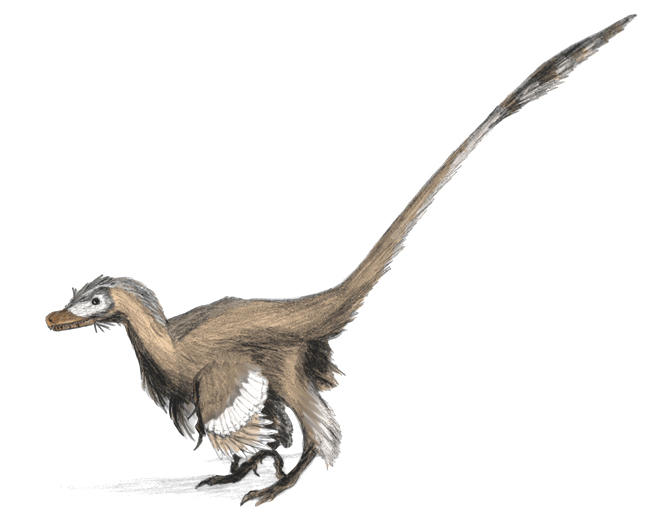
Birds’ closest ancestors were theropod dinosaurs (1). We all know what theropods dinosaurs are thanks to Jurassic Park (and as far as I’m concerned, only one Jurassic Park movie was ever made and it came out in 1993). As depicted in Jurassic park dinosaurs such as Velociraptor (see below), which is actually much smaller than depicted in the movie , and Tyrannosaurus, which may have been more of a scavenger than a predator, are both examples of theropod dinosaurs. In general, theropods were bipedal dinosaurs with strong hindlimbs and a long tail that was likely used for balance. From theropods we get birds, here is a woefully brief description of how.
An artist's rendition of velociraptor [Wikipedia]
To get from velociraptor to a contemporary bird, the first thing we need is feathers. Feathers were traditionally thought to only occur in birds, but a cascade of recent evidence demonstrates that many theropod dinosaurs had feathers as well (2) – I know what you are thinking, and no, Tyrannosaurus Rex could not fly. The theropod feathers were not used for flight, so other explanations must be invoked. The two common explanations are that the dinosaur “protofeathers” were used for signaling during sexual selection (due to the types of melanin researchers have found in fossils we know the dinosaur feathers were black, white, or red-brown type colors [3]); or, for facilitated thermoregulation. These two ideas are not mutually exclusive and hopefully future work will indicate the selective pressures that favored the evolution of the first feathers.
An artist's rendition of anchiornis [National Geographic]

At this point we have feathers on a roughly bi-pedal animal, but we still aren’t close to powered flight. To get powered flight we must move from the proto-feathers (see below) here is a very simple model of how feathers evolved) that resemble the downy feathers of chicks, to asymmetrical flight feathers. To get to contemporary flight feathers, feathers passed through intermediate stages, and an excellent review of this process was “Which came first, the feather or the bird?” by Prum and Brush (2003 – see citation 2). One of the main intermediate stages is the symmetrical flight feather (3). The symmetrical flight feather, compared to the asymmetrical flight feather, is actually worse for flying due to physics that will not be described here. Despite problems with a symmetric feather, components of the symmetrical flight feather were useful. For example, there are tiny hooks called barbules that help smooth the feather to maintain a feather’s airfoil shape. The evolution of barbules almost certainly occurred with or after the evolution of the symmetrical flight feather, thus making the symmetrical flight feather a useful stage to focus on. So, let’s skip ahead a bit and assume we have some sort of flight feathers on the arms, what comes next is the development of adequate wings.
Proto-feather evolution in chronological order. [Wikipedia]
The change from forelimbs with separated digits to the common bird wing involved numerous skeletal changes that I won’t describe.
Wings, such as the long wings allowing Black-footed Albatross to wander countless miles over vast expanses of ocean
evolved from the forelimbs of therapod dinosaurs. Pelagic out of Fort Bragg, CA. Aug. 2011. [Photo by Lukas Musher]

What I will mention as an aside is the downstream evolutionary consequences after wings evolved. After proto-birds lost any sort of forelimb dexterity, the duty of manipulating objects was transferred to the beak. This transfer likely explains the extraordinary diversity of bill forms, compared to other groups. So lets assume that the wing morphology is coming into place, even with wings, other physiological structures and adaptations were necessary to yield contemporary birds. Among the adaptations are hollow bone structures that largely reduce the weight of a bird (1), and save the bird significant amounts of energy during flight. And to actually get into flight, birds rely on their oversized breast muscles, which became so powerful that they need to be anchored to a keeled sternum.
Archeopteryx lithographica, Wyoming Dinosaur Center.  Taxonomically the first bird.  One of 8 specimens worldwide.
Note the details of feathers and other traits that link dinosaurs to birds including the furcula. [Photo by Lukas Musher]
All of these physiological adaptations compose the part of the story that describes “how” bird physiology changed over time to allow for powered flight. In addition to how birds anatomy changed, a complementary question is “why” birds are the way they are, and not otherwise. To answer why birds can fly, several ideas have been posited with varying degrees of support. In part 2 of this series, I will limn the most well established ideas for why birds evolved flight and some of the newer ideas as well. 

Gavin Leighton is a PhD candidate at the University of Miami, studying cooperative behavior in Socialble Weavers.  See more on Gavin at Guest Writers.

Citations:
1 Kaiser, G. The inner bird: anatomy and evolution. 386 (2007).
2 Prum, R. & Brush, A. Which came first, the feather or the bird? Sci Am 288, 84-93 (2003).
3 Vinther, J., Briggs, D. E. G., Clarke, J., Mayr, G. & Prum, R. O. Structural coloration in a fossil feather. Biol Letters 6, 128-131, doi:10.1098/rsbl.2009.0524 (2010).

To read the Why of Fly - the Origin and Evolution of Flight in Birds: Part 2, click here.

Wednesday, January 4, 2012

Compare-A-Sharpie

In addition to exciting birding, the new year has also ushered in a time for possible confusion. That is because birds are aged on a calendar system, so a hatch year bird on December 31st is now a second year bird on January 1st. We are comparing three different ages of Sharp-shinned Hawks (SSHA) in this post, but all three birds just passed their "birthday" and became a different age along with the new year. To reduce confusion I will try to break down how these birds are aged and how that relates to plumage differences before I get into the rest of the post.

From hatching until December 31st of that calendar year, these SSHA are considered hatch year (HY). The subsequent year they are considered second year (SY), and so on. Simple enough. But, these birds don't molt on December 31st and January 1st, so the different plumage types don't correlate exactly with their calendar age.  These birds generally molt in the fall; therefore, a SY SSHA early in the year (before molt) looks different than a SY SSHA late in the year (after molt). Also, SSHA that are past their 3rd calendar year don't show enough unique characteristics to age any farther than third year (TY) in December or after third year (ATY) in January. So, even if a SSHA is in its 5th calendar year, it would still be called an ATY.

So, to avoid confusion I will call our three Sharp-shinned Hawks juvenile, sub-adult, and adult. The juvenile hatched in 2011 and was a HY in December but a SY now, the sub-adult hatched in 2010 and just became an third year (TY) bird, and the adult hatched in 2009 or earlier and is now considered an after third year (ATY).
 
Now we will compare our two new SSHA to the one from last month in the post Birds in Hand: A Couple of Recent Favorites.
This is how we weigh birds. There is no harm done by putting the bird in a can or cup. [Photo by Luke Musher]
Here is a juvenile male Sharp-shinned Hawk. Note the yellow iris and thick, brown streaking (running the length of
 the body) as these are characteristic of juvenile SSHA. [Photo by Luke Musher]
Another look at the juvenile male Sharp-shinned Hawk. [Photo by Luke Musher]
This is the sub-adult male Sharp-shinned Hawk that we posted about last month. Note the orange iris characteristic of
 sub-adult male SSHA and the rufous barring (running across the body vs. along the length of the body) characteristic 
of older (sub-adult and adult) Sharp-shinned Hawks. [Photo by Cory Ritter]
A closer look at the sub-adult SSHA (SY last week, ASY today). Again, note the orange iris and rufous barring. [Photo
 by Cory Ritter]
This is a third male Sharp-shinned Hawk that was caught last Saturday. This SSHA is an adult based on the deep red 
iris. Therefore, this bird hatched in 2009 or earlier. So, these three Sharpies hatched in three different years. The top 
bird hatched in 2011, the middle in 2010, and this one in 2009 or earlier. Note how the rufous barring is pretty much
 the same as the middle bird, but the iris is a deeper red. [Photo by Cory Ritter]
We have caught some other pretty sweet birds lately. Below are some photos of some recent captures:
AHY Male Anna's Hummingbird. We feed hummingbirds sugar water, the same that goes into hummingbird feeders, to 
ensure they don't run low on energy during processing. This is a photo of Frenchie feeding this Anna's Hummingbird
 some sugar water. [Photo by Dan Lipp]
Here is another look at the AHY male Anna's Hummingbird. [Photo by Dan Lipp]
Cory measuring the wing-chord of a Bewick's Wren. [Photo by Dan Lipp]
Bewick's Wren posing for the camera. [Photo by Dan Lipp]
Posing, once more. [Photo by Dan Lipp]
This is Red-breasted Sapsucker was caught on New Year's Eve, and was a SY bird (now, in 2012, a third year [TY]
 bird). This photo shows the primary coverts that are uniform in wear and abraded--a trait of SY/ASY Red-breasted
 Sapsuckers. [Photo by Cory Ritter]
This photo shows more evidence of this being a SY/TY bird. There is a block of retained feathers, which are duller
 black and more worn, in the secondaries. Secondaries 1-4 are retained and 5-9 are replaced--this was the same on
 both wings.  HY/SY birds will show all secondaries of the same generation (no contrast) and ASY/ATY birds will show
a mixture of retained and replaced feathers that are neither in a block nor symmetrical on both wings. [Photo by Cory
 Ritter]
SY/TY Red-breasted Sapsucker [Photo by Cory Ritter]
So, we hope we haven't confused you by this post. There are lots of ages being thrown around in this post, and if anything doesn't make sense, please ask us and we can explain it further. Thanks!

By Cory Ritter and Luke Musher

Tuesday, January 3, 2012

Early (in the year) Birding and "Red" Fox Sparrow

It's early in the year, and that means there are still lots of birds to add to one's year list.  This makes for an exciting time for birding.  A time when a bird that might otherwise be common can now be exciting!  Anyways, beginning of the year aside, we heard about a really exciting bird, through the grape vine, that was seen right down the road from PRBO in Bolinas, CA.  We heard that Keith Hansen, a local artist/birder, had seen a Summer Tanager somewhere around the tennis court on Brighton Avenue in Bolinas.  We searched the area fairly well, but, much to our chagrin, we could not locate it.  We continued birding Bolinas, though.
Anna's Hummingbird, Bolinas, CA. 01/03/12. [Photo by Lukas Musher]
Starting around the tennis courts, we walked up the road leading uphill.  No Summer Tanager or eastern warblers, but lots of the common birds.  Anna's Hummingbirds were busy as ever displaying and feeding in the gardens along the road.  We then headed to the Bolinas cemetery to look for Pygmy Nuthatch (a bird both of us need for life).  We stopped to look at the wigeon flock across from the school and found two (maybe more?) female and male Eurasian Wigeon.
Eurasian Wigeon, Bolinas, CA. 01/03/12. [Photo by Lukas Musher]
At the cemetery we came across a very large flock of warblers that were, as far as we could tell, entirely Yellow-rumped (both Myrtle and Audubon's) and Townsend's Warblers.  We spent a lot of time sorting through them, but couldn't come up with anything else.
Townsend's Warbler, Bolinas, CA. 01/03/12. [Photo by Lukas Musher]
The biggest surprise of the day, though was what we believe to be a "Red" Fox Sparrow, which was feeding with a large flock of sparrows including both California and Spotted Towhees, as well as Golden-crowned, White-throated (no less than three), and Song Sparrows.  As far as we know, this race is quite rare in California, so we are hesitant to accept that it is a pure "Red."  We welcome your comments on this.
"Red" Fox Sparrow, Bolinas, CA. 01/03/12. [Photo by Lukas Musher]
We finished up the day birding some of the side roads off of Mesa Rd, looking again for Pygmy Nuthatch, but no luck again.  Birds around here included, Western Bluebird, White-crowned Sparrow, Townsend's Warbler, and a lone Cackling Goose in with the Canada Goose flock across Mesa Road from Overlook Drive.  On Mesa Road about one mile from PRBO we had one Say's Phoebe and a bobcat hunting in the coast guard field.

By Cory Ritter and Luke Musher

Monday, January 2, 2012

Starting the year off Strong...sort of

Happy New Year, all.  To live up to last year's list, I knew I had to start birding on New Years Day.  Although after a long night on New Years Eve, the other interns and I didn't leave until 12 o'clock! Pretty pathetic. Still, we made good use of the rest of our day off.  Rather than trying to get as many species as possible, Cory, Frenchie, and I headed to Colusa National Wildlife Refuge (3+ hrs away) to chase the Falcated Duck, which has been seen there for a few weeks now.  On the drive out we picked up lots of species including American Kestrel, Black Phoebe, Willet, Long-billed Curlew, Bufflehead, American Avocet, Belted Kingfisher, American White Pelican, Red-shouldered Hawk, Yellow-billed Magpie, Great Blue Heron, and Common Goldeneye to name a few.
American Wigeon, Colusa NWR, Colusa County, CA. 01/01/2012 [Photo by Lukas Musher]
 The refuge was loaded with waterfowl including hundreds of Greater White-fronted, Cackling, Snow and Ross' Geese, American Wigeon, Northern Pintail, a few Cinnamon and Green-winged Teal, Northern Shoveler, Gadwall, and of course a lone FALCATED DUCK, our target species for the day (only two previous accepted records for California).  It was one of the first birds we saw at the refuge thanks to its close proximity to the refuge observation deck and the half-dozen or so other birders and photographers watching it when we arrived.  We had great looks in the scope, and even with binoculars.  I was able to get some photos, but the lighting wasn't optimal, and the bird was fairly distant for my 400mm lens (photos of the Falcated Duck below have been cropped).
Northern Pintail, Colusa NWR, Colusa County, CA. 01/01/2012. [Photo by Lukas Musher]
Northern Pintail, Colusa NWR, Colusa County, CA. 01/01/2012. [Photo by Lukas Musher] 
Falcated Duck, Colusa NWR, Colusa County, CA. 01/01/2012. [Photo by Lukas Musher] 
Greater White-fronted Goose, Colusa NWR, Colusa County, CA. 01/01/2012. [Photo by Lukas Musher]
Falcated Duck, Colusa NWR, Colusa County, CA. 01/01/2012. [Photo by Lukas Musher]
Northern Pintail, Colusa NWR, Colusa County, CA. 01/01/2012. [Photo by Lukas Musher]
Northern Shoveler, Colusa NWR, Colusa County, CA. 01/01/2012. [Photo by Lukas Musher]
Greater White-fronted Goose, Colusa NWR, Colusa County, CA. 01/01/2012. [Photo by Lukas Musher]
Falcated Duck, Colusa NWR, Colusa County, CA. 01/01/2012. [Photo by Lukas Musher]
Other species added here include Merlin, Marsh Wren, Western Meadowlark, Savannah Sparrow, Yellow-rumped Warbler, and Prairie Falcon among others.

By Luke Musher and Cory Ritter