Tuesday, December 27, 2011

Still scrambling to pick up a few more year birds but with no luck!

Anna Fasoli of Speed Birding recently pointed out to me that I was in the eBird top 100 for my 2011 ABA (American Birding Association) area list.  I hadn't been checking my ranking since before I came out to California, but I'm glad she noticed that I was barely hanging on, now tied for 92nd place with 424 species (that's just over 50% of all the birds seen in the ABA area this year).  It's been a great year, but several birds relatively common in California remain to be added to the list.  Yesterday afternoon I went looking for Pygmy Nuthatches at the Bolinas Cemetery, although with no luck.  Nothing spectacular was around, but I did get to spend time watching and photographing some of the more common species; more than 6 White-throated Sparrows (a fairly good count for this part of CA), Song, White-crowned, Golden-crowned and Fox Sparrows, a few California Towhees, loads of Dark-eyed "Oregon" Juncos, Downy and Acorn Woodpeckers, Anna's Hummingbirds, Bushtits, and Chestnut-backed Chickadees. I also had 2 first winter male Eurasian Wigeons with the usual wigeon flock across the street from the Bolinas school.

Here are a couple of photos from yesterday:
California Towhee, Bolinas Cemetery, Bolinas, CA [Photo by Lukas Musher]
Dark-eyed Junco, Oregon race, Bolinas Cemetery, Bolinas, CA [Photo by Lukas Musher]

Wednesday, December 21, 2011

Find the Molt Limit

A quick and dirty molt lesson that will focus on a few aspects of molt that are necessary to know if you want to understand how and why we age birds the way we do:

All birds (for our intents and purposes) undergo one main molt, or growing-in of new feathers, each year. This molt is called the prebasic molt in AHY (after hatch year) birds, and the preformative molt in HY (hatch year) birds. Molts can be complete, incomplete, or partial. During a complete molt, birds grow in all new feathers--this includes all body feathers, and all flight (wing and tail) feathers. Birds that undergo an incomplete molt will grow in new body feathers and some, but not all, flight feathers. Finally, during a partial molt, birds grow in new body feathers and a varying number of wing coverts, but generally no flight feathers.

Now, why is this important? It is important because almost every adult (AHY) bird will undergo a complete prebasic molt, but the HY birds that have a prefomative molt will usually have a partial or incomplete molt. And it is specifically this partial or incomplete molt that will allow us to see a molt limit!

Molt limits are the "boundaries between replaced and retained feathers, resulting from partial or incomplete molts" (Pyle 1997). These boundaries are visible because the newer, replaced, feathers are generally less worn and less faded than older, retained, feathers. So, if all (minus an exception or two) adult birds have complete prebasic molts, then a bird showing a molt limit must be a........................hatch year bird!
Bird Topography.

We had a typical but interesting day at Palo today, with two Varied Thrush and a brand new hatching year female Spotted Towhee.  Check out some photos and descriptions of how we age and sex these species.
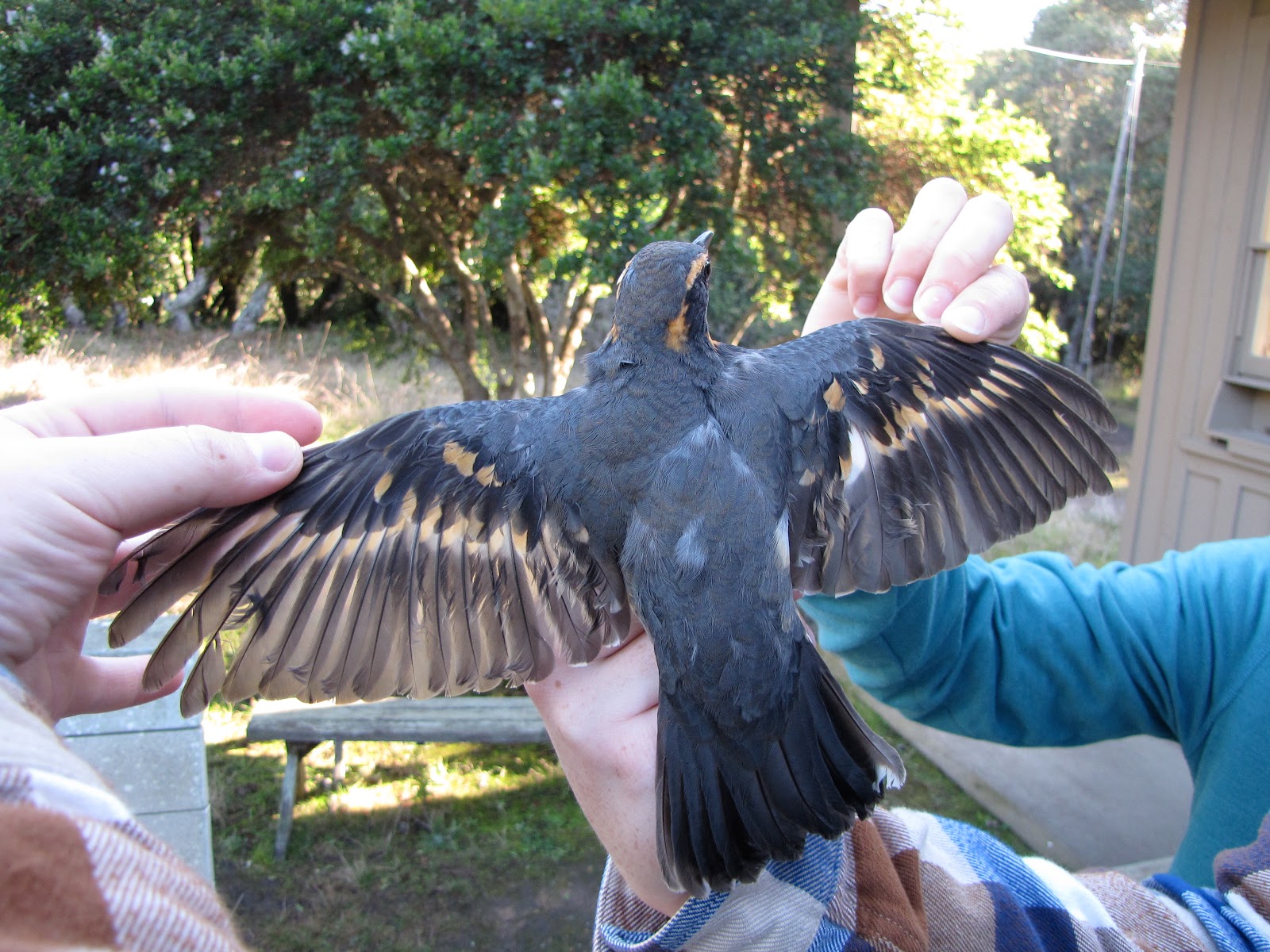
HY male Varied Thrush.  Females would generally not have such dark auriculars (cheek band) and breast band. [Photo by Cory Ritter]
HY male Varied Thrush.  Most of the rectrices (tail feathers) look fairly tapered rather than truncate, which is a good sign that this bird is a HY.  HY birds of most species retain many of their juvenal flight feathers.  These feathers are grown in the nest and quickly, so the quality is much lower than those of adults. [Photo by Cory Ritter]
HY Varied Thrush.  Note the overall ratty appearance and brown wash to the head and back (brown on the back is hard to see in the photo).  The wear and overall messiness is not a definitive indicator of age, but it certainly is supportive of a first year bird.  Again, this is because juvenal flight feathers are grown rapidly, and so are of poor quality, and become worn quickly in the nest. [Photo by Cory Ritter]
Male Varied Thrush. Deeper orange and blacker black than the previous HY above. [Photo by Luke Musher]
Male Varied Thrush.  Note neater, better quality flight feathers, broad and rather truncate primary coverts, indicative of an after hatching-year bird. [Photo by Luke Musher]
These rectrices appear more tapered than those of the previous Varied Thrush.  The inner edges of the outer rectrices form a gradual curve.  After-hatch-year birds will show rectrices whose inner edges form abrupt angles.  This ambiguity kept us from aging the bird. [Photo by Luke Musher]
HY female Spotted Towhee.  Its brownish rather than blackish head, wings and back indicate that it's a female.
HY female Spotted Towhee.  This Is textbook HY rectrix shape, narrow and tapered. [Photo by Dan Lipp]
Can you find the molt limit in this photo? [Photo by Dan Lipp]
Okay okay, not the best photo, but enlarging the photo, and putting in a nice red arrow, should help you spot the molt limit. The replaced alula covert on top is darker (less faded) than the retained alula feather.  This is another clue that the towhee is a HY. [Photo by Dan Lipp]
By Cory Ritter, Luke Musher, and Dan Lipp

Tuesday, December 20, 2011

Gull Watching: Little Gull

So I'm taking a break from the large white-headed gulls to show you Little Gull.  This is one of my favorite gulls.  These photos were taken on an overcast, snowy day this past February, so please excuse the slightly off focus and mediocre lighting on some of them.
First cycle Little Gull.  Note black ulnar bars creating M on upperparts, light gray mantle and scapulars, slate-colored cap, and dark black carpal patch.  Size, although not obvious here, is smaller than Boneparte's and Black-headed Gulls. Feb. 2011, Dunkirk, NY [Photo by Lukas Musher]
First cycle Little Gull. Note wing pattern (as above), short tail, short, relatively straight bill, and rounded wings. Feb. 2011, Dunkirk, NY [Photo by Lukas Musher
First cycle Little Gull.  Note shape, structure, and pattern of upperparts same as above.  Feb. 2011, Dunkirk, NY [Photo by Lukas Musher]
Adult Little Gull.  Note structure same as above. gray upperparts with pale wingtips. Feb 2011, Dunkirk, NY [Photo by Lukas Musher]
Adult Little Gull.  Note, underwing pattern distinctive, all black.  No other North American gull shows this combination of pale upperparts and dark underwing.  Wings rounded, bill short and straight. Feb. 2011, Dunkirk, NY [Photo by Lukas Musher]
By Luke Musher

Socializing with Socaible Weavers


Adult sociable weaver.  Sex can't be identified in the field and we have to use genetics to identify the sex of the weavers.[Photo by Gavin Leighton]
Avian biology and behavior have contributed much to our understanding of social behaviors.  The natural world is rife with prosocial behaviors, despite the tendency for natural selection to promote selfish individuals. An especially intriguing case of cooperative behavior is displayed by Sociable Weavers (Philetairus socius).  These small birds (~30g) live in semi-arid savannah in southwestern Africa; but what sets these small passerines apart is that they live in colonies that build and maintain perennial, communal nests (See below). Interestingly, several other species of birds such as Pygmy Falcons, Rosy-faced Lovebirds, and Scaly-feathered Finches have been known to roost in the empty chambers of Sociable Weaver nests. 
Sociable weaver colony.  At the colony we trapped 108 birds. [Photo by Gavin Leighton]
The communal nest also presents an opportunity to understand the evolution of cooperative behaviors that maintain communal goods.  Theoretically, Sociable Weavers that exploit the nest-building behavior of other weavers should be selectively favored, therefore increasing selfishness.  In contrast, such selfishness is avoided, and I am interested in delimiting the evolutionary mechanisms that maintain cooperative nest construction in Sociable Weavers.
These are two rosy-faced lovebirds, one of the species of parrots in Namibia.  Common in the Khomas region, they are known to hang around sociable weaver nests and in some cases even roost in the chambers of a sociable weaver nest. [Photo by Gavin Leighton]
One possible mechanism that may maintain cooperative nest construction is kin selection.  Kin selection supports cooperative behaviors by allowing cooperative individuals to spread their genes by helping relatives reproduce, who share genes with the actor due to common ancestry.  To delineate the relatedness of Sociable Weaver colonies, I recently visited Namibia to collect blood samples from Sociable Weavers.  The weavers are trapped en masse in the morning and it often requires multiple individuals to quickly remove all the birds.  I removed blood from the trapped individuals and will be performing genetic analyses to see if the nests are composed of extended family groups. 

To complete the work, I was helped by multiple individuals from the local city.  Most of the individuals that helped with the projects were Namibian ornithologists in the region, and most of these individuals are birders by passion and have a career in a field other than avian biology.  This is probably the most salient difference between birders in the US and Namibia.  In the US, most bird banding is conducted at designated banding stations, whereas in Namibia banding is performed by a dedicated group of individuals who band on the weekends and in back yards.
Ostrich.  The red on the lower shins is indicative that this individual is in breeding condition. [Photo by Gavin Leighton]
Such banding is critical to the success of Namibian ornithology, as there are no dedicated banding stations or dedicated ornithologists at the universities.  Due to the lack of research in the country, much of the bird life in the region is still shrouded in mystery.  As an example, Ludwig’s bustard is endemic to the region, but only one individual has ever been banded, and its behavior and breeding tendencies are almost completely unknown.  The landscape is entirely wide open, and the density of birds reflects the pristine habitat; in one day we found a nest of Secretary Birds 200 meters away from a nest of Lappet-faced Vultures.  Namibia also offers diverse habitats for birds and birders; from coastal regions to two deserts, birds of all types inhabit the land of Namibia.   
Yellow Canary. [Photo by Gavin Leighton]
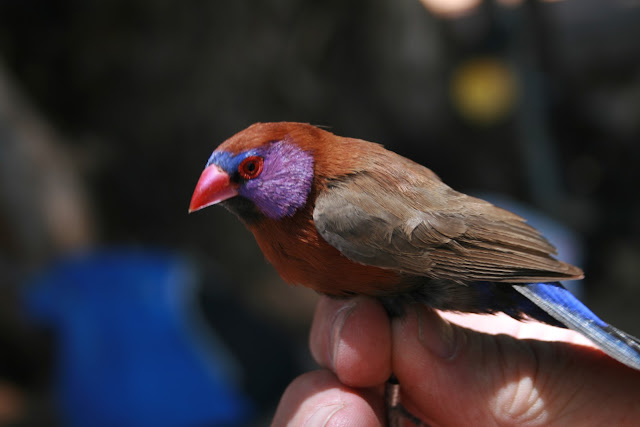
Purple-cheeked waxbill.  Common in the region. [Photo by Gavin Leighton]
Scaly-feathered finch.  Like Rosy-faced lovebirds, Scale-feathered finches are known to join sociable weaver feeding flocks and are also reported to roost in the chambers of sociable weaver nests. [Photo by Gavin Leighton] 

By Gavin Leighton

Saturday, December 17, 2011

Gull Watching: Iceland Gull

Let's look at some photos of a juvenal Iceland Gull.
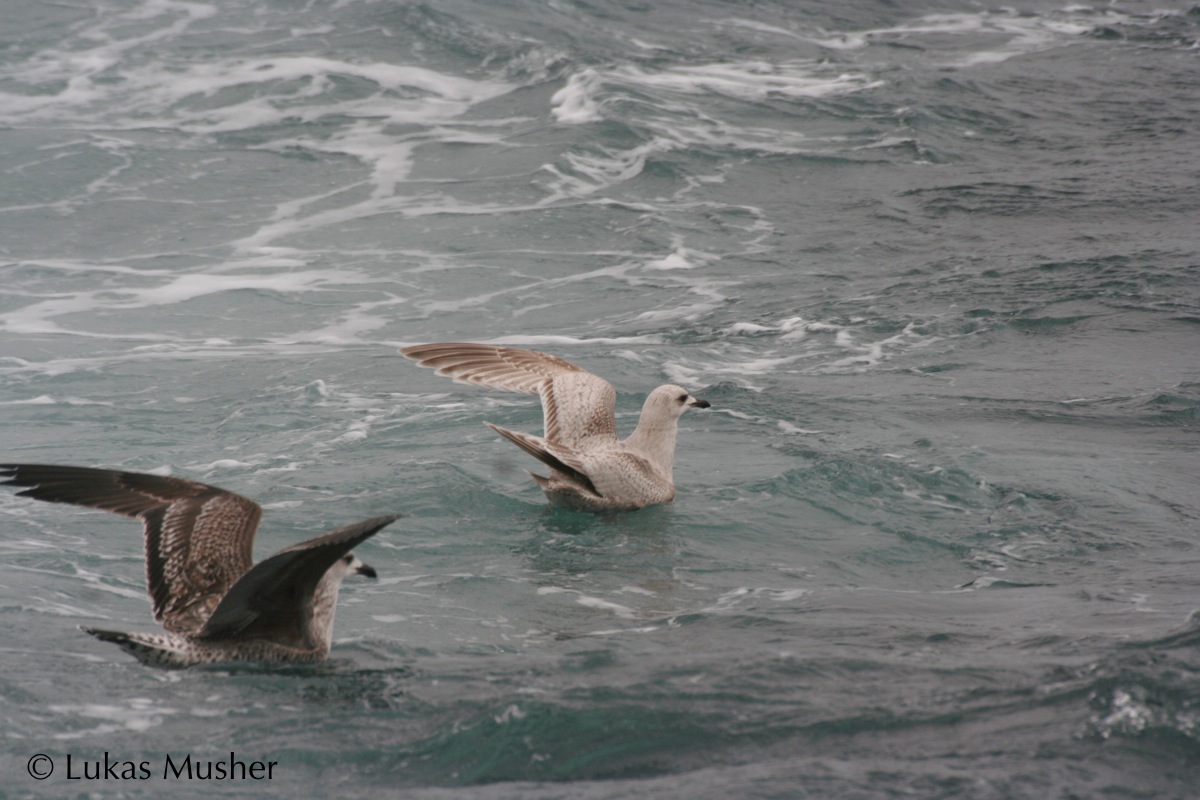
Juvenal Iceland Gull. Note short, black bill, round head, broad though relatively pointed wings.  Pale brown in color. February 2011. Pelagic out of Lewes, DE. [Photo by Lukas Musher]
Iceland Gull (center) with Herring Gulls and first cycle Great Black-backed Gull.  Note same structural features as above, plus short, bright pink legs and overall pale color.  February 2011. Pelagic out of Lewes, DE. [Photo by Lukas Musher]
Iceland Gull (center) with first cycle Great Black-backed Gull. Note primaries darker than body though not black or even dark brown like dark-winged species.  February 2011. Pelagic out of Lewes, DE. [Photo by Lukas Musher]
Iceland Gull (center) with Herring Gull.  Note bill relatively much shorter than Herring, short, pink legs and round body. Smaller than Herring with broad, pointed wings.  Compare to long, narrow wings, long bill, and overall slenderness of Herring, February 2011. Pelagic out of Lewes, DE. [Photo by Lukas Musher]
By Luke Musher

Friday, December 16, 2011

Gull Watching: Glaucous Gull

So I don't have any photos of adult Glaucous Gulls, but I have some photos of a first cycle bird that I think could be cool to share on the blog.  I wish I had some adults to share, but we'll have to do without.  Adults will have the same structural features and will be very pale gray on the upperparts with white wing tips and yellow bill.  Let's look at the first cycle bird though.
First cycle Glaucous Gull. Note long heavy bill, flat crown, large and stocky in size and shape, and mostly white plumage.  Bill brightly bicolored, pink-based and black-tipped.  February 2011.  Pelagic out of Lewes, DE. [Photo by Lukas Musher]
Glaucous Gull with Herring Gull. Note whitish plumage and wings.  February 2011. Pelagic out of Lewes, DE. [Photo by Lukas Musher]
See previous posts for species list in this photo.  First cycle Glaucous Gull (center-right).  Note that this bird is large and heavy-bodied with broad wings and a large pink and black bicolored bill, flat crown with bulging forehead.  White with brown wash, and nearly white flight feathers. February 2011. Pelagic out of Lewes, DE. [Photo by Lukas Musher]
Presumed "Nelson's" Gull, Herring X Glaucous Gull hybrid.   Note structural features similar to pure Glaucous Gull, with darker plumage (though still rather pale), brownish flight feathers, and heavy bicolored bill.  February 2011.  Pelagic out of Lewes, DE. [Photo by Lukas Musher]

Compare these photos with first cycle Iceland Gull (to come).

By Luke Musher

Thursday, December 15, 2011

Birds in Hand: A Couple of Recent Favorites

I want to share with you all my two favorite birds caught in the last week! 

First is the Black Phoebe. This is a species that we see at Palomarin every single day, but this is the first time I have seen one in the hand.  So, when I heard over the radio that French was bringing a Black Phoebe to the banding station, I was pretty excited and here is what I got to see.
Black Phoebe, a good photo to compare against the Eastern Phoebe in previous posts [Photo by Cory Ritter]

The other highlight was this second year, male Sharp-shinned Hawk.  I saw a lot of these at Hawk Ridge this fall, but it is a nice treat for Palomarin.  Also, a majority of sharpies caught are hatch year males, so it was nice to have a second year bird in the hand!

Luke attempting to make this SSHA look at the camera [Photo by Cory Ritter]

Here is a good look at the orange/red iris of a male second year Sharp-shinned Hawk [Photo by Cory Ritter]

Note the dark cap and nape, and the rufous (horizontal) barring on this second year SSHA, as well as the orange/red iris as seen before [Photo by Cory Ritter]

Here you can see the blue back and upperwing coverts on this second year Sharp-shinned Hawk [Photo by Cory Ritter]

Another look at the orange/red iris, rufous barring on the chest, and overall 'buggy-eyed,' or large eye-size to head-size ratio, appearance of the Sharp-shinned Hawk [Photo by Cory Ritter]
That's all for now, but check back soon for more updates!

By Cory Ritter